


Diregoldleaf
-
Posts
30 -
Joined
-
Last visited
Content Type
Profiles
Forums
Blogs
News
Store
Posts posted by Diregoldleaf
-
-
17 hours ago, swifteralex said:
We found an optimal result using statistical analysis and wrote a paper about it here: https://www.overleaf.com/read/xfmgpchwdczp#09b79b
The best sequence for maximizing power and minimizing risk of breaking is "quench, temper, quench."
Additional data showing the top 20 sequences based on expected damage:
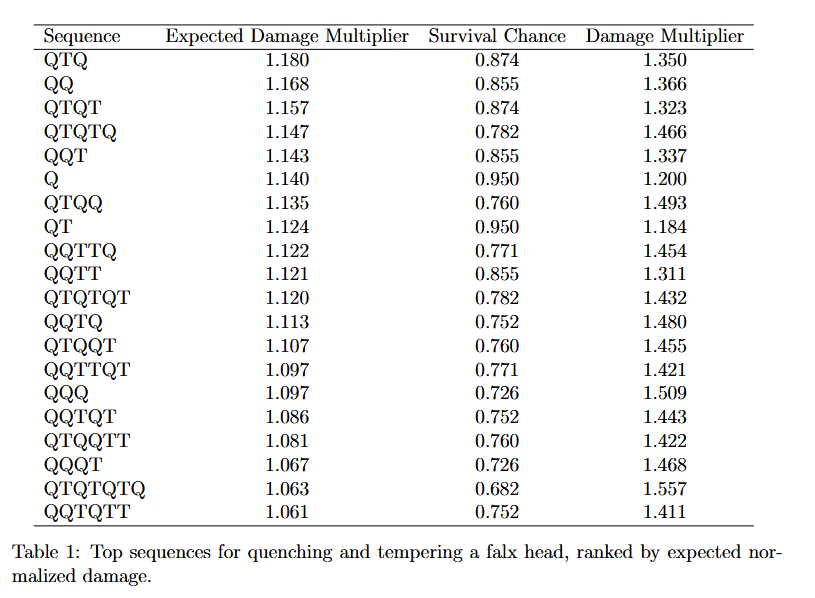
I haven't read the full paper but look at your maths you have very similar outcomes to graphs I made on desmos a while ago
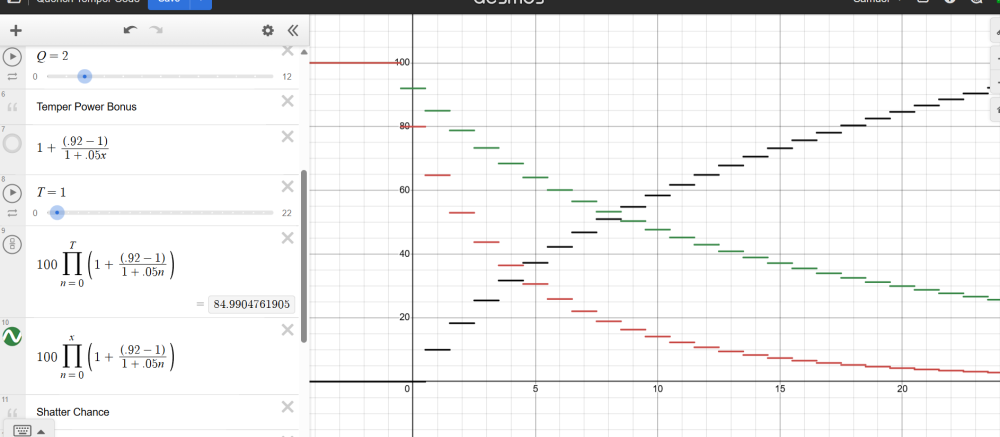
Black is Power Gain after Quenching, green is Power Gain after Tempering, red is Shatter Chance after tempering. There was some other stuff I did in Python to find if tempering really is useless but alas, there will be no further change so I gave up. Can't believe it's been 2 weeks already
-
22 minutes ago, Teh Pizza Lady said:
FUN FACT: If your bears are scrawny, feed them a couple times before you kill them and they'll drop lots of bush meat and fat! XD
Is this actually in the game
-
3 minutes ago, Teh Pizza Lady said:
I saw that. >_>
They're not confusing, they just don't make sense in the context of a video game. Niche uses need to have value over "this is one thing we added for use in a single thing that's not even really that great by the time you get the tech to make it". Not that anything you suggested was like that, but I will always vote in favor of simplicity in this case because the game was designed with mods in mind and because of that, expanding the systems too far limits the creativity mod creators can have when working on adding their own content to the game. We don't have firearms in the game (outside of mods) and they're not exactly period appropriate within the context of the game and its lore, although we do have everything in place to make bullets, gunpowder, and the guns themselves. Granted, adding something like gunmetal, for example, means that there is an additional resource that mod creators can use without having to create their own... so its a give and take process. But I still stand firm in that upgrades need to have impact instead of feeling like a side grade.
BTW, can you explain how gunmetal black got its name when gunmetal was typically a gold-colored bronze alloy?
Yh I know, I was poking fun
QuoteBTW, can you explain how gunmetal black got its name when gunmetal was typically a gold-colored bronze alloy?
Nope I cannot. I'm sure Moose can
-
14 hours ago, MKMoose said:
I suppose I don't need to explain what the primary use of gunmetal was.
You might need to explain it for pizza lady as she finds metal side grades confusing ;D
14 hours ago, MKMoose said:The blast furnace is a bit of a rabbit hole for me. I have some ideas on how deep I would want it to go in-game, but frankly I have no clue how deep most people would want it to go. The main quirk of it that seemingly very few people know is that a blast furnace is operated continuously, not in batches, and operating it is a whole skill and job in itself. A late-medieval blast furnace would run continuously for months, operated by a whole crew of people, casting something like 150-500 kg of iron at a time in ~8 hr intervals, requiring regularly adding new charge, draining slag, monitoring hearth temperature, adjusting the position of tuyeres that provide constant air input from water-powered bellows, rebuilding the sand bed between each cast. When something goes wrong, the whole hearth can solidify, rendering the furnace completely unusable, and that's just one of the possible failure modes. Furnace startup and shutdown are very delicate multi-step processes as well.
I've never understood the complexity argument against making mechanics detailed, intricate, and to some point realistic. Leather making is complex (though not to the point of full realism) and confuses the hell out of players making leather for the first time. Once you understand a complex process, complexity is never a problem.
Vintage story has lead me to go down rabbit holes of many irl processes; clay forming, leather making, ore geology, alcohol brewing, cheese making and many more things. That's one of the things I like about Vintage Story, it encourages curiosity
-
On 2/24/2026 at 5:29 AM, Enderminion said:
That's not how that works. The chance of each toolhead breaking is independent. For this example two toolheads is only 79% confidence of getting at least one with six quenches. For a 95% chance of getting a six quench with 55% chance of success per toolhead you would need four rather than two, and there's still a one in twenty four of not getting it.
The follow up example is worse, you are not owed one working of ten attempts. In fact with 11% obtainability ten attempts has a 31% chance of not producing a single toolhead to the desired specification. In fact you would need twenty six toolheads for 11% obtainability to have a 95% or greater chance of producing a single functional toolhead. However, that's still one out of twenty one attempts failing completely.
I'm curious about these numbers. You did 1-(probability of failing) ** n = (success chance) and solving for n, where n is the number of heads needed, right? Seems correct to me
-
6 minutes ago, Teh Pizza Lady said:
I think this has drifted far past the original topic and into tone and intent speculation, which isn’t productive, as well as personal attacks, which are against forum rules.
My position has been consistent: in a compressed game tech tree, iron should represent a clear advancement over bronze, regardless of historical transitional nuance. That is fundamentally a game design argument, not a historical one, though it also happens to be supported by history once the advantages of iron were discovered through continued use and refinement of metallurgical processes. The game makes no such distinctions and just classifies iron as simply iron. It has no other forms until steel. Introducing that complexity reduces the value of iron as an immediate upgrade and forces it into an awkward position where the tech tree is forced to expand from its already compressed form.
We clearly conceptualize this differently, and that’s fine. What's not fine is perpetual attacks against my character and insinuations that I have no good faith in my responses towards you. At this point, I don’t think further back-and-forth is going to add anything useful.
So I’m going to bow out here. I’ve made my points and done so respectfully, while pushing back against what I see as inaccuracies in both historical and in-game context. No hostility intended.
What you're saying is, I stated my idea, and your entire arguement against it is your personal opinion. I realised this a while ago when you made clear you had no intention of understanding my points and simply wanted to shout loud your own views
-
33 minutes ago, Teh Pizza Lady said:
I'm not being hostile. I'm being precise.
Everyone else has disagreed healthily without being hostile
33 minutes ago, Teh Pizza Lady said:You said "cast iron came thousands of years after wrought iron."
I corrected that by pointing out that this is regionally true, not universally true, which is historically accurate. That is not an argument — that is a factual clarification.Yes, wrought iron predates cast iron globally. That was never disputed. The claim I corrected was the timescale, not the sequence.
No I didn't. I said cast iron came a thousand years after wrought iron, as if to say, the first cast irons came a very long time after the the first wrought iron. Anyone can easily see what is meant here. For some reason you are so focussed on the timescale when it doesn't matter. You're missing the point, it doesn't matter if it's a thousand years or even 1 year, the statement that cast iron came after wrought iron is true. You realised your comparison of bronze to cast iron irl vs bronze to iron in VS was illogical but don't wanna admit it, so you're grasping at chances to be right. This is just childish and moving the goalpost. I will reiterate this again, arguing about the timescale of cast iron brings up no points relating to my idea.
QuoteAs for VS iron: we are in agreement. It is bloom iron. That is exactly why distinguishing between cast and wrought iron in this context is irrelevant. The game simply models iron, not metallurgical subcategories, which was my entire point.
Earlier you said iron is VS has no distinction, then said it could be compared to early wrought iron, then said because of that, my idea doesn't make sense because iron is stronger than bronze. ??? You keep bringing up historical points then not using them in your arguments. Just cos the game doesn't explicitly say it's bloom/wrought iron, doesn't mean it isn't. It 100% is. We know this because iron blooms come out of bloomeries in solid form. You are arguing a completely different thing because it's been made clear you don't understand what my original idea envisioned, nor have you made any attempts to ask for clarification
QuoteRegarding bronze vs iron: of course there are many alloys and grades. That does not invalidate broad mechanical comparisons. General material trends exist for a reason. Bronze is typically harder and more brittle, while wrought iron is softer and tougher. That is basic materials science, not bias.
Again, you have no clue what I'm saying do you? You are bringing up points that fundamentally miss the point of what I said
QuoteFinally, the game design argument is not "steel-manning your position." It is the exact opposite: it explains why historical nuance cannot directly map onto a compressed tech tree without harming progression clarity.
At no point did I misrepresent your position. I disagreed with it, explained why, and backed that up with metallurgy and game design logic.
If disagreement is being interpreted as hostility, that is not something I can fix.
 But make no mistake, I'm not attacking you, just your arguments.
You've been misinterpreting my position the entire time, without asking me to clarify on anything. You're attacking an idea you perceived in your head, not my actual idea. You bought up history and metallurgy that in no way contribute to countering my idea. The only thing they bring is they make you seem smarter and more correct because of superficial knowledge. The Dunning kruger hill is a dangerous place to be. Having studied things like critical points, austenite martensite pearlite hollomon jaffe parameter, crystal structure of face vs body centric etc etc, I know how how complex it can get
-
Quote
The arrival of cast iron depends entirely on where in the world you're looking. In China, wrought iron existed around 1200–1000 BCE, and cast iron appears by roughly 500–400 BCE. That is not a 1000-year gap. In Europe, yes, cast iron arrives much later, but that is a regional delay, not a universal rule.
You can argue as hard as you want, it is a universal truth that wrought iron was discovered/used before cast iron.
QuoteThere is no distinction between cast iron and wrought iron in VS. There is simply iron. So drawing a hard line between the two here is injecting false specificity into the discussion. The iron we have in-game is clearly intended to represent early forged iron, which in real-world terms would align far more closely with wrought iron than cast iron anyway.
This is ignorant on so many levels. The iron in VS is bloom iron that is wrought. Bloomeries don't get hot enough for cast iron. Cast iron has to be cast. You are taking the properties of cast iron and applying them to early wrought iron, which is why I responded with the "partially true" comment. Not sure if you did this out of ignorance or malice. I hope it's not the latter
QuoteBronze:
- is harder to obtain
- is harder, but more brittle
- is prone to fracture under stress
- tends to fail catastrophically when it breaks
Iron:
- is easier to obtain
- is slightly softer, but vastly tougher
- tends to bend instead of shatter
- resists fatigue and survives repeated impacts
Such a simple minded thing to say. There isn't just 1 type of bronze or 1 type of iron. There are many types. Some bronze are better than some iron in some qualities, while worse in others. Thanks for comparing the weaknesses of bronze to the strengths of iron, such an unbiased and fair comparison. Your knowledge of material science is superficial
QuoteThat tradeoff alone heavily favors iron for tools and weapons, where toughness, impact resistance, and durability matter far more than raw hardness. And most importantly, for the purposes of a video game, making iron a side-grade makes little sense.
Games compress centuries of messy technological development into clean tech-tree steps. You are not reenacting history. You are progressing through capability tiers on the way to steel, which is the real technological breakthrough.
From a game design standpoint the tech tree...
Stone >> Copper > Bronze >> Iron > Steel...must represent clear, meaningful advancement as denoted by the double arrows vs single arrows. Bronze is a small upgrade to copper. Steel is a small upgrade to Iron. Iron cannot be a small upgrade to bronze for it to be a clear, meaningful advancement. If iron is reduced to a side-grade, progression stagnates, incentives collapse, and the tech tree loses coherence. Iron exists primarily as a necessary stepping stone to steel, and therefore it should be strictly superior to bronze, even if that slightly departs from early transitional history.
It's just simply good game design which trumps any sort of preconceived notions of how things actually work in the real world.
All these words just to steelman what I'm saying. Not going to respond here. You came here extremely hostile, remained hostile, and you've made 0 attempt to understand what I'm saying and have consistently misunderstood things that I've said. Either you are going through some stuff or are trolling
-
 1
1
-
 1
1
-
48 minutes ago, Teh Pizza Lady said:
No. Read the full context:
Cast iron came a thousand years after wrought iron...
-
35 minutes ago, LadyWYT said:
The Middle Ages did come after the Iron Age, however, my point remains that the game is set during the late medieval period. Thus the main focus should be the technology appropriate to the late Middle Ages, and not so much the tech level of earlier times.
But you still go through the early iron ages, even if the technology exists, you are utilising early bloomery iron, which wouldn't be all that superior to bronze
35 minutes ago, LadyWYT said:And my point is that bronze and iron tiers are overlapping more in 1.22 due to that extra processing time. Prior to that, it was very easy for the player to only invest in a bronze anvil and bronze pick, before replacing everything with iron. Copper tools would suffice for everything else, and bronze armor wasn't really worth it since gambeson is much better and it was much easier to farm flax in large quantities. Now flax requires more investment in farming, meaning that the player will probably want to save the linen for a windmill. Iron requires a bit more time and effort to refine, so if the player wants to do things like start the main story earlier, tackle procedural dungeons(supposed to be added in 1.22), or otherwise just be safer while out and about, they'll probably consider investing in some bronze lamellar and weapons while they work on iron.
I see what you're saying, but it's less of an overlap and more of a delay. I agree with you that bronze age is now more "enjoyable"
QuoteWhat I suggested is basically just giving the player more gameplay options at that stage of the game, acting as horizontal progression rather than linear. Iron is still better than bronze, but if the player is too busy investing time in things like livestock, herbalism, and other areas of gameplay then that's time they aren't investing into iron working...meaning that they will be reliant on bronze longer. However, the player still has the option to skip bronze and focus on iron if they so wish.
I think we are talking at cross purposes here? What I'm arguing for is a feature for the sake of realism and less-linearity, not for the sake of extending the bronze age
QuoteThat is not at all what I said. The game is set in the late Middle Ages, thus the focus is going to be on the technology appropriate to that era, with some early industrial/steampunk thrown in for the very late game. Stone, copper, and bronze aren't worthless by any means, but that's not the tech levels that the player is really intended to remain at for extended periods of time. The idea is for the players to use those as a stepping stone to get to iron, so that they can tackle things like the main story or machinery and whatnot.
So what I'm arguiing for isn't going to extend the bronze age at all. It'll only optionally overlap it with the iron age, giving the player the choice between iron and bronze tools. It doesn't extend the bronze age de facto, just gives you an option to stay in it if you value the power over durability of iron. Of course players wishing to advance to iron age would continue as normal. I think this wouldn't affect many people
QuotePretty much this. The main reason to make higher tier materials more durable and powerful than lower tier, is to both encourage the player to improve their equipment, discourage them from relying on the cheaper, more convenient early game materials, as well as give them an actual sense of accomplishment when they acquire better materials to work with. Copper feels powerful compared to stone, while bronze feels powerful compared to copper. Same goes for iron. If iron was just a bit more durable but not packing the same punch as bronze, a lot of players would very likely feel that it wasn't really worth the effort to acquire. Some players currently ignore steel entirely for similar reasons, I believe--the durability of steel is better but there's no notable power increase, while the steel itself takes a lot of time and resources to acquire. Thus, those players just skip it and stick to meteoric iron, since it also is more durable than iron but requires less processing(it smelts directly into ingots).
You have a very good point with the steel argument and it's defo a genuine argument against what I'm saying. The only thing I can really say is early iron would be a stepping to late iron so there's incentive to progress. For steel, there's nothing beyond that
QuoteI'll post behind spoilers for those who don't want the story spoiled, but I do recommend playing the main story at least once, as well as digging into the lore.
SpoilerQuote I won't read it but thanks for putting it behind spoilers. I do intend to play the story one day
Alas, I was never in the mindset that this feature would be added. I enquired about it more to hear people's thoughts. There is no point debating on this topic as if it's on the fence of being added or not
-
16 minutes ago, MKMoose said:
While others have replied to this already, I want to mention that, purely in terms of generation parameters pulled from game assets, bronze is significantly more common than iron, even when controlling for durability. Granted, it can be more annoying to obtain due to smaller deposit size and extremely high deposit frequency in righ areas.
Intradesting
16 minutes ago, MKMoose said:To some extent, this is already the case, though admittedly it seems like an accidental consequence of the system more than a clear design choice. Bronze finds its use primarily in cases where durability is the only parameter that matters. Tongs, hammer, crowbar, chisel, wrench, as well as anything that is intented to be used for crafting. It's doubly useful for the tools that don't have to be forged, because casting in quantity is easier, faster and cheaper.
Yes that is true, but I was arguing more for your main tools
17 minutes ago, MKMoose said:Personally, I'm not opposed to the idea of bronze being better in some capacity than iron (I've suggested it elsewhere myself), though I think it might be better to achieve a similar effect by adding work hardening and annealing for bronze (and potentially low-carbon wrought iron as well), to provide effects similar to quenching and tempering (but weaker and/or at the cost of some durability), smoothing out the sudden transition to iron.
If aiming to separate the Iron Age into two parts, I would personally look into splitting it clearly into "Bloomery Iron Age" and "Cast Iron Age" (not real terms, but illustrative enough). Iron obtained from the bloomery process and wrought by hand would contain uneven grain and more slag inclusions, so generally produce much lower quality results, and realistically it wouldn't be quenchable. Iron produced in a much more complex process using a blast furnace (and ideally processed using a powerful helve in a finery forge) would be a much better product in a whole range of metrics, reflecting the actual way iron quality has progressed from being at best a sidegrade to bronze to eventually well superseding it - through gradually advancing metallurgical knowledge as well as improved smelting and forging processes. And that's not even mentioning the benefit of the blast furnace that lies in cast iron.
>I've suggested it elsewhere myself
I may have got idea from you. I've seen it floating around for a while and only recently if this has a chance to integrate into the game with the new quenching mechanics. The word side grade perfectly sums up what I was envisioning early iron, with late iron being the upgrade-
 1
1
-
-
Quote
Penalize leaving a quenched tool untempered
I really like the idea of a durability penalty (by 30% or smth) and being removed when tempered
QuoteMake temperature control less forgiving, and especially add a penalty to overheating the workpiece.
A good excuse to add annealing and normalising
47 minutes ago, LadyWYT said:Sorry, I forgot.
 It gets hard to track what's been posted where sometimes, especially when threads have similar topics.
-
1
-
-
Quote
The widespread use of iron meant that research into the metal was cheaper and easier to study. Iron didn't become more popular just because it was more economical, it became better because once people figured out how to work with it, they realized it was just better overall.
Would you say people figured it out how to work with it due to it's easy of access?
QuoteWhen people figured out how to make cast iron (which requires higher temperatures to get the ore out of the rock and to work the metal effectively) there was a huge upheaval. New conquering peoples arose and kicked the butts of the bronze-age civilizations. Greek culture was battered so badly it lost literacy - they literally forgot how to read and write...
Why? Because bronze work hardens and becomes brittle and breaks. The same bronze weapon used over and over will break. The same iron weapon used over and over will bend and get hammered back into shape. Societies that relied on bronze lost a war of attrition as their weapons literally fell apart.
Is this not in support of my arguments that late iron age should be better than bronze in terms in power, while early iron age should be a little weaker
5 minutes ago, Teh Pizza Lady said:I think she said what she said and reading anything extra into it is just projecting what you want to read instead of taking it at face value. NGL, not very nice of you to do that.
Apologies, I didn't mean it in a rude way, more in an inquisitively surprised way. I don't know what she means here as I most played caveman mode (story mode off), and haven't finished any chapters yet (waiting for 8 chapters to come out in 10 years time so I can do all of them together)
-
1 minute ago, LadyWYT said:
Cheap as in it's not particularly rare or difficult to obtain in the game. Copper, tin, zinc, and bismuth are all quite easy to find in large quantities, and can also be purchased from traders. Raw iron can't be purchased from the typical trader, and while it occurs in large deposits those deposits can be tricky to find sometimes.
I've never had "trouble" finding iron, but I also haven't prospected many times for it so I can't argue against that. Maybe you have a point here, however, I want to point out something which I'll point out in the next paragraph
QuoteRight, but what I'm trying to say is that the processing time seems to be increasing a bit in 1.22, meaning that the jump from bronze to iron isn't quite as fast as it was before. Thus to me, it already seems more worth investing in some extra bronze stuff that I wouldn't have bothered with before.
Yes you have a point here again. There is definitely more time to enjoy/utilise bronze, however, the point I want to make is all of that only delays iron. It's completely 1 dimensional in the sense that it's still a linear process. I'm saying Ages don't have to be discreet, and if they overlapped with one another, it'd be much more interesting, realistic, choice-driven etc
7 minutes ago, LadyWYT said:I'll put it this way: I think a better solution to make bronze tier feel more meaningful, is to give players more stuff to do at that tier and give bronze other niches, rather than try to do something like "iron has more durability but bronze is more powerful". The latter really doesn't make much sense, at least to me, and I think in practice it's going to end up feeling like artificial progression gating to players.
That is, if the player has more options in the earlier portions of the game for pottery, farming, livestock, herbalism, etc., they'll need to think about what goals they want to prioritize rather than just focus on jumping straight to iron every time(though they can still do this if they choose). Likewise, if bronze can be used to create things like bells(decorative, useful, or even the contraption kind) or diving gear(brass and copper could see more use here too) or even more advanced cookware, that gives it a special niche that iron perhaps cannot fill.
Again this is only delaying the progress and is keeping it linear. I don't see how it doesn't make sense to have a choice of 2 different metals. That's how it was in real life and to me it makes more sense that way. We all have different ways we view the game. When I first looked it VS, I assumed bronze would be better than early iron and was disappointed to find progression was exactly like minecraft
11 minutes ago, LadyWYT said:Sure, but the gameplay still needs to match the story and setting the devs want the game to have, and the story makes it rather clear that the setting is the late Middle Ages. Stone, copper, and bronze are still important to the player's progression, but they're just stepping stones to get to the meat of the game, and not intended to be the main focus otherwise.
I edited the original reply to say more stuff, you can check it out

But are you saying gameplay doesn't start until you get to steel? The journey doesn't matter, just the destination? By that logic, why make any developments for anything before steel age?-
1
-
-
1 hour ago, LadyWYT said:
I disagree. Bronze is cheap, and is still valuable in the late game for making nails, tools to trade, or cheap tools like wood-chopping axes, scythes, shovels, etc. when the player would rather devote the iron and steel to other things. Depends a lot on the player's personal preference as well.
Cheap in what sense, that it's easy to cast? In that case yes, but it's not cheap in the sense that it's rarer and more difficult to obtain. You have a point with nails, cheap tools etc, but I'm talking more about your main tools, eg falx, main pick, main axe etc (the iron/steel quenchable ones). The progression feels too linear for those
1 hour ago, LadyWYT said:This is how it currently plays out in 1.22, in my experience. Iron is clearly better, but requires more investment to refine in quantity. It's not enough to just dig up the ore, smelt it in bloomeries, and then throw it on the helve hammer. The player will need to work the bellows to heat the iron up quite a bit first before it can be worked, lest they want to constantly juggle the item between the forge and anvil. Thus bronze retains more use for an extended period, and isn't so easily skipped over.
1.22 only prolongs the process of iron ore to tool, which is absolutely not what I'm trying to advocate for; once you forge an iron pick, your bronze pick becomes obsolete considering iron is like 25% more powerful and lasts 2x longer. You are not really going to switch back to bronze since you're gonna wanna save that for nails etc.
What I'm advocating for about is utilising bronze during early iron age. So now you get the choice of an iron tool or bronze.1 hour ago, LadyWYT said:As for quenching and tempering, those are there to make good tools and weapons better, if the player is willing to invest the time. That's one of the main strengths of iron over bronze in the game, but that doesn't mean that iron should just be worse than bronze unless the player puts in that extra effort. If it just takes a single quench for the iron to be better, players are just going to ignore bronze in favor of iron anyway since the first quench is risk-free. If it takes more than one quench, then players are likely going to get annoyed at how much extra processing it takes just to make iron better than a lower tier material, as well as the risk of breaking the item in the process since more than one quench is risky.
> but that doesn't mean that iron should just be worse than bronze unless the player puts in that extra effort
It's not worse than bronze though, it still has 2x the durability. The only thing my idea would reduce is the power. I could be wrong but I don't see any progression issues; You use bronze, then unlock early iron and have the choice of powerful bronze and durable iron, finally unlock the forge/bellows and switch to iron.
As for the quench thing, that's more of a "we agree on the idea, now how do we put it into practice" problem :))1 hour ago, LadyWYT said:Keeping in mind that the current setting is the late Middle Ages as well, and not the Bronze Age.
I dont see it that way. I see it as us starting in stone age (ignoring the village), and making our way through the different ages. We are not constantly in the Middle Ages, only near end game do we reach it
QuoteBronze was still a useful material in the medieval period, but had been replaced by iron when it came to tools, weapons, and armor
You are comparing apples to polar bears my dear. Firstly, bronze wasn't immediately replaced, it was still the preferred metal. Secondly, the Middle Ages came wayyyyy after the iron age so it doesn't make sense to compare since I am talking about early iron age here. The forge could be considered middle/late iron age which would make sense for iron to become "better" (in quotation since it is better in durability already) than bronze
-
1 hour ago, LadyWYT said:
No, not really. That's more likely to confuse players. Since iron is the next tier of material after bronze, players will expect it to be better regarding stats; having it be worse is likely going to make it feel rather unsatisfying to obtain. .
It'd only confuse players at the beginning. Progression doesn't have to be a linear process like it is in the other block game, having it complex adds more depth.
1 hour ago, LadyWYT said:Keep in mind that it already requires more processing than bronze in order to use, since the player needs to construct bloomeries to smelt it, and then work the blooms into usable ingots, which will require bellows and quite a bit of time(even with a helve hammer).
Once you get iron, there's such an abundance of it it makes bronze obsolete, which is already difficult to obtain. This makes bronze feel like a temporary stepping stones to iron (the same way copper feels temporary to bronze), and there's little incentive to "enjoy" the bronze age.
The way I see it, once you get to a new age, it shouldn't be an immediate switch, but a gradual process. The player would have a choice of more powerful bronze, or more durable iron,
When iron was first used, bronze was stronger and harder, and iron only became widespread due to it's abundance and lack of requirement to trade cassiterite as someone pointed out above. Basically iron mainly became popular because it was more economical. Wealthy people preferred bronze (also cos it was rarer) for their armour (like in the Iliad)
-
Since heat treatments now exist, would it make sense to make iron less powerful than bronze and buff power gain when quenching
-
5 hours ago, Teh Pizza Lady said:
the game literally wouldn't let you or it would just break?
It's let me quench it, but the stats wouldn't change
-
1 hour ago, williams_482 said:
It's also not realistic for infinitely more quenches to continue to improve material characteristics. I'm not an expert (although I have some limited blacksmithing experience), but it doesn't look like quenching something more than two or three times is a normal thing for smiths to do. Capping the number of quenches at three cuts down on the slot machine elements and gives you a meaningful maximum damage figure for a triple-quenched steel falx that other stuff can be balanced around.
The argument against that is the whole mechanic is unrealistic anyways, and it's more fun without the limit. If you had a low, easily-obtainable limit, the meta would be to get to that limit. Regarding the slot element, it's not so much that as there's a time sink, and the cost is so high for such slow rewards (as opposed to big win).
1 hour ago, kal_culated said:I agree with MKMoose's earlier comment that quenching and tempering does allow some pretty ridiculous stats, and I'd rather something more methodical and less RNG. I think that'd be more in line with Vintage Story's ethos, as well, but I can't offer any good ideas, maybe beyond able to spend more resources to slowly quench and temper an item up with minimal loss risk but more time and items.
An rng system like Materia overmelding % chance from FFXIV is not something I'd ever like to engage with again, lol
Especially with a full tool loss when a quench fails, I'd still like to get bits or broken tool heads in vanilla one day instead of tools just disintegrating.
Mixed with the state bellows are in currently, if quenching / tempering becomes expected for future content, blacksmithing could become very tedious. But we're still in preview builds, so I hope for better number and mechanic tweaking.
What would be your ideal improvement to the system?
I agree that shattered tools should return material, but not with blacksmithing becoming tedious. It's an extremely optional mechanic with slow but firm rewards.1 hour ago, MKMoose said:The first quenching is a little odd, but it seems to have no "shatterChance" attribute at that point, so the default value of 5% would be used. By modifying "quenchIteration", I can get it to show up in the tooltip. But after quenching a couple dozen times I haven't gotten it to trigger, so I'm not certain if it can actually shatter on the first time.
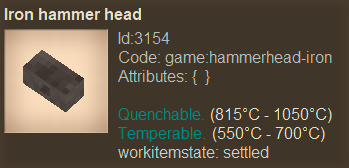
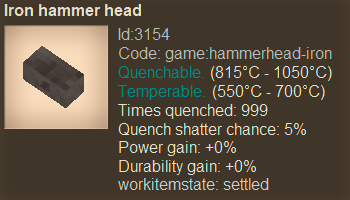
Intradesting. I've quenched hundreds of heads, only a few first quenches, but I haven't had any of those shatter either.
1 hour ago, MKMoose said:What I especially like about this approach is that it could create a much more approachable and interesting puzzle out of the system. In this case, there would be a real high-level choice behind tempering (which would then probably have to get heavily buffed): do you prefer to reduce the risk of shattering at the cost of slightly reducing the maximum achievable power of your weapon, or do you take the resource loss for a small chance at a perfect weapon?
I can see where you guys are coming from, but I feel the same logic can be applied for the current complex quench-temper tree. Do you take the risk and quench for a quick risky reward, or do you temper and take your time, allow the tool to go back up the tree for a bigger survival chance? There's also the added benefit of adding rarity and collectibility to tools.
1 hour ago, MKMoose said:Kinda unrelated, but my main gripe with suggestions to return bits or damaged toolheads when a tool breaks is that most of these ideas kind of don't serve a purpose. What's the gameplay reason for it? A tool breaking is ultimately a loss of resources - if some of those resources are given back, then that's still the same kind of loss, just a bit smaller, and you end up having to carry the bits or toolheads back home and repurpose them, which will most likely feel like extra obligation or maintenance.
1. You get the choice of what to do with those returned bits. Just because there isn't a singular purpose for those bits, doesn't mean they shouldn't exist
2. Most players want their resource back regardless of whether or not there's a gameplay reason for it
3. It makes the mechanic feel more complete and polished, among many more other things53 minutes ago, Teh Pizza Lady said: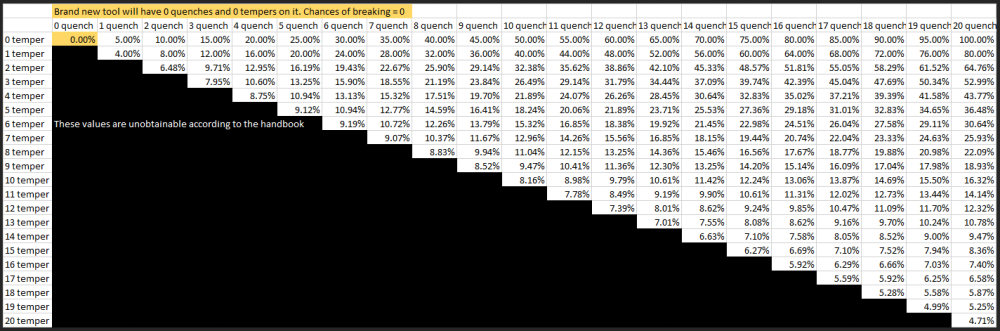
There's a hard limit on quenches I believe. I couldn't quench more than 12 times consecutively (no tempers). After 1 temper, it was still 12. After 2 tempers however, it was 13. After 22 tempers, it was 18. There seems to be a lot of inconsistencies regarding this.
54 minutes ago, williams_482 said:I actually had faction/civilization dynamics in mind here. On servers where groups of people expect to fight other groups of people, having as many faction members as possible dumping as much time as possible into the quenching lottery to get the group as well armed as possible would probably be a decisive advantage that few participants are likely to actually enjoy long-term.
Besides what LadyWYT said about the self inflicting problem, what you are asking is to cap the amount of time spend on this mechanic. Whether you want a cap of 3 or 7, you are essentially introducing a limit to the time spent on toolheads, whereas it should be up to the player to allocate their own time to their own tasks. Also by introducing a cap, that cap becomes the new requirement/ meta and (thinking from a factions perspective) other elements of the game will inevitably have to balance around that.
With the current system, as well as the difficulty in obtaining high end quenches, the quenches are more of a bonus rather than a requirement.-
1
-
-
4 minutes ago, LadyWYT said:
I would be inclined to say limit how much a tool can be tempered, however, getting incredibly high durability on a tool or weapon is still going to require a lot of time, as well as fuel and fire clay. While increasing durability might be easier than increasing the power, it's still a pretty big investment.
Given that a somewhat frequent player complaint is tool breakage, being able to have a low-risk way to significantly increase the lifespan of a tool is quite nice.
Agree with everything here. On top of everything you said, it makes tools with excessively high durability into optional collectibles.
-
1
-
-
30 minutes ago, LadyWYT said:
Does there really need to be a hard limit on tempering? It might be possible to get an OP tool/weapon with some dedicated effort, however, the time and resource investment seems big enough that most players probably won't be doing that other than maybe once or twice.
I completely agree with you here. The hard limit on tempering shouldn't exist for Power Quenching so we can have the complex and non-linear tree above.
For Durability Quenching, since there's no punishment for tempering (unlike with Power Tempering where you lose Power Gain), you can temper so many times and lower the shatter chance a lot, meaning you can quench an absurd number of time without worrying about shattering, thus increasing the durability by a lot.
It sounds OP to have high durability tools, but having high durability only increases convenience rather than being OP.I hope they don't introduce the tempering limit for either.
-
55 minutes ago, Teh Pizza Lady said:
Yes. I suspect the best route would be QTQTQTQTQT.... because according to my calculations after 20 iterations of QT, the break chance is 34%.
Yes, mathematically this is the best route. You are lowering the next shatter chance by 1% each time but if you do multiple in a row, it lowers by an additional 0.8% then 0.64% etc each time.
Unfortunately by limiting the tempering you are forcing this linear QTQTQ gameplay
-
15 minutes ago, Teh Pizza Lady said:
the 0% at 0Q0T is because you have made a brand new tool. Your shatter chance is zero, because there is no chance of a tool breaking until it is quenched or tempered. The shatter chances aren't applies until you begin quenching or tempering. According to the handbook you cannot temper more times than you have quenched so I did not extend the graph beyond that.
Ah I see what you are doing, thought the values were referring to the next quench shatter chance. The handbook is either wrong or the game is bugged cos atm you can there's no limit on tempering
16 minutes ago, Teh Pizza Lady said:But my numbers are off because for the first temper I mistakenly started the temperIteration at 1 instead of 0. It appears the iteration does not go up until after the break chance has been applied. Here's a new chart:
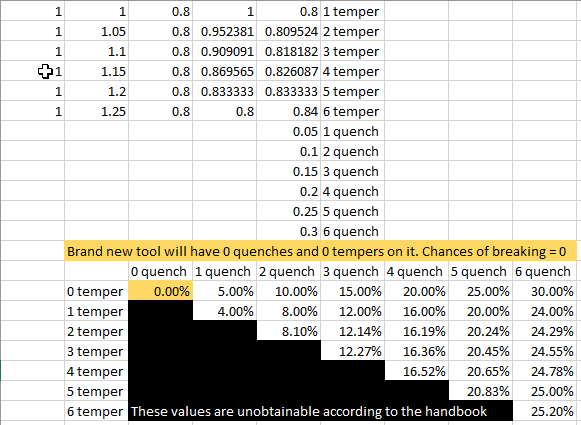
Great table again, though this is only 1 pathway through the tree. There's still the ability to do things like QQQTTTQ or QTQQTTQ, and they will have different obtainabilities and shatter chances
I suspect temper limit is intended to only apply to Durability Quenching to prevent OP durability gains (though imo having absurd durability on a tool doesn't make it OP). It makes little sense to have a limit on Power Quenching considering cumulative shatter chance.
-
5 hours ago, MKMoose said:
Note that most of the OP's numbers appear to be based on items which are only tempered a number of times after the first quenching, which is why it may seem odd.
The reason for this is you can't temper an item without quenching it first

 But make no mistake, I'm not attacking you, just your arguments.


Quenching-Tempering: Finding the best combination
in Discussion
Posted · Edited by Diregoldleaf
Short answer, QQQ..., TTT... etc. Long answer, it works for mixing and matching. The graph shows the multiplier for each iteration as per the c# file. Note the temper curves need to move 1 place to the right; you can see at 0, temper PG or SC is not 0
In general, for quenching, we add PG to Qnew - Qold
For tempering, we multiply PG by Tnew/Told
Example
(QT)2Q = QTQTQ
Q1-Q0 * T1/T0 + Q2-Q1 * T2/T1 + Q3-Q2
(.10 - 0.00) then * (.92 / 1.00) then + (.183333 - .10) then * (.8499 / .92) then + (25.476 - 18.333)
(QT)2Q: 23.3%
The sliders mean nothing, they're there for the equations