

cautious_asparagus
-
Posts
7 -
Joined
-
Last visited
Content Type
Profiles
Forums
Blogs
News
Store
Everything posted by cautious_asparagus
-
Macro Waypoint Multi-Word Titles
cautious_asparagus replied to cautious_asparagus's topic in Questions
Forgot to reply, that workaround worked. Thank you. I would have never thought to edit the macro files themselves. -
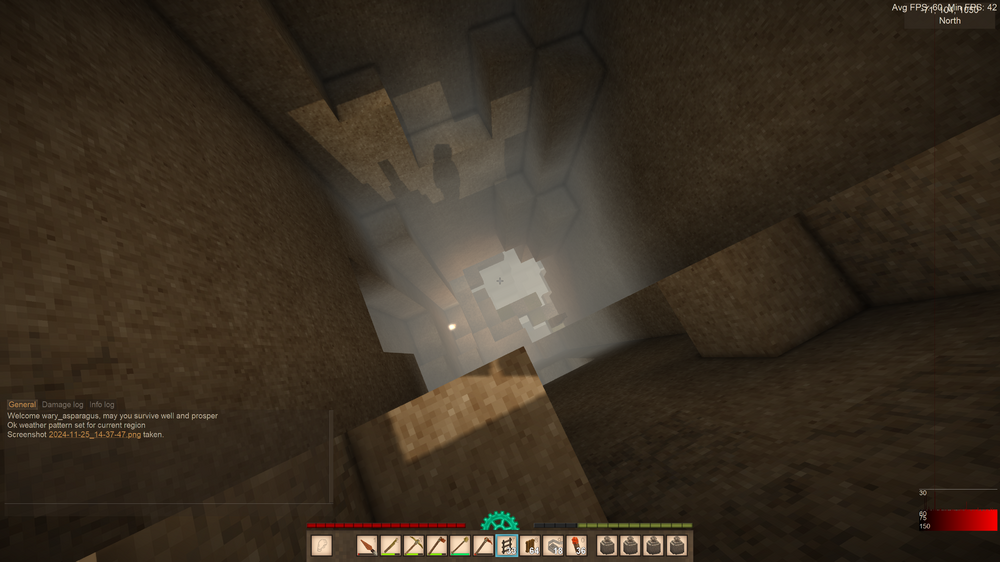
Is anyone else getting some strange fog effects? It's white on the surface, appears denser below a certain Y level, and turns completely pitch black when you get far enough underground away from sunlight. It makes it incredibly tedious and annoying to go in caves. I don't have a screenshot of it, but the darkness is insane. It's like torches stop working 10 feet away from me. I'm using mods, but none that affect the weather or world.
-
Macro Waypoint Multi-Word Titles
cautious_asparagus replied to cautious_asparagus's topic in Questions
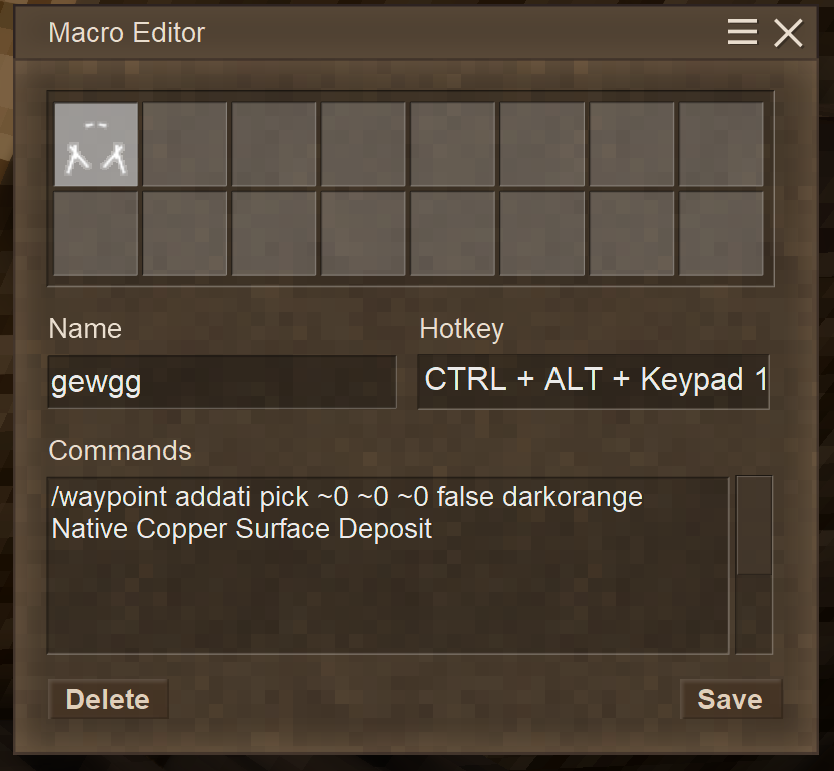
I have discovered the issue, which should have been obvious from the start. The command window in the macro UI is too small. It's not the word count at all. The window is not wide enough for my command to be one single line. As we can see, the command for the waypoint wraps around and goes to a lower line. This invalidates the entire command. Until they allow (or if they do, please tell me how) resizing of windows, this cannot be fixed. That really sucks.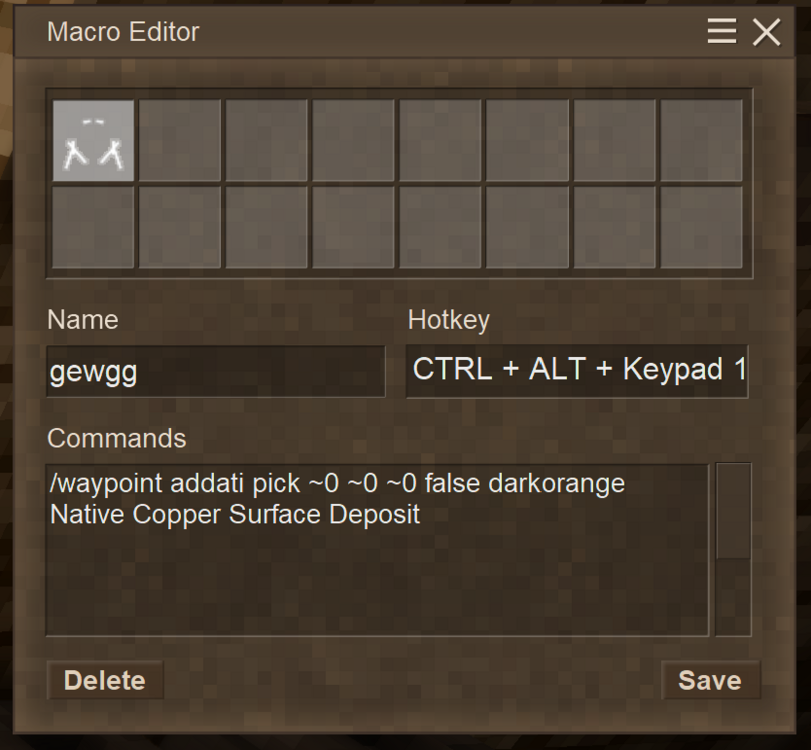
-
Multi-block structure and Accessories Although not strictly necessary (or historically accurate) for many players, the forge should have the capability to be expanded into a multi-block structure. Adding an extra forge block would double your capacity for heating, and look much more impressive. This would also allow multiple smiths to work more efficiently at the same time, since tending one large forge could be the responsibility of a single smith, while the others are working. This might also allow for the capability to build your forge in a different way, such as adding forge hoods or chimneys. Pictured: A chimney from an iron forge in Quebec from the 1700s https://live.staticflickr.com/8438/7810344504_4c57cc8541_z.jpg This brings me to the matter of accessories. There are a handful of common accessories in coal forges, but the specific one I would like to suggest is a bellows. A bellows is a pretty common smithing implement used to introduce air into the fire. It's used to heat the forge faster and more efficiently, as well as start it. https://blacksmithu.com/wp-content/uploads/2018/12/bellows5.jpg They can come in many different designs, but they're all fundamentally the same. They're typically made of 2 wooden plates, with leather "accordioned" between them, to a create an expandable air sack. It could be placed on an empty side of a forge, to increase the maximum heat, as well as heat the forge faster. Why would you need something dedicated to heating a forge, when it's already so fast? See my next suggestion. Changes to forge heating (Disclaimer: We obviously can't have things be 1:1 with real life, such as time and fuel consumption, so times are based on how rewarding I feel it would be) I suggest that the forge should have a more detailed heating system. Instead of just adding a handful of coal, lighting it with a torch, and using it for a few hours, it should instead be a more involved process, with maintenance and cleanup. The first change would be to add stages to the process. Stage 1: Startup Stage This phase involves cleaning out the excess ash and debris from the last heating cycle, and preparing to start the forge again. You would use dry grass or sticks to start a small fire in the forge, and quickly lay down coal afterwards. If the forge has already been used, a small amount of coke would be present in the forge, and can be used to start the forge quicker. After starting the fire and igniting the coal, you can optionally use a bellows for airflow, to bring it up to temperature quicker at the expense of your own time. After the forge has warmed up (approx. 3-6 hours later), we enter Stage 2. Stage 2: Work Stage After Stage 1, we enter the work stage. In this stage, depending on the fuel, addition of a bellows, and the construction of your forge, it will be at the max working temperature. You are now able to add ingots to the forge, and heat them to a malleable temperature. This stage is identical to how the forge functions in-game, with one caveat: it lasts longer. To offset the amount of time and work it takes to start and maintain a forge, Stage 2 can last for a much longer amount of time than currently in-game, while using less fuel. I think 1-2 hours per piece of coal would be fine. With regular maintenance and upkeep, you can forge for days on a single cycle. Stage 3: Cooldown Stage In this stage, the forge has run out of fuel and is slowly cooling down. The time it takes to cool down is dependent on the weather, temperature, and construction of the forge, but the end result is the same. A significant amount of ash and debris as well as a small amount of coke. This debris cannot be taken out of the forge until it has been cooled down. At any time during this period, more fuel can be added to the forge to start it up again and revert to the work stage. The leftovers So, we now have a forge full of byproducts. But these wouldn't be useless, they would actually be one of the greatest benefits of having a forge. Coal ash, also known as Fly Ash, is a byproduct of burning coal. Coal ash is an good fertilizer by itself, and it would be a very good replacement for the powdered charcoal in the Terra Preta recipe. Brown Coal: 2 Coal Ash produced for every 4 pieces of coal. Black Coal: 1 Coal Ash produced for every 6 pieces of coal. Coke is the byproduct from heating coal in an environment with very little oxygen. It is already produced in larger quantities by the coke oven, but it is also a common byproduct in a forge. Coke produced by the operation of a forge will be very limited, as to not replace coke ovens. The coke produced by a forge will mainly be used to start the forge quicker on the next use. Brown Coal: 1 coke produced for every 48 pieces of coal. Black Coal: 1 coke produced for every 32 pieces of coal. (Numbers subject to change) Misc Suggestions Metal tongs would be a welcome addition to the game. I do not feel like wooden tongs are fit for the purpose after getting your first copper tools. You should be able to place crucibles in the forge to melt metal, instead of making a rather pathetic campfire. A forge can already heat to temperatures FAR in excess of a campfire, so it's only natural that we should be able to place a crucible in the forge instead. This would allow the forge to both smelt molten metal metal AND allow metal to be worked. In Conclusion, I think these additions could bring a lot more complex and rewarding gameplay from smithing. I would love your feedback on these suggestions.
-
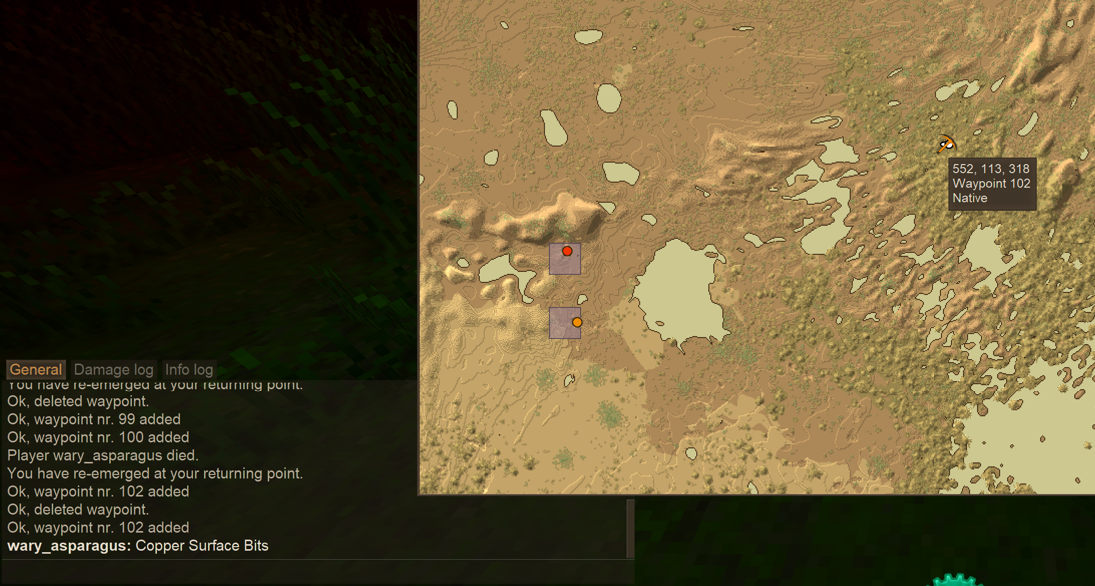
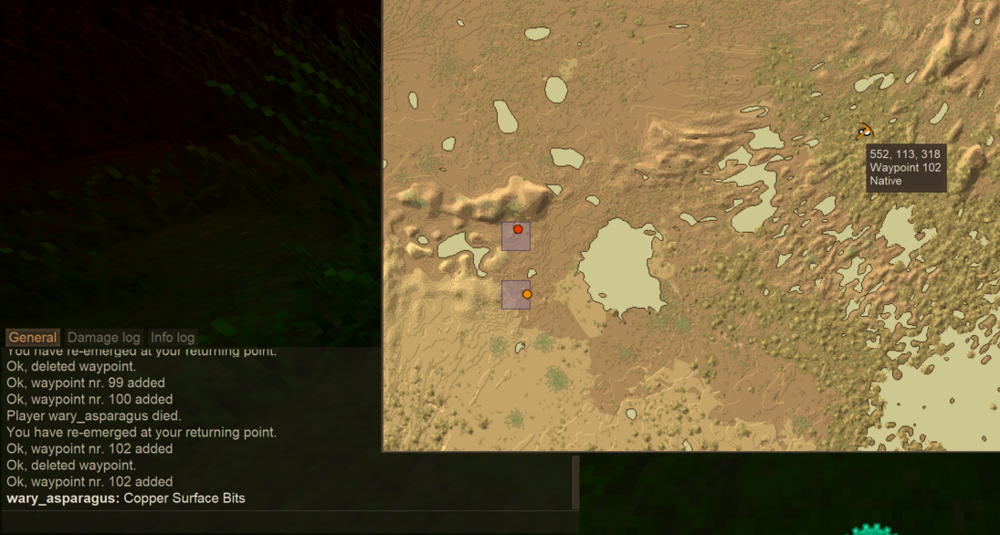
I'm having issues with setting up macro waypoints that accept multiple words in a title. For example, the macro I am trying to set up is: /waypoint addati pick ~0 ~0 ~0 false #FF8C00 Native Copper Surface Bits For reference, the default command is: /waypoint addati [icon] [x] [y] [z] [pinned] [color] [title] When I use this command in the chat, it works flawlessly and exactly as intended. However, when I use it in a macro, it has this issue: It instead uses only the first word of the title argument, and I don't know how to isolate multiple words of the title as one argument. I've tried to use some delimiting characters (such as "Native Copper Surface Bits") but it doesn't seem to work. I would appreciate some help.
-
Hunting Adjustments (Animal health, Bow damage)
cautious_asparagus replied to cautious_asparagus's topic in Suggestions
@Thorfinn Thanks for the reply and feedback I should note that none of these mechanics are being suggested with players in mind. Solely for animals. to facilitate better hunting. -
Why does hunting need to be adjusted? As it stands, using a bow to hunt for small-medium sized game is not viable. Earlier game arrows (copper, tin bronze) do not do enough damage to encourage their use, and animals have too much health compared to their "real life" counterparts. With the amount of effort it takes to make a bow, it has an almost negligible advantage over other ranged options, such as spears. This, combined with the lack of lethal traps or snares (remedied by mods, but it should be in the base game) makes it difficult to routinely acquire enough meat, fat, and hides early in the game. How do bows in-game compare to real life? We should take a look at the longbow in-game. A modern longbow, and longbows historically used for hunting, have an average draw weight of around 60 pounds. I am assuming this is the kind of bow we have in-game. A longbow with a draw weight of 60 pounds is more than enough for any kind of game you're likely to encounter. From bears, to moose, to deer. Depending on shot placement and the arrow-head, a single shot it usually enough to kill or incapacitate them. Compare this to the bows in-game, and there is a massive problem. A bow that should be killing deer in one or two shots is taking several to kill even small game. What can be done to make this better? I believe four things can be done to make hunting more satisfying and realistic. 1. Bleeding A bleed mechanic would be an easier way to make up for the low power of bows. After taking damage from an arrow of a sufficient tier, an animal would begin to bleed. After a certain amount of time, if the animal does not die, the bleeding would stop. Say, after a period of 5-10 seconds. Small Animals: Flint arrow and above, 1.50 HP/s bleed. Medium Animals: Copper arrow and above, 1 HP/s bleed. Large Animals: Tin Bronze arrow and above, 0.75 HP/s bleed. Huge Animals: Iron arrow and above, 0.50 HP/s bleed. An increase in each tier of arrow would contribute more to bleeding. Say, a copper arrow on a small animal would add a 1.50+ HP/s bleed, for a total of 3 HP/s bleed. (Numbers obviously would need tuning, these are just an example). 2. Animals receive damage based on arrow tier Instead of arrows just adding a flat damage increase, animals should be affected by the tier of the arrow itself. Small animals, such as rabbits, racoons, and chickens, might be instantly killed by a copper arrow, whereas that same copper arrow will just confer the original flat damage boost to a large animal, and it would take an arrow of a much higher tier to kill a large animal like a deer or moose. 3. Wounding Lastly, a wounding mechanic could be implemented. Similarly to bleed, it would activate based on the tier of arrow being used. But instead of inflicting a damage over time effect, it would impair or incapacitate the animal, adding a slow-down effect or similar to the damaged animal. This wound might last from anywhere from a few days, to weeks, giving a long-term debuff to the affected animal. This also allows predators to maintain a healthy weight, as it would be easier for them to catch and eat wounded animals over healthy ones, letting players contribute to the local ecosystem in a roundabout way. 4. Locational damage The last big feature that could revolutionize hunting would be locational damage. Shot placement for arrows would introduce a much bigger skill ceiling, and encourage more clever hunting to get a good shot. A shot to the head or to the center of the chest would do much more damage than a shot to the legs, for example.