


MagpieOAO
-
Posts
60 -
Joined
-
Last visited
Content Type
Profiles
Forums
Blogs
News
Store
Everything posted by MagpieOAO
-
Huh this never occured to me and explains a LOT about armor, its advancement and contemporary design. Thank you for this insight! Something as simple as "how do you treat wounds", let alone how do you live in it prepared for a fight hadn't really come to mind. If someone needs to march several days (or ride on horseback) and still be in good shape to fight, light, flexible and comfortable armor which allows you to conduct daily tasks is a must. Let alone emergency tasks.
-
The black are their pupils which are massively dilated from lives underground with the white being reflections and/or predators eyes dilate when they see prey.
-
Extending water mechanics - Wiers & Irrigation furrows/ditches
MagpieOAO replied to Crylum's topic in Suggestions
I'm all for more things involving water to be expanded upon! Also this is a great way to keep the grounded theme of VS rather than a magical supply bucket of infinite water (though I know that can be turned off, there are many ways to 'delete' water even from river and lake sources which should not be possible). -
I would also hope it would be possible to fix/restore tools and weapons we find. We can make sulfuric acid which is a component in removing rust to restore machines back to function IRL, let alone simple tools. I have a couple of scythes that are fairly ancient but you won't find better equipment for hacking down green brush and weeds. They'd been used as decoration or stored away for decades and after a bit of sharpening they work well enough for that.
-
Wonder if I'm doin something wrong, vanilla game. Found a lorebook! Put it in active slot and right clicked, nothing happened. I can put it down that way, but it's added nothing to the journal =/
-
Huh, yaknow that's a great point. Every ruin at least has some bony soil which DOES contain useful things. So every ruin does have good stuff, you just have to pan for it.
-
What distro are you running? I'm a complete linux newbie and testing things out, first thing I did was check if I could play it on Linux Mint (Cinnamon). Used the flatpack installation method and the game appears under the "Games" area on the menu and runs for me. I know "it werks" isn't very helpful but the mint distro is easy to use and stable. Nvidia GPU and intel CPU.
-
I recall the next patch is going to try to improve on navigation of the world itself, which is a bit of a chore. I've noticed too I'm holding space as much as I'm holding W to navigate. This is a perennial issue of block games. But with the chisled blocks in VS or just half blocks, would it be possible for the system to generate terrain that can actually be navigated without constant jumping required? Would it look weird? How would you escape from wolves now!?
-
Even now though getting a copper/bronze tool is jumping ahead. Someone posted they found beat up steel armor once and torch holders, lanterns some have described are huge advancements from constantly having to replace torches. Ruins are a form of resource; Finite and scattered and must be surveyed to be found. Unlike ores, veggies, fruits or other objects though which all have defined uses, Ruins as a resource are of random benefit though most often they are of no benefit, even detriment because you're using time, food and tool durability to dig out a ruin only often to find nothing but dirt. At a minimum, I'd like to see fragments of lore, and things that can be repaired into proper use than just decoration. I've even found a couple of 'broken' maces with good stats but 15 HP. It would be nice if I could actually repair them.
-
Familiarize yourself with the handbook! Hit H to open the handbook and anything you mouse over and hit H with, it'll jump to that thing in the handbook to show what you can use it for or how to get it. The handbook can walk you through pretty much the entire game but in a way that still feels exploratory. Secondly I'd say walk around and take your time! You'll need to identify food sources and avoid things that see you as a food source, it helps to move slowly. And it burns less satiation. Grass can be crafted into straw blocks which are extremely quick to break again, making it excellent for temporary structures and doors. Sticks and a knife can craft wattle fencing which can act like windows, and wattle gates which can act like reliable doors. Cheap to make and very nice to get some light sources in your early home.
- 10 replies
-
- 2
-

-
- new here
- new account
- (and 2 more)
-
I got a treasure map, dug out a small cavern and might move in because I can't find the treasure D:< Dug out shallow all the dirt around it maybe in 10x10 down to the stone, dug down in the stone below the mark. Nothin. How deep? How wide? Thank you!
-
I've dug through many but often find its a bit lackluster. I was disappointed to find a bed I'd restored could not be used nor could a chest I'd found be repaired to function. After realizing they just have a few loot pots/chests at best, it got me thinking, what would you actually want to find that would be cool, aside from the occasional treasure and decorative items? I'd explore every one I saw if there were lore books scattered throughout, even just a few pages. I've yet to find a bookshelf with a book, if that's where they spawn. Perhaps tapestries like the artist sells in tattered condition, telling a bit of story. Likewise other artisan items perhaps, it's a nice reward in itself sometimes collecting the aged stones. I once saw a bin of junk parts, but assumed like most it served no purpose. But it would be cool to find things which have rusted gears that can be extracted. Perhaps treasure maps of a sort? Notes of evacuation or shelter orders, or trade being conducted that point you to more significant ruins. If ruins are a form of resource, they're finite and relatively rare. But to have anything of significance is rare, and even more rare when what's in it can be non-functional clutter. I guess I'd like to see more functional clutter in ruins?
-
I'm not necessarily suggesting a system but rather poking around the idea of how such a system might work or what it would need to work. As you point out, something that reduces functional durability is a straight nerf. To my knowledge they do want to have a repair system but as we can see it's difficult to imagine how one would work well and be fun. Rudo does lay out a good idea of how it could work though, gear has an HP and a condition, HP is only reduced when being repaired or continuing to use it at the lowest condition. At perfect condition the tools have highest effectiveness, let's say maybe current effectiveness +.5 at good condition they're where they're at now and at poor condition they're at -.3 A tool can still be used at poor condition, for example you might need to continue using a pick, axe or sword while condition is low and if it's a steel tool, it'll still be way more effective than your hands, but now you're going to be putting damage on it. Maybe at the same rate you break things. But if you keep a blade in 'good' condition and use an oiled stone, you can really preserve its HP and effectiveness for a long time with some regular maintenance. Eventually you'll need to re-forge it (repair it) but it won't break on you this way. Alternatively if it's a throw-away tool, whack on a new edge with a coarse grindstone after abusing the crap out of it and you'll burn through the tool but it'll do good work while it lasts.
-
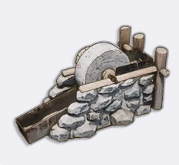
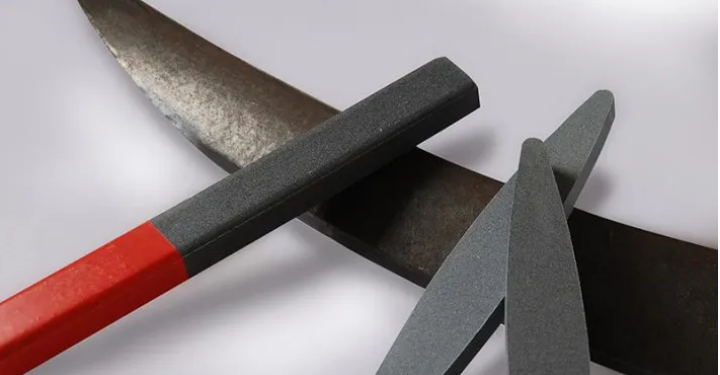
It's a much requested feature, possibly even on the list but consider how the game itself works; You have the ability to knap stones to grab series of expendable tools literally off the ground which is an encouragement to progress in tech to where your tools aren't falling apart so quickly and you spend less time crafting them, more time using them and searching for the materials to continue making better tools to enjoy even more access and time. Basically betters tools > less clutter and less time sunk into crafting them, aside from the initial investment. I think at its simplest, tool fixing/sharpening would need to become the new resource/clutter sink that replaces or at least supplements the crafting of disposable tools. Given if repairs are more painful than replacement, people will opt to replace and the repair system becomes pointless. I think real world examples can give us a few ways to explore repairs that have a similar depth as the rest of the game; The central tool on a homestead is a grindstone. It's been said that the quality of a farm can be determined by the quality of their grindstone, given it's the key tool used to sharpen all other tools for use. Dull tools make hard work. A grindstone consists of a single dense stone chiseled into a wheel shape with a pin it can spin on and very importantly a water trough that keeps the wheel wet. I expect this helps with heat of the blade and reduce friction. Stones can be powered by a hand crank, by a foot pedal or con temporarily by electricity so a water or wind based motor would also be able to turn it for you resulting in a lot less effort required and higher precision. Obviously you can't carry this with you, but most would carry whetstones which operate on the same principles to keep their edges sharp while they worked. These are examples of scythe whetstones made to slide along the edge of the blade after dipping in water or oil. But there are many shapes and forms of whetstones for different kinds of work. Coarse stones for more abused blades and finer stones to sharpen them further. Even leather strips for an extremely fine blade. -----------How does this translate to gameplay?------------- If we go with the somewhat-realistic design of VS, I'd add "condition" along with the HP of a tool. Every time you hone a blade, you're removing more material to form another edge. You ARE slowly destroying the tool. But a metal tool can also be re-forged with new metal to restore it for less metal than an entirely new tool. Stone doesn't have that advantage. The better the tools you have to hone a blade, the better it functions and the less material you're taking off if you're using good materials and taking a lot of time. Some gameplay examples; You have a bronze shovel, you've used it 20 times and its gone from "perfect" condition to "good". Because of this it does slightly less damage to soil. You take out a fine wetstone made from marble and spend a minute or so sharpening it. This slightly reduces HP but restores condition to "perfect". You pull out a flint knife that's dull but has good HP. Because it's dull, it's barely better than using your hands. You pull out a coarse flint whetstone and sharpen it for a few seconds, taking the HP down a lot but restoring it to 'Good' which is still faster than knapping a new blade, though you will have to at some point because this one can't be honed in a similar way again. You have a sword at low HP. You heat up a quarter-bar of ore and work that onto just the edge of the blade, restoring its HP. Then proceed to sharpen it with a grindstone, a fine whetstone and a leather strip. This takes a fraction of a minute between each tool but the end result is the sword is back to perfect HP with Perfect condition. You have an iron axe and a bronze axe. Though they both do roughly similar amounts of damage to the objects they harvest, their HP is different and the bronze loses condition faster than the iron, simulating it getting duller quicker. Overall, less time will be spent honing the iron axe than the bronze one. ----------What does this add to gameplay?----------- Rather than every tool being disposable and needing to carry multiple, it'll become more possible to become attached to a tool with instead repair materials and tools that are expendable rather than the tool itself. More materials and better materials not only create better tools but better tools to maintain tools. Ideally at some point we could even make customized tools, like the various colors and materials available to shields and with engraving on them. If well designed, the system balances out new tools and maintaining tools in such a way that maintenance is easier, cheaper, more readily available but relying on similar materials and progression as not to remove the incentives for progressing.
-
I just joined recently and while i'm someone who tends to go to wikis, I picked up the handbook pretty quickly and would spend my nights studying it. The handbook is as integral and as impressive as the game itself with how it lets you navigate around through every item, sub-item and showing the how they are processed. Even information on the mobs found in the world. There were some things that weren't so clear that I ended up looking up outside the game but only while starting off. Some kind of tutorial would be good, like spawning in a ruined home with a book you HAVE to grab to leave the room (maybe it's on a lever) which is the guide-book so players are literally forced to see the guide book exists and a brief explanation on how it exists (along with an ingame reason for having it cause why not) before going out wandering around and deciding "I can't figure anything out". I don't think anything more than forcing players to pickup and read a page to get playing should be used or required. If they aren't willing to put in that much effort they probably aren't going to enjoy VS which shouldn't compromise its vision for them. That said the guide isn't PERFECT but it is really good and continue to improve.
-
What the fucky fuck is up with enemy spawns in this game?
MagpieOAO replied to Shotai's topic in Discussion
Torches are also really useful to start fires, much better than the firestarter. Eventually you can find something to help make your torches last and not need to swap them, or replace them. In my experience portals always spawn on the surface and roughly on a flat space. I built my house into a spire (Tall, narrow mountain) and because it's so relatively high, portals are never near me. I've also built 3 floors so on the odd occasion a portal appears on top the spire or maybe on the roof, I can move down a level or two and it's fine. It's always a slow enough drain to manage unless you're right on top of them or underground. In addition to what LadyWYT noted on packing dirt (two rows of 3) straw can make for a makeshift 'door' given it can be easily made and quickly broken to pick up without tools. Also wattle gates (a small L of sticks with the knife in the corner) can act as reliable early doors that can even be seen through. Enemies might press up against them but I've never had them open one -
What the fucky fuck is up with enemy spawns in this game?
MagpieOAO replied to Shotai's topic in Discussion
My understanding is enemies spawn on 2 factors, temporal stability and light level. You need to have windows in your house to keep it lit when you're gone, this can be done easily with a wattle fence, you can make 5 with a handful of sticks and a knife. For night you'll need a light in there, torches last 48 hours so replacing them every morning will help. If your temporal stability is too low, enemies will spawn around you regardless. An improvised shield requires some reeds and sticks and will block 100% of projectiles while actively blocking. Alternatively you can make some hay blocks which can be quickly put down and picked up and will block everything as well. Before you go to check caves hit C and check what the general temporal stability is. If it's calm, enemies might not spawn much in caves even in darkness. If it's higher, expect lots of enemies. RE needing to eat all the time, copper; Sprinting and working (digging,chopping wood, fighting, etc) drains satiation and when looking for copper and other ores its useful to walk around anyhow because you'll find surface deposits by finding rocks. Make sure to mark them on your map to come back for later once you have a pick, dig down around 6 blocks and you'll usually find it. -
You got a problem, Pal!? (ง ͠° ͟ʖ ͡°)ง I'm looking forward to herbalism, given the degree of complexity they've added in many other aspects of the game and already having a vast array of flowers, herbs and trees in the world it'd be really neat to have a couple of easily farmed ones with additional benefits. Tea/coffee and cinnamon being great additions to herbalism as well!
-
Good to hear maybe devs will be getting a new home with you! As for the topic of the game being too grindy; What is grind? A repetitive task towards some kind of goal that takes a while. Ok but look at any athletic sportsball game, all people do is run back and forth down a court. If you describe it that way, sure it's the MOST boring gameplay imaginable, and most of the time you don't even have a ball! What!?!? But we know a game is more than its constituent parts. Yes it takes a lot of time to accomplish things in Vintage story that in other games wouldn't take as long and they're more complex and ingame more resource intensive, but rather I feel this grants more accomplishment in even mundane tasks. I play pretty casually probably averaging 8 hours or so across the week. First world and it took me 60 + hours to get to bronze. But it actually feels like I've done something rather than just punched trees to get a pick to get coal to get copper in about 30 minutes.
-
And only one kind? The flavor text indicates a flax is better against unnatural creatures. My understanding of the historic weapon is it was vicious and particularly detested for its ability to hit over shields.
-
Obvious first; Improvised - Bare minimum armor Jerkin - An intermediate product to better armor but can be used Leather armor - An easily farmed armor...literally. Good for hunting and exploration, easy to maintain if you have livestock. Gambeson - like leather, but if you enjoy a bit of gardening. Also comes in cooler gambeson flavor with less downsides. Plate - Best protection and highest downsides ---------- What I'm trying to sort out and the wiki doesn't seem to list it all, so going from a bit of memory... Lamellar- Primitive and easy to make armor due to casting, light and low downsides Chain- Basically better lamellar but harder to make, not just materials (jerkin and leather) but actually hammering out the chains themselves Scale- If I recall this uses hides, making it a somewhat more primitive heavy armor than leather. If it only needs scales to repair, this means it can be made without a tannery, saving you some effort and time. Brigandine- A kind of manufactured heavy armor due to stamped plates from mechanized helve hammers. It requires only slightly less industry and materials than plate, but is only just a tad more flexible (Fewer downsides). If for whatever reason you wanted to produce a bunch of heavy armor, this would probably be the least effort assuming you have the materials for all of them giving you better protection for the effort than scale or plate, which require more effort and/or materials.
-
I do like the sound of that!
-
With herbalism planned I expect we'll get something to propagate herbs and flowers. We can farm animals, we can grow and harvest crops, forests, so I expect the same will be true of herbs.
-
Bunnyhopping in general is a weird consequence of the block game design. I'd like an alternative but don't know what the solution would be, to make the world more easily traversed without having to jump constantly up hills.
-
Yeah balance was a concern that came to mind. Ultimately though it seems people are prone to min-max so it may be best to simply leave it up to the devs choice for the base game.Best way to ensure the kind of game they want.