DarkGold
-
Posts
130 -
Joined
-
Last visited
-
Days Won
3
DarkGold's Achievements

-
Real life month, mentioned on the wiki. I believe it persists; I've seen YouTuber Kurazarrh do some very cool stuff with them before October started, so I guessed they were from a previous year.
-
v1.22 - First time playing chapter 2 thoughts [spoilers]
DarkGold replied to DarkGold's topic in Suggestions
Something I'd like to see added to the game is the ability to save out an image of the explored area of your map. I typically manually do this in sandbox games I play, but being able to do it with the press of a button would be nice. Maybe there is already a mod for this? Here's an example of the map of my world that I saved out recently: I zoomed the map in the game all the way out, then 1 click of the scroll wheel back in, then print screened the map, and stitched the screenshots together using an image editor*, where grid lines were also added. The original map is actually 10x this size, but I resized it to upload to the forums (since there's an upload storage limit). I also added the numbers for this version, where usually I just have grid lines. It would be nice if the map tools were expanded slightly so that icons could be filtered, like ores can be filtered in the prospecting map tools. This way I could, say, temporarily hide all the berries and plants on my map, but keep the house and trader icons if desired. It would also be nice if I could choose the export size (using zoom level or max image dimensions) and whether I wanted to include or hide grid lines and numbers (though I don't mind adding them after export using an image editor, it would just be convenient if they were a built in option). *Note: This was created over multiple sessions; I have a working file that I update as the map changes. New or updated areas of the map are intermittently added over time.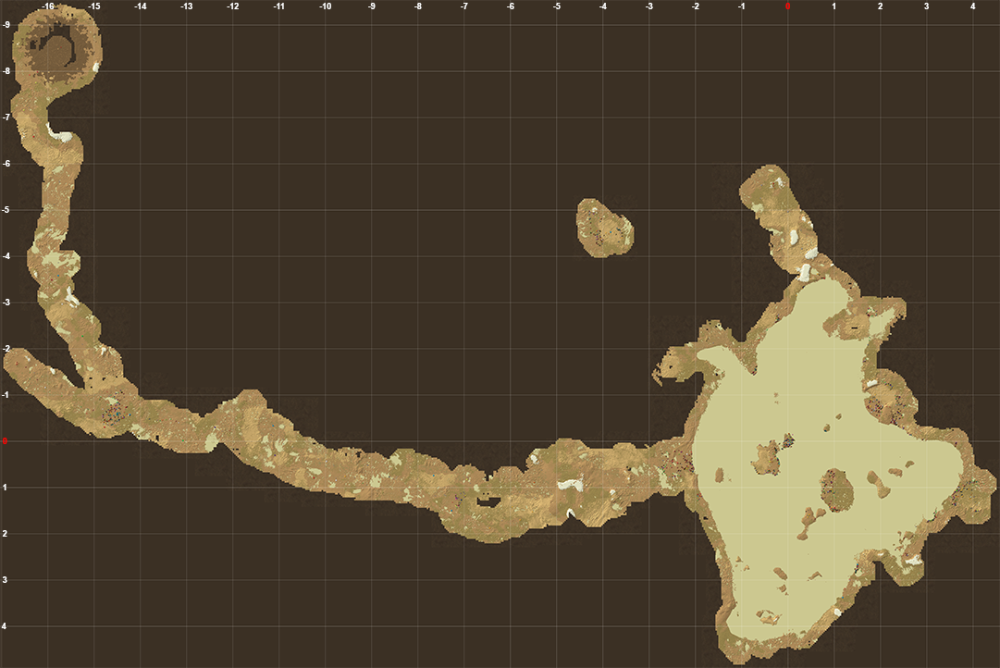
-
I originally made a topic called v1.21 - A new player's thoughts, after I'd been playing for about a month, to give feedback on my experience of the game as a new player. I updated the topic as I progressed further through 1.21, completed chapter 1, and my final post in that topic was about my experience moving from v1.21 to v1.22. This topic continues in that vein; I will be covering my experience in v1.22, continuing from the end of chapter 1 to end of chapter 2. Same seed, new version When version 1.22 released, I had played 5 in game years in 1.21, completed chapter 1, purchased an elk, and marked the first location of chapter 2 on my map. I wanted to experience the changes to world gen (like the changes to traders), so I backed up my 1.21 world, updated to the new version, then created a new world using the same seed and settings (now in version 1.22), then copied my base (and a couple of other builds, like my dock, an outpost) from v1.21 over. The experience was straightforward and worked very well, with only the most minor of hiccups (see the last post in the previous topic for more info on that). It turned out that the maps to the chapter 1 and chapter 2 locations I had acquired in version 1.21 still worked in 1.22; so I was able to pick up the chapter 2 journey right where I left off without rerunning the chapter 1 content. This was very convenient given I was interested in continuing my journey, rather than starting it from scratch, since I was right in the middle of it. Everything before chapter 2 You'd think this meant I immediately set off on my chapter 2 journey, but there were some goals I set out to achieve before making the journey. First off, I wanted to make the Arctic Hunter set that was added in 1.22, so I had to find cinnabar. I also had all but one of the Jonas parts I needed to make a terminus teleporter, and I was interested in making one before making the chapter 2 journey for numerous reasons. So I ended up spending 2 in game years prospecting for pentlandite, gold, and cinnabar. In that time, I also finished repairing the Forlorn Hope armor I had purchased from traders. I finally found the missing Jonas part I needed for my terminus teleporter in my third year, and only then set out on the chapter 2 journey. The chapter 2 journey, bugs The trip to The Lazaret went smoothly, and I enjoyed exploring it. The trip to The Village was also smooth, but there were some odd audio transitions and all the villager's trades would take more than 400 days to change and seemed to be selling random items. I ended up using the command in this question solution eventually, but much later (after completing chapter 2). I decided to visit Tobias' Cave before setting out to The Devastation, and had a hard time finding the entrance via the water. I saw the vents sticking out of the walls elsewhere, and climbed down onto the skylight, before I ended up googling to narrow down what I was searching for. This was much like the issue I had with finding the door to the Resonance Archives in chapter 1; once I knew that I had to search within 20 blocks, and what I was looking for, the search was simple. Without that information, I had no idea how far to search or if I should be digging. For Tobias' Cave, by now I knew I shouldn't be digging, but it was still a large area to search. Simply knowing I needed to look by the water was enough to find the entrance, but I had been looking at the top of the mountain before that (thus found the skylight). Unfortunately, there seemed to be a number of audio issues in the area. Most sounds stopped working (and did not resume working until I saved, exited and returned) at times. For example, footstep sounds, sounds of the seraph taking damage, the environment, all stopped working in the vicinity of the mountain. After leaving the mountain, when I was attacked as I was nearing The Village again, I did not hear any audio of the enemy or of taking damage. After spending some time at the outpost I constructed near The Village and completing a couple of quests for the villagers, I head out to The Devastation. I experienced 3 bugs that prevented me from continuing the game. Upon approaching the tower, I was unable to timeswitch. I needed to regenerate the chunks to resolve the issue. In the basement, there was an iron fence I was unable to proceed past. Closing the reopening the game resolved the bug, but I wasted a lot of time before I googled what was going wrong and found a solution. It was natural to assume that I was simply looking in the wrong place, rather than encountering a bug, so this bug in particular was bothersome due to the amount of time it caused me to waste. This is a problem when you are carrying a limited amount of food. I got trapped in a tank on the 6th floor of the tower climb, and was unable to escape it by timeswitching or logging in and out. I needed to switch to spectator mode to escape it. Besides these 3 bugs, the rest of the level was enjoyable, and the elevator was intuitive and worked well for me. The boss at the top did not initially show up, but leaving the tower, resting at my outpost on the edge of The Devastation, then returning to the tower, fixed the issue, without using commands or having to leave the game. The battle was a little easier than I expected, but I did fall off the tower at least once during the fight (with a glider, so not a problem, took the elevator back up), and the climb was challenging enough I didn't feel that I needed a hard fight to be satisfied. I was wearing Forlorn Hope armor, and wielding a meteoric iron falx, a recurve bow (I purchased from a trader, I'm a Commoner), and carrying 3 stacks of iron arrows, so I was well equipped. I didn't need to heal or timeswitch during the fight, as I took so little damage, which surprised me, as I found the first chapter's boss more challenging. The only thing that confused me was the defeat behavior of the boss. After I took the boss's HP to 0, the boss returned with ~2/3 health before I could pick up The Lens. After defeating the boss a second time, I picked up The Lens, but the boss returned with ~1/3 health. After defeating the boss a third time, I decided to leave, rather than stick around to see if the boss returned again. The boss did indeed return a forth time, and harried me all the way to my outpost at the edge of The Devastation, before I slept and it left. It was unclear if this was intended behavior; I had expected the boss to be disabled (or fly away) like the boss of the first chapter after defeat. Could this have been a bug caused by being forced to regenerate the chunks? Either way, the inconsistency of the health bar did not seem intended. Returning to Tobias' Cave after defeating the boss, I was quite loaded up on loot, so when I asked for my reward, I was scared I would not have inventory space to receive it. Receive it I did, but I worry what could have happened if I didn't have the space; has this scenario been accounted for? I enjoyed the dialogue options available, and that Tobias gave me some bread, but I almost didn't ask for my reward (as I tend to play a more "for good, not for reward" type of character). If I had not known that the reward was such a valuable device (from information on the forum and having checked the rickety translocator on the wiki, after seeing it in the handbook), I may have missed out. It might be nice if Tobias was a little more forthcoming with his reward; after telling us he may take up to 10 years to figure out our next steps, it would have been great to have him offer us this device as a way to return when he is done without further prompting. After chapter 2 I made steel before chapter 2, so I would have sturdy saddlebags on my elk, so I'd already completed the tech tree. Now that I have completed the story (and have made the Jonas device I was interested in), I consider my vanilla play through of the game likewise complete. I might yet set up a dairy farm, explore a few more ruins, and I have continued to do some chiselling work on my base, so I haven't put the game down yet, but I have a pretty full picture of the game now. Feedback Overall, the feedback I have from my 1.22 chapter 2 experience is: The chapter 2 bugs did seriously interrupt my enjoyment of the game. Yes, the game is early access, so some bugs are to be expected, I just want to highlight this is an area of the game that needs additional work. I was playing a single player, vanilla version of the game, with a world made in 1.22, on a performant Windows 11 PC. The bugs I ran into could not have been prevented by my set up. I hope we see updates to Jonas tech in the future; in how we go about pursuing parts and in the function of devices. Also, cupronickel nails; odd I can't smith them, but I can smith the rods. Only noticed it after I tried to build my rickety translocator and it said I could use cupronickel nails in the handbook, but then I went to smith them and there was no option to do so. Hauling loot between dungeons and base remains frustrating. I hope we get additional solutions in the future. The rest of my experience of the game has been very positive. I've really enjoyed the story so far and am looking forward to future chapters. Edit: Originally posted this in Discussion by accident. Moved to Suggestions, as this is more for feedback than discussion, but discussion is welcome :).
- 1 reply
-
- 3
-

-
Impassable story bug (Devastation spoilers)
DarkGold replied to Discipline Before Dishonor's topic in Discussion
Made it to the top of the tower without any problems after that, but I think I need to fight someone who isn't here to get this lens... They were around last play session, but notably absent this session... Update Went to the edge of the devastation (where my outpost was), slept, came back, and they harried me on my way back to the tower. Took the elevator to the top, squared off against them with my bow, successfully saw them off (took HP all the way down)... and then they immediately came back with about two thirds health before I could pick up the lens? So fought them off again... picked up the lens... and they came back with about 1 third health? So I fought them off again... then I decided to leave the tower rather than risk them coming back again. Is that expected behavior? Found the fight easy enough (didn't need to timeswitch or heal during the fight with forlorn hope armor, meteoric iron falx, recurve bow with 3 stacks of iron arrows), but the climb was hard enough I didn't feel like doing a particularly hard fight at that point, so I don't count an easy fight as a negative. I did get knocked off the tower during the fight at least once, and had my glider, so that wasn't a problem. Using the elevator to travel back up the tower and continue the fight was not a problem. Update 2 They came back a forth time and harried me all the way back to my outpost at the edge of the devastation. -
Impassable story bug (Devastation spoilers)
DarkGold replied to Discipline Before Dishonor's topic in Discussion
Got stuck inside a tank on the 6th floor after a timeswitch, can't timeswitch out... had to use spectator mode to get out.
-
Impassable story bug (Devastation spoilers)
DarkGold replied to Discipline Before Dishonor's topic in Discussion
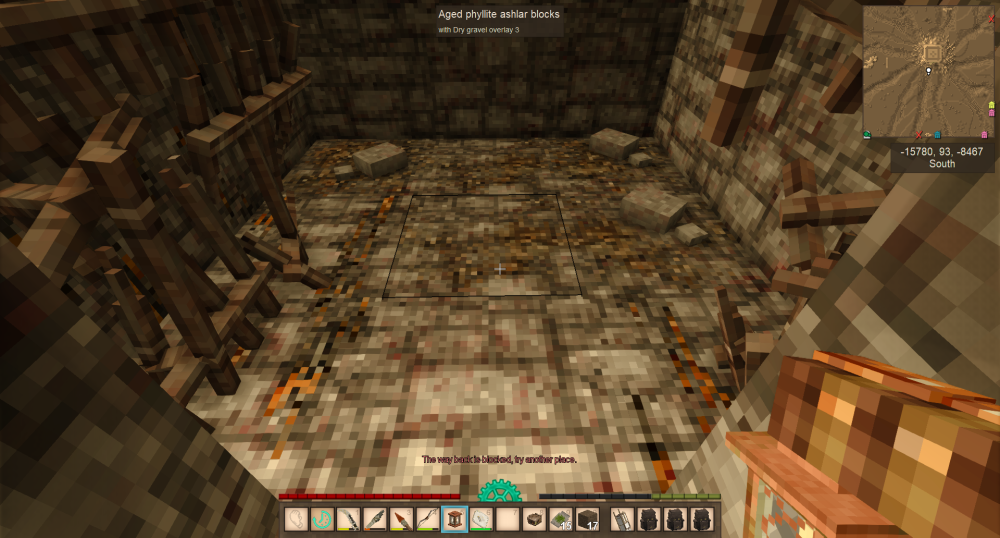
It's a bug that disappeared when I closed and reopened the game. There is a block that the fence sits on, a block with some stones on the floor (that you can't pick up due to claim protections) that you must crouch to enter (as the roof is low) then a pile of rubble immediately after that block. Pressing Y (or right clicking with the hotbar selection) when standing between the fence and the rubble was not working. I attempted very thoroughly; I stood on the wrong side of the fence, switched to the present (where there was no fence) and spammed the Y button while walking all the way from the wrong side of the fence right up until the rubble stopped my path. I also did this without spamming. Only once I closed and reopened the game did this work without the "The way back is blocked, try another place" message occurring. It was not particularly tight (standing anywhere on the block with the stones seemed to work) at this point. Edit: I honestly wish that I'd tried opening and closing the game sooner (it had not solved the initial separate bug that required regenerating the chunks), as I spent so much time assuming that I was simply going the wrong way and fruitlessly exploring the map, before I eventually checked the wiki to see what I was doing wrong and verified that the experience had not changed between releases. I experienced no further bugs in the basement levels, successfully got the front door open, and am up to level 5 of the tower climb. Elevator working well. Left my progress at the tower there for the moment, as a temporal storm was about to hit, and I wanted to face that somewhere else. Will be continuing the climb after the storm next play session. -
Impassable story bug (Devastation spoilers)
DarkGold replied to Discipline Before Dishonor's topic in Discussion
I'm running into this bug right now; exactly the same. Can move beyond the fence in the present, but can't return to the past once beyond it. I spent a really long time looking for another path and can't find one. Is the only way to get through creative/spectator mode? Saved & left world in the room, returned, it started working. Definitely a bug. I'll add that I also experienced the inability to timeswitch at all initially, as per this bug: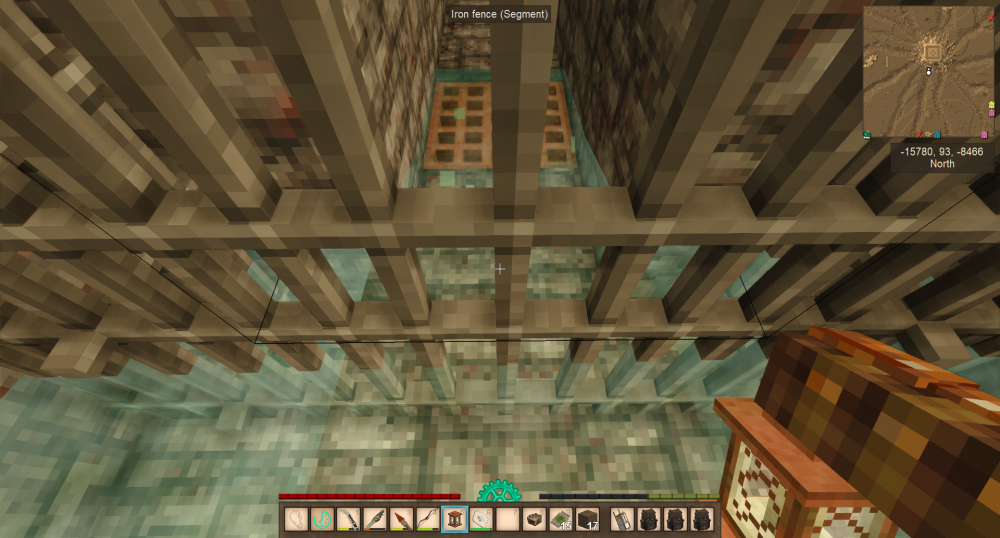
-
Just ran into this too; latest version, vanilla client, Windows 11. Could not timeswitch after approaching the tower for the first time and seeing the message that told me I could, despite the hotbar option being blue. Closing and restarting the game did not solve. The above solution fixed it for me. Thanks @Daykiller!
-
It could be interesting if the BRT functioned a little more like a Town Portal in Diablo; instead of 1 way teleportation, a portal that stayed open for a short amount of time. This would allow the player a window to move loot between locations, before it shut. It wouldn't have to be a long amount of time; say 4 minutes (or 2 in game hours). A prepared player could accomplish plenty in that amount of time (transfer large quantities of loot between trunks). Given we see a lot more instantaneous teleportation than portals, I don't expect this to be a desired direction for the game though. The BRT also seems to be more intended as a single-player item, whereas a portal seems like it would be more useful for multiple players. Perhaps a different kind of Jonas device?
-
I definitely relate to this. I decided I wanted to build a terminus teleporter (TT) for 4 reasons: I had not yet started my chapter 2 journey, and figured it would be easier to be able to get back to base and pick up useful stuff if I died, than have to leg it all the way back the long way if I found I had neglected to bring something important with me. I wanted to avoid the strategy of spending temporal gears in an incremental fashion on my journey, in order to save myself a very long run back to my death location if I died. Spending 1 temporal gear on death would be more efficient than spending a handful over the course of the journey, and I had relatively high confidence that I could do the run with less actual deaths than desired checkpoints. I was very close to having all the Jonas parts I needed to build the TT at the end of chapter 1. I would need to track down some gold and nickel (which took a long time, but I was interested in doing anyway), and I needed a Jonas sub-assembly (A complex joint). Surely this wouldn't be that hard to find? 4 years later... I had not enjoyed hauling all my loot back at the end of chapter 1; it was very tedious with the amount of inventory space available. I thought that while I was looking for the Jonas part I needed for the TT, I might get the parts I needed for a base return teleporter (BRT), which would alleviate some of that frustration. With the promise of a TT just within reach, I was more interested in pursuing the goal of finding that one missing part that could make my life easier than starting the second chapter, which I knew would likely conclude with a frustrating loot haul. I figured once I completed the second chapter, I would have less need of a terminus teleporter (at least until chapter 3 content was released), so better to pursue it before chapter 2, when I could make good use of it, rather than after. This made me willing to be brave; the mentality of "if I just do this one thing, the pay off could be huge", rather than "you will definitely have to spend countless hours in dark holes and fighting tough monsters". Thinking that the end of my search could be at the bottom of the next cave or drop in the next temporal storm made me want to face the challenge and plan to tackle each opportunity. Now that I have built the TT and a BRT is not going to single-handedly solve my loot problem (it will surely take more than 1 trip back to base to haul all the loot I have found back), I have little incentive to continue searching for Jonas parts. The gap between having a sufficient number of BRTs to solve the loot haul problem and the amount of time it is likely to take to acquire the necessary parts is too great to make acquiring the BRTs a worthwhile goal.
-
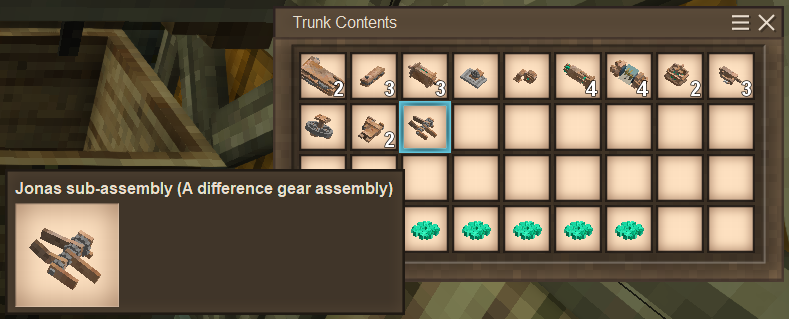
That final part I had yet to find dropped from another deepsplit shiver I encountered in a story location today. Now I've found one of each part. So not too long after my 31st part. Maybe the 33rd or so. It'll take me a while to get back to base and check how many were in the chest. Edit: Checked the chest when back at base; it was the 34th part found.
-
Ahhh, a nugget of wisdom I will store away. I generally avoid the deep dark underground, because I am a coward, but I know there would be clever ways to use this information to seek Jonas parts in the future. You say "almost entirely randomly"... is there anything that modifies the randomness that you are aware of? If they all dropped evenly randomly, I would have hoped to get 1 of each part by now (31 drops is more than 2x 13, the odds are good that most drops would have happened by now), so I was wondering if some parts do show up more often, or if I have just been unlucky to not hit a 1/13 chance in 31 chances yet.
-
I guess they'd be really helpful down on the mantle! What do you get up to down there?
-
With my base being well lit, rifts are prevented from spawning by the light level, so I don't need a Jonas device to stop them spawning there. It would be useful if I wanted to do something outside my base, but usually I just pick calm temporal weather in that case, or I'm underground, and I need to put lights everywhere to stop things spawning without rifts anyway, so I just don't see much use for them? I know some mods make them more useful (they effect temporal stability), but I'm playing vanilla, so by default I just don't have much of a use case for them. I wish they worked on temporal storms!