


Erik
-
Posts
268 -
Joined
-
Last visited
-
Days Won
41
Content Type
Profiles
Forums
Blogs
News
Store
Everything posted by Erik
-
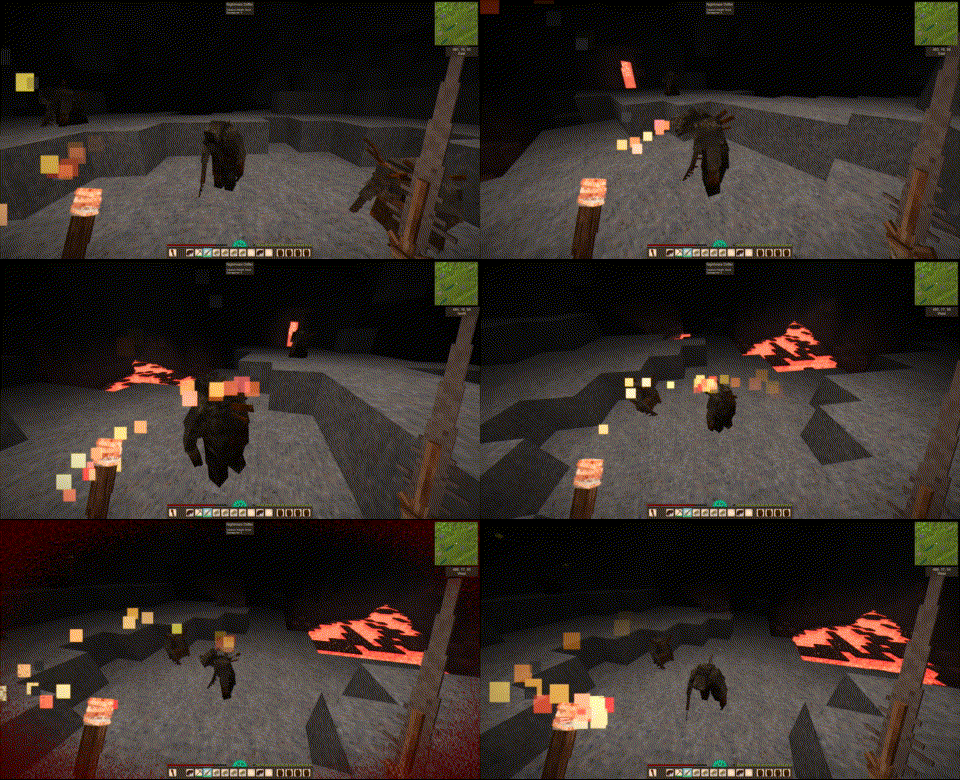
Vintage Story's combat has some fundamental flaws, that need to eliminated before any new combat mechanics are introduced: This small clip highlights the two main problems: Disconnected attacks and wrong timing Wrong timing: This is the smaller issue of the two and is relatively easy to fix. The issue is that attacks hit after the animation has been completed instead of during the animation. This makes timed dodging or blocking of attacks much harder, as the visuals deceive the player. In gamedesign, attacks can be seperated into three phases: The windup that is used to notify the player of the attack and the type of attack, giving him some time to to react, the actual actual attack during at the end of which hit detection will detect if the player has been hit or not and the recovery, when the attack has either hit or missed the target, giving the player some time to act. The drifter attack animation has a short recocery, when the hit frame is seen is the swing at 90 degree angle to the starting position, having being the closest point to the player if the player would stand directly in front of the drifter. But the hit frame is, as seen in the clip, after the recovery, when it should be in fact before it. The drifter is not the only example of this, the problems described here apply to all NPCs in Vintage Story. Disconnected attacks: The second issue is that although the animation indicates that the attack clearly missed, the attack still hits. This is a huge issue for gameplay, as it makes dodging attacks sideways or into the enemy impossible, leading to the common technique in many games with bad combat system: backpaddeling. Getting distance from the attack is the only way to escape it, so players constantly walk backwards in combat, while trying to outreach the enemy. One extra thing to note in the clip is that the animated attack should not only miss the player because of the rotation, but the reach of the drifters attack is exagurated, hitting more than range the animation actually has. The animation reach at the hit frame and the actual reach of an attack must match not only for NPCs, but also for the players, which attacks have even more additional range, to ensure attack readability in PvP and PvE situations. The attacks of the drifter seem to simply check if the player is in range of the attack and are completely disjointed from the animation and orientation of the drifter. While actual weapon swing simulation with real time detection if a weapon hits a target is not required, proper hit detection, checking if the player is in the attack cone of the enemies attack, is. For the player, cone based hit detection would also make sense, making hitting targets easier and differentiating the sword from a short range gun. The design of many, if not all attacks in the game should also be fundamentally reworked: The enemies should generally not rotate during the attacks, so dodging sideways or into the enemy is possible, attacks like the bighorn sheeps charge should not be like a homing missile, but like an actual animal charge, first getting some distance to then charge at the player, either hitting on a collision or continuing for a while past the player on a miss. Drifters could use a forward lundge attack in addition to the swing, to close distance and force the player to force the player to dodge sideways rather than backpeddeling.
- 11 replies
-
- 16
-

-

-
Brewing alcohol is something that is planned for the game, specifically update 1.14, and without there being a hydration system, there would be very little gameplay reason for it. However the inclusion of alcohol brewing as a mechanic opens the game up a very interesting and fun idea: An alchemy system, in other words a potion and poison brewing system. The goal of the system is not only to allow players to temporally buff oneself for certain tasks, but also reward players for exploration and experimentation, offering them an amount freedom. The alchemy system should therefore also act as a puzzle, to offer enough depth that experimentation and mastering the system is actually useful, rather than there being an easy way to always produce a perfect potion. An alchemy system obviously starts at potion/poison effects with the status effect system. A status effect should have a variable duration and a variable magnitude. After the duration has expired, the status effect is removed from the player. The magnitude determines how big the impact of the effect is, what it actually does is dependent on the type of status effect, for a healing effect it would improve the amount of health restored per second. Instant effects are possible by having a very low duration. Some examples for status effects: Healing: The player regenerates X health every second for T seconds. Harming: The player loses X health every second for T seconds. Exploding: The player explodes with a strength of X after T seconds. Haste: The player breaks blocks X times faster for T seconds. Status effects obviously aren't limited to the player, they work on any living entity. The same status effect can exist multiple times on one entity, meaning that the player can drink two potions to heal faster. There needs to be a menu players can access that lists all active status effects, with their description, magnitude and remaining duration. So what has this to do with alcohol brewing? Alcohol acts as a solvent and base for tinctures, which carry these effects. To create a tincture, an alcoholic beverage must be aged inside an aging barrel together with any number ingredients of ingredients. Alcoholic beverages can be made in several ways, producing different types of wine, beer and booze. By oneself, they don't do much, they maybe provide some nutrients or saturation and certainly make you drunk. As the base for a tincture they have three stats that vary depending on the type of alcoholic beverage: Duration, magnitude modifier and base toxicity. The duration determines the duration of the effects of tinctures made with this beverage as base. The magnitude modifier modifies the magnitude of the effects of tinctures. The base toxicity determines how drunk you'll get from drinking this beverage or tinctures made from it. Toxicity is actually an important gameplay system rather than just a bit of fun. Consuming beverages and tinctures will raise the drunkenness of the player. A bit of drunkenness will just give the player a slightly blurred vision (a depth of field effect, never the nausea effect Minecraft has, because only the player character should get nausea, not the actual player). It will get more blurred as the drunkenness increases. Next thing would be slight camera movement without player input, making the player character harder to control as drunkenness increases. At some point player input will be delayed and then the player characters will move about a bit without player input. As vision gets so blurry that it's almost as if the player character was blind, at 100% drunkenness the player instantly dies. Drunkenness thus acts as a limiter to tincture consumption, so players can't just drink ten healing potions at once and be invincible for a minute. (And I admit, it's probably a little funny too, looking at Deep Rock Galactic) Drunkenness on the player constantly decreases over time, so if you don't become addicted to tinctures, it should be easy to manage. But how do you actually craft a tincture? Well it starts with the ingredients. Ingredients are a type of item that doesn't carry effects, but contain alchemical elements. There can be multiple elements on any ingredient and multiple of any element too. So horsetail as an ingredient may contain 3 aqua, 2 terra and 5 umbra. You can see the elements represented by icons with numbers representing the quantity on the tooltip of the ingredient. When you add ingredients to an aging barrel, they will be dissolved and the elements they contained get added to the beverage. You can dissolve as many ingredients as you want into a beverage, even dissolve multiple of the same ingredient, and all the elements get added up. So when dissolving two horsetail, the beverage will contain 6 aqua, 4 terra and 10 umbra. Adding sulfur (4 ignis, 1 umbra) to it, it will contain 6 aqua, 4 terra, 11 umbra and 4 ignis. If a beverage in an aging barrel contains the same amount of different elements, like the 4 terra and 4 ignis here, the tincture created after aging the beverage will get the combinatory effect of that combination. Any combination of two elements will yield an effect, so as long as there are two elements of the same quantity in your aging barrel, the created tincture will have an effect. This allows the player to experiment and discover the effects different combinations. Some effects may appear in multiple combinations, meaning it is possible to get tinctures that apply the same effect twice, which would make for a tincture twice as powerful. While you can add as many ingredients as you like to your beverage, the lower the amount of elements in a combination, the stronger that combination will be, or in other words, the higher the magnitude of the resulting effect will be. So a combination of 1 terra and 1 ignis will produce a more powerful effect than a combination of 4 terra and 4 ignis. Each effect on a tincture will also increase the toxicity it by 25% of the base toxicity. All elements that aren't included any combination also decrease the magnitude of the tincture by a small bit. This means that you want go get close to no unnecessary elements in your beverage for it to be most effective. Only when the aging barrel is sealed up the combinations are locked and after a set amount of time you will have your tincture. The tincture can be filled into bottles, flasks or water skins and consumed by the player by simply drinking from those. Alternatively the tincture can also be applied to weapons and will apply the effects of the tincture to enemies upon hitting them. Applying 10 portions of a tincture to a weapon will yield 10 hits applying it. For the earlygame there should also be ways to utilize the alchemy system before brewing: Paste Instead of an aging barrel a player can use a pestle and mortar and instead of alcoholic beverages he can use animal fat or honey as a base. Pastes are created with the same system as tinctures, but their big advantage is they don't possess any toxicity. However they can only be applied to wounds and are generally much weaker than tinctures, but last longer. To apply a tincture you don't eat it, you apply it to a bandage and wear that bandage on an armor slot. While the wearer doesn't have full health, the effects of the bandage are applied. Bandages decay over time, like food. After it is decayed, the effects will no longer be applied. When toxicity is the trade off for tinctures, bandages using an armor slot is the trade off for pastes. Good ingredients are hard to come by and they almost always have more than one type of element, however there is an endgame way of extracting certain elements in their purest form: The alembic. The alembic operates very similar to an aging barrel, in the sense that you need to supply alcohol to it and can dissolve ingredient into it. Instead of sealing the barrel, you light a fire under the alembic and instead of being able to use any alcoholic beverage as base, it needs pure alcohol, which is only obtainable by repeated distillation of beverages in a small distillation tower. The alembic, while similar to the aging barrel, turns the alchemy system on it's head. Upon lighting the fire, types of elements are of the same amount, and therefore would combine into effects, get evaporated with the alcohol. What remains is a fine powder only containing the remaining elements. This powder is an ingredient itself and can be used for creation of tinctures or further refinement in the alembic. Encouraging experimentation and exploration While the system would work, a quick look on the wiki could make finding the right combinations and ingredients trivial. To make this impossible, the effects that appear on combination of elements should be randomized per world, only the elements on the ingredients should not be randomized. Upon creating a tincture or paste, the discovered effects from used combinations should be added to a searchable list in the survival handbook, so players can easily look them up. Alchemical recipes, outlining the effects of element combinations should also be able to be found in ruins as loot, which are also added directly into the handbook upon reading. Pure alcohol, alembics and powerful ingredients could also be ruin loot. Eating an ingredient containing two different elements of the same amount should also discover the combination of those elements. Implementation discussion While I think the system is quite elegant and easy to understand (only the less equals better aspect may be a bit counterintuitive), there is a problem regarding the implementation: How many elements do there need to be? The number of possible combinations and thus possible different effects can be very simply calculated with this formular: nC = n! / (2 * (n - 2)!) nC ... Number of possible Combinations n ... Number of different Elements As the number of combinations would probably not always exactly match the number of effects, there would need to be duplicate effects, which is a good thing, as it makes more useful and general effects like healing more accessible. I'd argue each effect should at least have two combinations that produce it, many effects may even have more. 16 elements would yield 120 possible combinations, which would allow for 60 effects, if every effect would have exactly two combinations. As there likely won't ever be more than 60 effects in the vanilla game, I think this number is fine. Effects would have a weight value assigned to them that determines how often they appear in combinations compared to other effects, so the randomization process can assign the effects to combinations properly. Each effect is however at least assigned to one combination. This would make the effect system easily moddable, allowing the creation of new effects. However as there is the hard limit of 120 combinations with 16 elements, it should be possible to add new elements. Elements are assigned manually to ingredients, so this would also require new ingredients or edits to existing ones, which shouldn't be hard to do. What do you think about this system after you got to the end of this wall of text? Any feedback is welcome!
-
It is a sandbox survival game, not just a sandbox game. It should force you to do things. The default survival game mode should not have a completely skipable night imo, as it defeats a lot of the purpose of the night. Being just able to skip the night defeats the purpose of building up defenses, a simple fence and permanent light. It degrades the purpose of crafting armor. The bed is what ruined the Minecraft survival experience for a lot of people, as the game became too easy with it. And players can do things at night time, it's the best time to do the crafting and smelting, prepare food, decorate the interior of your base. Once a player crafted some basic wooden laminar armor, the night isn't even that scary anymore as drifters are not even a threat anymore. Quality of life features are generally a good thing, but this wouldn't be a quality of life thing, it would be a major gameplay change, that would also only effect single player. I'm however not against some world creation setting or mods that allow you to sleep through the night, this is just about the default survival mode.
-
Assuming trees generated by the world don't grow and there is no natural reforestation (i.e. trees planting saplings without player input), the performance hit would be limited to world generation only. Only player planted trees would cause a performance hit, but that should also be fairly manageable, as the trees would grow quite slowly, probably taking a few ingame years come close to the size of "naturally" generated trees. The difficult question is how to efficiently handle a tree as a entity. Having one "tree entity" assigned to every tree seems to be the most straightforward option. Trees generated by the worldgen don't have a tree entity, because they don't need it, they don't grow. The tree entity itself would be stored inside the block that was originally the sapling. The entity would store the positions of all blocks belonging to it and would only update those the tick before a growth tick or the tick when part of the tree or part of the tree is unloaded. Tree destruction should still be done by an algorithm on the axe and should not utilize the data structure on the tree entity, as that would require the data-structure to store the coordinates of the tree blocks in a tree data structure instead of a simple list and the tree entity belonging to the chopped tree would still need to be tracked down by an algorithm on the axe, as well as trees without a tree entity still having to utilize the old search algorithm on the axe, so the whole endeavor would not be worth it. The one tree entity per tree approach however comes with some negatives, like having to check the tree positions every now and then, at least before the growth of the tree, as any of them could be destroyed/removed. Finding and updating the tree entity whenever a tree block is destroyed is also a possibility, however there may be ways to exploit this, such as possibly just moving blocks with pistons in the future or using save game editing tools. Then there are always the problems that could arise with trees lying in more than one chunk, being partially unloaded. Another way to handle tree growth would be to have multiple moving tree entities on one tree. These "tree runner entities" would only simulate growth at their position (and maybe surrounding blocks for leave generation). On a growth tick they grow the branch and move to the next further from the root until they hit reach the end of the branch and then either extend/grow the branch or grow branching. A runner also deletes itself when it reaches the and of a branch or a branching, however at a branching it also spawns new runners for each of the child branches. A new runner entity would be periodically spawned at the root/origin of the tree. They would essentially allow running the tree growth algorithm over multiple ticks, preventing stutters at growth ticks that would maybe be possible with a "one tree entity" model, when it has to check the positions of all blocks. It also has the added benefit of having a lower memory impact, as the tree block positions don't need to be stored on the entities. The downside of this approach being that there is some additional overhead, as there are a lot more block entities that need to be taken care of. Block entity visualization would also be needed to allow efficient debugging, but this also allows for much better debugging of the growth algorithm and modding of custom trees as they would visualize the growth algorithm itself. Problems with multi chunk trees and unloaded chunks can also be handled quite efficiently, as loaded runners can run as usual until they are either destroyed by reaching the end of their branch or hit the border of an unloaded chunk, when they would, instead of deleting themselves, just wait until the chunk becomes loaded, potentially stacking many runners at the chunk border to be released and quickly running in a single tick when the chunk gets loaded. I personally prefer the second approach, for its more intuitive solution for issues with partially unloaded trees and being less prone to lag spikes.
- 10 replies
-
- 2
-
-
- inspiration
- worldgen
- (and 1 more)
-
Make a pickaxe and a hammer. When there are copper rocks on the surface, there is always copper ore underneath. With a bed, you can sleep half the night.
-
Currently, the ore distribution is not designed to suit building mining infrastructure like minecarts. I just think the game could gain a lot by having ore distribution that at least encourages and rewards building mining infrastructure. Ofc the game is currently working as intended, as there isn't any infrastructure right now, but that could change in the future, especially seeing as transportation (boats, minecarts) is a highly requested feature for 2020. More options are always great, but I think the game should focus on the more realistic, more interesting option. This isn't Minecraft, the target audience aren't kids, having Minecraft like ore distribution as a default would probably only harm the game, as it makes the "Minecraft-clone" arguments much more valid. Maybe a middle ground would work best, with most ores generating like they currently do (aka, small clusters with quality depending on the stone type and quantity depending on the ore map), but more advanced ores like iron or some types of coal generating in rare, long, thin veins with low quality ore that go on for miles and warrant construction of infrastructure, as iron and coal are very commonly used materials. It would spice up the system and give a good bit of variety. Maybe making only copper ore generation more like Minecraft would also help, as it is the starting material. It would certainly help new players, while not taking away from the prospecting, as any other ore requires it. Another supportive way of encouraging infrastructure would be to lower the stack size of ores and make turning ores into nuggets require an anvil.
-
Only true if time and monetary restrictions are not a thing. Nope, mods are a big sales point. Easy installation is just a bonus. And currently there just aren't many mods available. I'm not against CurseForge support, I think it's not a bad idea, as it provides free hosting and easy installation for mods. But making it out to be a "must-have" and a "valuable business decision" that has to be done "right now" is just plain false. Right now, new features and extentions/reworks of existing game systems is what the game would benefit most from, long term. When there are a few more mods available, it may be time to think about mod hosting and installation.
-
CurseForge support alone won't generate any new sales nor awareness, they aren't doing free advertisement. And integrating into the Twitch Launcher on the same level as Minecraft might not be as easy as it sounds. And it won't provide features, like auto-download of mods on joining a modded server, which I would personally rank much higher than third party one-click-install services. The most user and modder friendly way will therefore always be to offer first party mod management directly integrated in the game maybe with support for a variety third party mod hosting services. First party hosting would probably also be very nice, like with Factorio, but comes with additional work and costs. However, at the current point in time where there are only very few mods available for Vintage Story, it generally isn't worth it to put so much effort into a feature only very few people will use.
-
You're right that MultiMC doesn't have a browser for mods and modpacks included with one click install/update functionality. But you are not limited to Legacy FTB packs only, with the "Import zip file" option you can import any curse forge pack (apart from forge 1.13+ packs). Twitch Launcher however can't install FTB Legacy packs nor does it support Fabric. The twitch launcher is also unbearably slow and nowhere near as responsive as MultiMC, it is also loaded with a lot of features unnecessary for modding Minecraft, the whole twitch stuff. While it arguably provides the better user experience compared to MultiMC, but MultiMC is lightweight, fast, doesn't need a twitch account and has all the necessary tools to create and play modpacks. Sharing modpacks for private use is also easier imo, as you can just export a zip file. Switching to Steam for higher sales at a 30% cut would be a good business decision for most companies, but most companies turn out new games or dlc every year, generating new sales. Anego Studios however will probably only produce a tiny quantity of games (only Vintage Story for now, though Tyron said he wants to do a freelancer type game sometime in the far future), so the money from each purchase really counts, as I suspect most people will only buy the game once. Steam may be effective in short term, but in the long term, Anego studios loses out on a lot of money. Having created quite a few mods for VS myself, I think modding the games is quite easy and powerful already and I don't think rewriting the game to Managed Extensibility Framework is needed nor worth the investment, as you can already add/remove mods without restarting the game, as the game assets and libraries are only loaded on entering a world. Also not the right thread for such a topic.
-
Something that needs to be added is, that the launchers of those huge mod hosting sites like Curse and Nexus Mods are often just inferior to mod launchers specifically developed targeting a specific game. For Minecraft, twitch launcher is really bad in comparison to MultiMC. For Fallout/Elder Scrolls the Nexus Mod Manager or it's newer replacement Vortex is much worse from a feature and usability viewpoint than Mod Organizer 2. Using an inferior software doesn't actually sound that bad at first if it does what you want. But they often promote bad modding habits and thus result in a lot of mod compatibility issues, the user is unaware off. This is especially the case for something like the Steam Workshop. It's presented as a simple click to install service, but in games like Skyrim it really fails and causes a lot of issues because the user is unaware and unable to configure the load order, nor is the load order automatically managed with something like LOOT (Load Order Optimization Tool). Even the Nexus Mod Manager had a similar problem, while it allowed configuring the load order of mods (only manually though), it didn't allow configuring the install order and warn users about mods overriding files of each other. Vertex fixed both those issues and does a really good job at telling people of those issues and forcing them to fix them, but makes this unnecessarily tedious and lacks important features like manually changing your load order. Getting twitch launcher support for Vintage Story would just stick it in the Steam Workshop situation. Mod installation is easy, but things like conflict detection and resolution are not possible for the user, because the launcher is just too general and not specific enough to Vintage Stories needs. Also on a completely different note about Steam, why not release on Steam with a higher price to compensate for the 30% cut? Something like 22€ would still leave the devs with just over 15€ and provide regional pricing as well as more awareness and probably boost sames a bit. While not perfect, it seems like the best compromise.
-
Sorry for the late reply, had to deal with studying and writing exams first. Thanks for the liking the suggestion, I guess I don't think this is a very good idea, as that makes the stamina system very present outside of combat, punishing more relaxed playing or just AFK-ing. Being able to brew beverages and potions that increase the maximum stamina would probably be a better and more fun/involved, although less realistic and more game-y, way to do it. A damage boost after a parry sounds like a very good idea, I really like it. Although I think it would better fit the attack blocking, as it's much harder and riskier to pull off and lends itself more towards a hyper-aggressive style of play. Also like this idea, but would limit it only to the axe (and maybe a dedicated, stackable throwing knife), because encouraging players to play with a knife and a shield would make them look kinda weird imo. The regular knife could do extra damage and ignoring armor if attacking a target from behind. Absolutely. Definitively. Yes.
-
The return of the combat suggestion It’s been a while since my last combat mega suggestion and I think it’s time for a refresh to end this trilogy. This one is a bit more specific and tries to present a (theoretically) fully functional combat system design. I’ve had even more time playing melee combat oriented games like Mordhau, which released into early access last year. While it has some of the best, if not the best, first person melee combat in games, the general design would be very unfitting for Vintage Story, as it requires real time sword simulation, more accurate hitboxes, high tickrate lagfree servers and procedural animations and multiple metric tons of balancing to be somewhat serviceable. But it has some ideas Vintage Story could really benefit from, like some other games like Mount and Blade, Dark Messiah and even Skyrim. Combined with some of my own ideas, I’ve come up with a melee combat system for Vintage Story that meets these requirements: Melee combat rather than a short range first person shooter This is the biggest problem of Minecraft combat, the long attack range makes hitting other players really difficult, as they can easily move out of the cross-hair of the other player. The game becomes more about aiming and clicking at the right moment, resembling a FPS much more than a melee fighting game. Enough depth to enable a large degree of player freedom Having a combat system with a high skill ceiling and many viable playstyles makes the combat much more replayable. A large amount of player freedom aims to archive this and have players evolve their own styles, emotionally connecting them with the gameplay. Little complexity for easy use without need of a tutorial Complexity is the evil brother of depth. It would make combat much harder to learn, understand and even implement for the developers. Having combat be easy to learn is essential for the new player experience, as combat is a major part of the game. Simple mouse based control without need for extra keybinds This is a good way to limit complexity and make it easy for new players to learn the system, not having to look up controls and being familiar to many other games. Working with ray traced or cone based hit detection This keeps the implementation effort much lower than real sword swing and collision simulations would require, as well as having a much lower potential for issues (no potential inverse kinematics, etc.) and exploits and being much more performant. Allowing for both engaging PvE and PvP combat The game allows for both PvP and more prominently PvE combat and the combat system should reflect that, being fun and providing depth at both levels of gameplay. No turning combat into a waiting game for cooldowns Minecraft 1.9+ combat has annoying cooldowns, making the players unable to perform any action directly after attacking. This makes for boring unengaged combat. First Person use doesn’t give players big disadvantages Vintage Story is primarily played in first person because of the focus on the building elements of the game, having the player switch perspectives for combat seems like a very bad idea and lowers the overall immersion dramatically. Therefore the combat should be designed primarily for first person use. Combat system not majorly interfering with other game systems The combat system shouldn’t effect other game aspects much, like exploration, as to not make these aspects less fun or more frustrating, by for example limiting running or destroying blocks outside of combat with a stamina price. More player skill based than character skill or gear based While gear progression and character skill should have a significant impact on combat, as to allow for more PvE progression, the most important factor for combat should be player skill, to allow for an engaging PvP experience and progression of the players skills. Effective reaction for every action and reaction This is a core piece of the combat design, the player should be able to react to any combat action and if doing so successfully forcing a new reaction from the opponent. Ideally there would be more than one possible reactions, to allow for player freedom. The goal is to never have the player in a situation where he is unable to do something helpful, making the game never feel unfair. Easy readability to allow for reaction based actions To be able to react to an action, the player has to be able to read which action he has to react to. The first person perspective and limited animation system can make this hard from just animations alone, requiring very expressive and clear animations and sound effects. Playability with higher latency and lag While the combat gameplay benefits from a lower latency, the combat system shouldn’t break at higher latency and therefore shouldn’t rely solely on precise player inputs and reactions and keep being playable even with lag. Stagger There are basically three types of actions in the system, the offensive attack triggered by the left mouse button, the defensive block triggered by the right mouse button and the evasive dodge triggered by the movement keys. Fitting those actions, there are also three types of stagger, fitting each of the actions. Attack stagger hinders combatants to attack for a variable duration. Block stagger hinders combatants to block for a variable duration. Movement stagger hinders combatants to move, but not to dodge. These staggers are mainly used as a punishment for those effected, very but short staggers are also frequently used as a way to limit spamming certain actions and allow for more dynamic combat. A key thing to note is, that the player should almost never be effected by all three types of stagger at the same time and only very rarely by two, as to not limit the players actions completely. To prevent the player being “stagger locked”, dodging can always be performed to break out of a stagger, providing the player has enough stamina. If he doesn’t, he screwed up one last time. During the stagger, distinct stagger animations should be played, to convey which type of stagger the player or his opponent is effected by. Stamina Speaking of it, stamina is also a major aspect of the combat system. It’s a limiter for the player’s defensive and evasive actions. The player has a large pool of stamina, which could almost be seen as a second health bar and certainly is that important, often quickly resulting in the death of the player if empty. Stamina regenerates over time. Most actions in combat consume an amount of stamina to balance them and punish players spamming some actions, while not explicitly preventing players to do so like with stagger. However, while many things consume stamina, only three actions are prevented by having not enough stamina for them: Blocking, dodging and running. Combatants can’t block if completely out of stamina, making him very venerable. Combatants can’t dodge if the stamina remaining is smaller than the cost for doing so. Combatants can’t sprint if completely out of stamina, making them unable to flee from combat. While all actions effecting stamina will be outlined later in this suggestion, there are two existing actions interacting with stamina, sprinting and jumping. Jumping just prevents stamina regeneration for a short duration. Sprinting is only possible when not out of stamina and prevents stamina regeneration, but only consumes stamina if stamina is below two thirds of the total stamina. This makes stamina normally not limit sprinting, only if the player was already engaging in combat. This makes stamina only have a relevance in combat and not limit the player outside combat. Stamina is required for not having to result to more limiting ways of preventing players spamming certain actions. Without some way to punish spamming, the PvP combat would result in the same problems the Mount and Blade combat (i.e. feint spam) has, which resembles this system in a lot of ways. The attack The most important part of the combat system is always the attack. The player can attack simply by pressing the left mouse button. The player won’t regenerate stamina while attacking. The attack can be split into six distinct phases: The start By pressing the left mouse button the player begins his attack. The movement direction of the player during this decides the type of attack the player launches: If the player moves forward, he will launch an overhead attack. The overhead attack is the slowest attack and has also the least reach, but does the most damage. For hit detection it uses a vertical cone, making it easy to dodge by stepping sideways. If the player moves backwards or sideways and backwards at the same time, he will perform a stab attack. The stab attack has the most reach and is the fastest, but does the least damage. For hit detection is uses a ray cast, making it the hardest to aim and easiest to dodge. If the player moves sideways or forward and sideways at the same time, he will perform a swing attack. The swing attack strikes a middle-ground of reach, speed and damage. For hit detection it uses a horizontal cone, making it the hardest to dodge. The direction of the swing depends on the sideways movement of the player, moving to the left will cause the attack to come from the right and moving to the right will cause the attack to come from the left. The swing direction is only important for attack blocking, which is described in the third attack phase. If the player stood still during the attack, the last movement direction will be used to determine the attack direction. During the attack, the player will be slowed down when moving in any direction other than the direction starting the attack, making movement more important. The wind-up As long as the player keeps holding the left mouse button, the attack won’t launch, only the wind-up animation will be played. During the animation, the player slowly looses a bit of stamina. If the animation is finished, the player will hold in the last position of the animation until the mouse is released. The player can release the mouse at any time, even during the animation, to immediately launch the attack into the swing phase. The further the animation progressed, the more damage the attack will do. If the player just tapped the left mouse button a very small wind-up animation will be played and then continue into the swing phase. During the wind-up phase, the attack can be cancelled by blocking. The swing The swing phase marks the last phase of the attack the player has any control over it. When the swing phase starts, the player looses an amount of stamina, dependent on the weapon used to attack. A swing animation is played and the attack will progress to the next phase when it has ended. If the player presses the left mouse button during this phase, the attack will be cancelled and he will immediately start a new attack (returning to the start phase), but gets block staggered for a small amount of time, meaning the player can’t cancel his new attack by blocking if he doesn’t wind it up for some time. This is called morphing. If an attack hits the player during this phase and it has the mirrored direction of this attack (i.e. overhead when overhead, stab when stab, right swing when left swing, left swing when right swing), it will be attack blocked, meaning it won’t do any damage and let this attack continue. During the swing phase, the attack can be cancelled by blocking. This is called fainting. The commit The commit phase marks the phase the attack can only be cancelled by the player getting attack staggered, by for example being hit by an attack himself. The phase starts by the player making a short scream, making it clear to his opponent, that he can’t cancel his attack. The players camera is also locked during this phase, meaning he can’t aim his attack in a different direction. However the player can still move. The commit animation is played and when it ends the attack transitions into the next phase. The hit detection The hit detection is ran. When the player has successfully hit an opponent, that opponent gets movement staggered for a tiny amount of time. If he wasn’t blocking he also gets attack staggered, causing any attacks of the opponent to cancel. And well, the opponent gets damaged. The recovery The recovery is the last phase of an attack and plays right after the hit detection. The player gets attack staggered for the duration of the recovery, but the player can cancel the recovery by blocking (however not cancelling the attack stagger). This phase can be of really different length and animation, depending on how the last phase went If the attack misses, a long animation is played where the sword continues travelling and then hangs in the air for a bit. If the attack hit an opponent who wasn’t defending, a short animation is played where the weapon first stops for a small while on the opponent (hit-stop) and then goes through the opponent. The hit-stop conveys that something has actually been hit and the player isn’t just swinging through the air. And a nice meaty hit sound plays. If the attack hits a block, a medium length animation plays where the sword is stopped and lingers at the shield for a while. A fitting sound is played. If the attack hits a parry, the a medium length animation plays having the sword bounce of the parry. A fitting sound is played. If the attack hits an attack block, a very short animation where the sword is bounced of the enemy sword is played and a metal on metal grinding sound is played, maybe some nice spark particles get also in the mix. The sound and animation of each should be very distinct, to make it immediately obvious to what happened to preserve readability. In summary: Directional attacks (overhead, stab, right swing, left swing) Holding the attack for increased damage (wind-up) Cancelling attacks with blocking (feinting) Changing attack direction by restarting attacks (morphing) Directional blocking with attacks (attack blocking) After you scream, you lose control over the attack (commit) Attacks getting cancelled when being hit by one (hit detection) Different animations after the attack hit or missed (recovery) The block Blocking is much simpler than attacking, just hold right click while not being out of stamina to hold your weapon or shield in front of you. Players can block as long as they want and when they release the right mouse button the block immediately stops. Stamina however doesn’t regenerate while blocking, but blocking does actively deplete a small amount of stamina. When out of stamina, the block is cancelled. This makes hiding behind a block extremely ineffective, it’s best to block only when about to be hit. When an attack hits the front of a blocking player, the blocking players health doesn’t get damaged. However the blocking players stamina gets damaged depending on the health damage the player would have endured. After lowering a block the player get block staggered for a while and thus can’t block again immediately after and stamina won’t start regenerating for that duration. Up to two seconds after the block has been hit by an enemy attack, this drawback is not active, so the player can block right again after lowering his block and stamina regeneration will also start immediately. If the player presses the left mouse button while blocking he will perform a parry. A parry is an active attempt to deflect an enemy attack. A short parry animation gets played and if an attack hits the player during this animation, the attack will be blocked without giving any stamina damage to the parrying player. After the parry animation ends, the player will get block staggered for a short while if no attack hit the parry, forcing the player out of blocking. This makes parrying a dangerous but rewarding action, if timed properly. In summary: Holding a block costs a small amount of stamina Attacks hitting a block cause stamina instead of health damage Can’t block again directly after blocking Parry negates the stamina damage from blocking but must be timed The dodge Dodging is a simple and effective way to, well, dodge enemy attacks. The dodge costs a medium amount of stamina and the player won’t regenerate stamina during the animation and a short while after. Just tapping the sprint key while having enough stamina to cover the cost will cause a dodge in the current walking direction, without changing the looking direction. A short dodge animation gets played and the player quickly moves a few meters in the walking direction, smoothly moving over up to one block high ledges. While dodging is a very effective means of evading attacks and leaves the opponent in a venerable position after having missed an attack, being in a long recovery animation, it also leaves the player venerable right after dodging, suffering a short block stagger and very short movement stagger. Combined with the comparatively high stamina cost, this makes dodging a supporting means of defense to be used in conjunction with smart movement and positioning in PvP, but a very important defensive measure in PvE. The gear With an armor system now in game, the system can be easily adapted for this combat suggestion. With active blocking, the effectiveness of armor needs to be reduced a bit, to not make fights last centuries. Furthermore, the move speed penalty of heavy armor should be reduced for significantly for balance and comfort reasons, adding new negative modifiers to heavy armor like reducing stamina pool and raising stamina costs for certain actions, like dodging. Shields should be introduced, lowering the stamina consumption from blocking, but raising the cost of other actions like attacking or dodging. Spears should also only block, when the player has a shield equipped, retaining the throwing ability otherwise, giving them a very unique playstyle focused around evasion and attack blocking. Stamina modifiers could be added in many places, however they shall only change stamina costs and the players stamina amount, not the speed at which stamina regenerates, as that would be too big of an advantage or disadvantage. Stamina costs act as a new balancing factor and would be applied to any weapon and also to drawing a bow or throwing stuff like rocks and spears. The balance I did not add any numbers to stamina costs or action/effect times on purpose, but some wording describing the relative length of effects, because providing hard numbers isn’t exactly useful, as only extensive testing will find the right numbers. But generally speaking, offensive and defensive actions should be somewhat equal in stamina costs, to not make super aggressive or super defensive playstyles superior, although giving offensive actions slightly lower costs than defensive actions seems like a good idea to give incentive for active offensive playing. Overall, the block and attack staggers are setup in such a way, that the attacking combatant and defending combatant are always switching, as there is a block stagger after blocking and an attack stagger after attacking. Conclusion I hope his system is easy to understand and fun. Other than that, replacing the red flashing when landing a hit with a proper hit animation would be a wise decision. I invite anyone to provide any kind of feedback on this. Did you understand the system, do you dislike is, think it's too complex and complicated or maybe too shallow or do you think it's just total and utter garbage? Every type of (hopefully constructive) feedback is welcome!
- 27 replies
-
- 19
-
-
The problem is that most people today have a very short attention span, so they will watch three minutes and then form their opinion of the game. These players don't get to see most differences from Minecraft, but all the similarities. And most people also mod QoL things into MC, so they are no huge benefit to them. That is certainly something I want to see, but as it is more of a midgame thing, it won't be visible in the first impression of the game for many players. It is not a pressing matter, so it may be better to implement it later. For me the grid crafting feels rather out of place compared to the other crafting mechanics, it's just there to remind people it is in fact a Minecraft clone. Other than that, having to look up the recipes for it is also a drawback. Maybe not, but it at least should try. I imagine the reason why so many youtubers haven't made videos about it, is because it is too similar to Minecraft and there are little mayor improvements, just different features and graphics. I think we need at least on "WOW-feature" that VS has against the competition and I think that would be utilizing cubic chunks to generate impressive world gen, like huge mountains. Sure, Hytale has a different focus, being more of a fantasy RPG. But Hytale succeeds to set itself apart from Minecraft and is a direct competitor for parts of the playerbase of VS. In the absolute worst case, Hytale is vastly better on the core features of a voxel game and people mod VS's features into it, making VS redundant. Details are nice, but Minecraft also has many details. Details just don't sell the game, as marketing 1 big feature/improvement is much more effective than marketing 100 small details.
-
While it would certainly help, it would still not prevent comments like "This can be done in Minecraft with mods" or "This is just a Terrafirmacraft ripoff". Especially with Hytale coming closer to release, there need to be some unique stand out features, so it can compete against it. Hytale is going to have a standard world height of over 256 blocks, probably 512 and while VS has a configurable world height, anything above the standard height takes ages to generate and is unplayable to the way world generation only scales vertically. I really want VS to succeed, but the current situation worries me, as the length time it took to release the last update and the lack of some essential features in it (world configuration screen, configurable climate, oceans/landform size) shows, that VS needs more coders and thus more money to hire them.
-
Strangely this topic from 2019 is still getting some traction. The original topic was from a time, when the long term success of VS was very much uncertain, having been out for nearly three years but still only garnering a very niche cult following. However, now the circumstances of Vintage Story have completely changed, it has finally found the popularity it deserves and has enough word of mouth marketing, that initial impression based on surface-level similarity to that other block game aren't hindering it. I'd assume if the development team stays true to their vision (like they've always done), the game will continue flourishing. Old, original topic content (the suggestions I gave there weren't particularly great even at the time, being more things I've wanted to see at the time than things that would help majorly setting it apart from MC )
-
Some first impressions on this mod: First of, the amount of effort and work put into this mod is simply amazing, I feel like that needs to be mentioned, as I know from personal experiences, that making mods is very work intensive. What this mod does really good: Predators sleeping is something that is very cool and makes the game more fun, as wolves won't constantly attack you. It seems a little bugged at times (when the sleeping wolf attacks you and is always looking towards you) Dead animals are beautifully realized, with realistic skinning processes. Problems with this mod: The mod is not really intuitive and lacks documentation. There are a lot of things the player can knap right away, but most of this things are useless at the beginning and overwhelmed me a bit. I figured out quickly that the hand tools are supposed to be your first tools, however I haven't yet discovered how to create the materials for the rope that is required for the stone tools. The changes to wood (different log sizes) make inventory management really painful. VS's inventory is just not build for this type of stuff. There is a lot of "microcrafting" involved, i.e. crafting steps just to make things only used in other crafting steps, which can get a bit annoying and does cause more inventory problems. There are a lot of oddly specific wooden blocks for creating rooftops. While it enables making good looking roofs, it is not user friendly at all. How problems could be fixed: A simple solution for making the progression more streamlined, would be to remove stone tool heads and use the hand-versions in the crafting recipes instead. Or there could be only one "stone hand tool" which is used as an axe, knife and hammer at the same time (which is also somewhat realistic). More tooltips on things and documentation on this forum topic. Just stick with the normal wood logs, or at least allow players to turn the thinner variants into firewood. Maybe a bigger starting inventory or a weight based inventory (which sadly wouldn't be easy to implement). Less crafting steps. Fixing the rooftops isn't easy, it would probably require dynamic model selection or something in the line of the Carpenter's Blocks mod. Anyhow, these are just my subjective first impressions on the mod, feel free to ignore them if they don't fit your vision, this is your mod.
-
I edited the poll, to reflect the feedback.
-
I don't think the frequency and direct detection go well with each other, as direct detection would only be useful with much rarer veins and frequency detection with much more common clusters. If you can dig down everywhere and expect to find ores 70% of the time, there is no real purpose in using direct prospecting. If you won't find more than two veins in an area, there is no real use in frequency prospecting. The methods of ore generation have different problems for the player to solve. With larger rare veins, the player needs to find the vein. With common small clusters, the player can easily find clusters, but might wan't to know where the most clusters for what metal are. You're right. But I wouldn't say they are separate issues, I think that they are tied together, where only one option of prospecting makes sense for one option of ore generation.
-
I'm really unsatisfied with the current mining experience. It's basically like minecraft, where there's little patches of ore everywhere and mining infrastructure is useless. Prospecting only tells you, if a chunk has many ores or few, which isn't overly useful, since the most useful ores are also the most common. I would rather prefer a Terrafirmacraft like approach, with better prospecting (Prospecting in TFC is very difficult to get into). Veins would ideally be generated like the Reasonable Realism mod (very long, thin veins). Prospecting should tell you if there are ores beneath in a certain radius (like 6 block diameter). If there is a ore block somewhere directly beneath the prospected block, the player should be notified. So prospecting would be a search on the surface, with clear results. I added a poll to this post, I would be very happy, if you could fill in your opinion.
-
I think the game has a long way to go to be called "finished", I would judge the current content to be 30% of the way. The main problem now is, that a lot of systems feel unfinished: Smithing needs a big rework, hopefully promoting player skill. Iron production needs to be finished, there needs to be an iron bloom that is worked. Knapping/pottery is a very annoying task, I would like the recipes to have a smaller grid with bigger tiles. Farming could use more diverse crops, maybe fruit trees (see Growthcraft). Food and health balancing needed, maybe introduction of stamina. Underground/cave rework (cave biomes, deeper = dangerous) The bag/inventory system needs to be reworked/rebalanced. Animals and mobs need an AI and behavior rework, right now everything is a monster that wants to kill you. Combat is the worst, I will probably post a more streamlined overhaul suggestion soon. The current ore/prospecting system feels kinda useless, finding tin is really hard. Would love to see something like in Reasonable Realism. Connected textures are desperately needed, I can't stand the look of redwood trees anymore. Now to missing/needed features for release: Steel age. Leather working. Animal husbandry. Mechanical power system. Mechanical computing system. Minecart/railroad system. Mechanical automation tools. Alchemy and herbology systems. Cooking and nutrition systems. Armor system. Seasons and weathers. Oceans and drowning. A tutorial and an TMI/NEI/JEI of some sort. And this was just the survival mode content I think the game needs. Some things that you also planned: More story content, maybe dungeons, should only be released at 1.0, to contemplate spoiling the story before release. Villages and npcs. I feel like a basic system like in minecraft would be very disappointing, so I would push this behind the release in a big update. And here are some things the game may not need imo: Player stats/attributes, they usually promote grinding and systems that require no player skill. More streamlining, the audience for this game isn't stupid and wants something that is more than a pretty minecraft clone.
-
My opinion on death punishment: Gravestone, no item despawning. Makes death dangerous, but not frustrating.

