


Vratislav
-
Posts
322 -
Joined
-
Last visited
-
Days Won
1
Content Type
Profiles
Forums
Blogs
News
Store
Everything posted by Vratislav
-
I see, chiseled out as hell. (I assume it is a creative build, if vanilla. But I see it feasible with ChiselTools mod in survival too.)
-
Differences are not big. If you have it next to your hands, make bismuth bronze first. In mid- to late game, having diversity of bronze helps with trading, as traders frequently require tool made from bronze variant you actually do not have
-
It is just a nice thing to keep it leaned next to the door as a reminder of incoming winter and not to bother with putting the actual shovel into the hotbar when snow comes. Nothing more. Still, little buff would be welcome, at least as a part of some vanilla tweaks mod - if anybody bothers.
-
For needs of protein and veggie combination, stew with cabbage is a killer combination. I usually double it with fruit pies to have 4/5 nutrients balanced. (No dairy as I usually have bad luck for goats, and buying cheese is really big luxury.)
-
Except improving base and chiseling, there is other stuff to do, if you are not focused on building nice stuff. You may extend your reach: You can build road infrastructure, like direct stone paths to your nearby locations (mines or traders), increasing speed of movement. For distances up to 2000 blocks, making "elk rideable" paths in difficult terrain segments like forests or mountains may benefit. There are even people who build path to the first story location. You can explore nearby caves specifically for translocators and make network of connections for mid-distance travel. Translocators are frequently close to each other, so you may have chain of 2-3 translocators, reaching areas around 15 thousand blocks far, if your are lucky. If you have oceans (good chance if you have 70% and less land set up), you can build a boat, a port and explore by boat. Travel with eyes open to find rare or missing resources Do not rush during the first part of journey to the second story location, especially if you are in group. Spread and explore for rare or missing resources (e.g. exposed marble, rare seeds in ruins, or so.) Up to 5-10 thousand blocks, you may return there from the base to gather there resources effectively. If you are missing particular ore, take propick and check time from time. Travelling to the south will bring you new flowers, seeds and wood types. If you started in default climate, first redwood forest can be found up to ten thousand blocks south. You may explore all kinds of technology available and make everything is possible. Make a glider and You can make all four Jonas tech devices available in game. It requires nickel, coke and good amount of gold. To have fuel for them and for translocators, you can create some kind of temporal gear grinder (haven't build it, but some schemes do exist) In the second story final location, you get a device that allows you make one more Jonas tech machine, that is genuinely usable. Establish economy to make large deals with traders Grow lot of flax, breed lots of pigs with flax grain using autofeeder (chest -> chute -> trough). Then 1) flax -> flax twine -> linen -> profit, 2) pigs -> leather -> profit. Learn the best things to sell. E.g. use flax twine either to sell directly, or to make required product (linen, linen sacks, boots or so) on the spot. Find around 10 traders around your base up to about 2-3000 blocks far. Establish convenient round trip to make deals, that may be done in 1-2 days by elk riding. You may make paths or use translocators to reach good traders. Find what all traders on your round trip want and expand your portfolio accordingly. Bronze tools that do not require smithing are quick to make (axe, shovel, pickaxe, hammer, hoe) and can be sold for 4-6 rusty gears. Make all three kinds of bronze and take only tool heads to the trip, as they can be stacked. Colored linen (blue, brown) and leather (orange, black) is usable for items bought by clothier and other traders. Agriculture trader buys soya beans that are durable and otherwise not much usable. You may try more demanding stuff like lanterns, if you need some quick money, but this stuff is not very suitable for repeated trading as it is time consuming to make it. Some people take flour and fireclay oven next to traders who buy bred and make it on the spot, but it is rather mid-game approach. Then you may buy various stuff and go to the next step. Focus on luxuries Buy broken Forlorn Hope armor and repair it to the perfect condition (requires quite amount of gold) Make full plate armor from meteoric iron (shiny!) If you have a tailor in your group, let's make him/her all kinds of nice clothes and colored fitted gambeson armor. After you are rich thanks to established trader economy, buy all kinds of luxuries from furniture, artisan and luxuries traders to decorate your base neatly. Also, after you finish second story location, And there are more things to do I haven't mentioned for sure.
-
This looks like very specific kind of challenge, that may push the player to stay in the early ages much longer. It is also pretty more realistic and based on history, as e.g. late bronze age East-Mediterranean civilizations had to establish trade routed for tin, as they did not have good deposits in their areas. As other mentioned, it may be achieved by making landform scales bigger, resources rarer and distances to story locations farther. Also, landform mods are mostly going this way, especially combined with increased world height. Maybe, such kind of gameplay would be much interesting for multiplayer. 5-10 thousand blocks spaced but bountiful resources would lead to establishing mining towns specialized on tin, iron or even silver or gold. For this, however, these deposits should be not only much rarer, but also much bigger, so finding e.g. gold mine would suffice needs of tenths or even hundreds of players. Some very small deposits may be still found elsewhere, but they should be really tiny. Here, rivers should play significant role, as they may be source of small secondary deposits of these ores. And if we want to play it big, then secondary deposit should mean that there is maybe some rich primary source somewhere upper by the river - that would make prospecting much more interesting and realistic... But it means to build complete ore generation from scratch.
-
I really like this idea (having several thousand blocks of paths done, I am looking for such challenge in my actual world). What is the design? Like width, maximum slopes, surface? Is it designed preferably for running or for smooth elk ride?
-
Fortunately, the boat navigable canal requires only 1 block water depth, that is relatively manageable as every single canal block can be waterlogged without auxiliary blocks aside. Troubles come with deeper water bodies.
-
I assume that it may be used also to make ponds, as even with moving sources, to make several blocks deep artificial pond is pain in ass.
-
I can confirm from experience, that there are both these issues, although I cannot confirm the exact mechanics. Unolading chunks during sorting causes item loss. Horizontally item movement without change of direction stops after 3-4 blocks. These limits are hard for item sorter design and usage.
- 6 replies
-
- 1
-

-
- automation
- technology
- (and 2 more)
-
I have built two these item sorters in my worlds. For the new gameplay, I was fiddling with this design in 1.22 creative, particularly to find designs covering more segments, e.g. having chutes going over doors or so. I was also testing the Archimedes screw with waterwheel - i hoped for reliable solution, but results were not convincing, as there is limit on straight horizontal movement of items, so designs with more segments laid horizontally are generally not working. The best I got as practical, was to have design about this size as pictured (2x8 crates in my case), stacked on two layers, so covering about 30 distinct items in two layers. Then, items were not stuck or delayed. It is not much, but good enough to throw stuff from inventory after returning from trip, with good chance that less than half ends in the overfill in a minute or so. Also, good item management helps, as it is practical to put most frequent items in first crates. Stacking more layers shall increase the capacity, I can imagine like 2x8x8 =~ 120 distinct items sorter in two to three-storey hall or building.
-
You are right that I did experience it in the past and not in the 1.22 version (as I have learned to build fences higher, so no case study this time ). But I may confirm that the block next to the fence does not work anymore, I had to add another block over the fence to make the trap working in this version.
-
It happened to me when I had overcrowded hare pen, they probably jumped on each other heads. And, when the snow falls, then 1 block high fences can be climbed.
-

Mapping without a map - landmarks and other features
Vratislav replied to Zaph42nd's topic in Discussion
Yes. In my longtime world, I made this kind of paths, spanning about 2-3000 blocks from the base in three directions. Mostly only smoothed terrain or cleared forest. For orientaiton with about 7 block high pylons every hundred blocks or so, sometimes equipped with oil lamps and rocks marking the direction change of the path. -
Mapping without a map - landmarks and other features
Vratislav replied to Zaph42nd's topic in Discussion
There was another thread discussing it: I do not want to copy much there, but to answer questions: Landmarks, markers and drawing a paper map were essential. Roads not so much as I did not progress far to have resources to build them to the areas that were unknown for me when playing. The topic not mentioned yet was a necessity to bump up render distance to keep the landscape recongizable. I had to maximize it to my computer limits, and I was using the Farseer mod.- 13 replies
-
- 2
-
-
- infrastructure
- wilderness survival
- (and 1 more)
-
Yes, it is possible to play it this way after one is experienced. I have realized that after hours riding elk to local traders and for exploration, falling into pits just stops happen. The last time I did C2, I was confident enough to use only two temporal gears before entering these two difficult locations of four (and died only in the second one as I am really bad in parkour ). Traveling in night or even during temporal storms is fully possible, as you need solid armor for the story locations, and it can be worn when riding the elk without speed penalty (this should be maybe changed a bit, I wouldn't mind like 1/2 of speed penalty from armor when riding elk). Comparing with the first journey: it was in 1.20 testing so the distance was twice as far (yes, it is already halved now). I did not know what is waiting there (intenitionaly skipped all spoilers), was inexperienced with elk riding (it was also more janky then), so riding in dark was not an option. Some things making the progress in that D. location easier were not yet implemented, and I did not bring one nice item that helps a lot. I have underestimated amount of food needed (started the journey in February) and got to give up the first attempt of the D. due to hunger and went foraging and trading for several days to get some food. On the other side, trades were more welcoming then with their beds then, that helped a bit. Still, it got me from the comfort zone of uninterrupted basebuilding progress and I was satisfied with the result. This is the part I have entirely different experience. If I remember well, in the entirely first journey to C1, I have found surface marble deposit. In the longest played world, I dug out small limestone deposit nearby my base and was very happy to find chalk eleven thousand blocks far on the C2 journey. Also, I have found enough olivine to move to the second tier of refractory bricks at the time. In the last gameplay, I have found basalt I needed for build just when traveling to the C1 and limestone that I was missing at whole my neighborhood (replaced by borax, but not for plaster) when traveling to the C2. So as I can recall, I have almost always find something valuable from journeys to the story locations, maybe except the first C2 run that was difficult other way and the story locations satisfied me, so I do not remember if there was something usable outside story locations. But for repeated journeys, there is a lot to be interested in. Maybe the first time, when the journey feels demanding, people tend to be focused only on the travelling as fast as possible so they miss the opportunity to really explore the land and use as much from the journey as possible. The elk's speed is counterintuitive to the exploring for the resources. But setting secondary goals for the journey beforehand (as looking for particular missing resources), helps for sure to make to journey worthwhile by more ways than just by stepping to the next chapter.
-
It seems to be rather problem of spur wheels, as my tests were made in creative with creative engines.
-
Not entirely sure about it. I did some experiments in creative and in some cases it was jammed despite rotating directions were compatibile. But I was trying to combine waterwheel and windmill...
-
- Some (again more valuable) vessels are burried by one layer of dirt. - Most "village" ruins have one or two buildings with a cellar, where more valuable loot can be found. Can be found by digging holes by ruin walls, if the walls go deeper than 2 blocks, there is good chance of cellar to be found. It is usually accessible without pickaxe.
-
I have found some mods that either try to fix the issue by shortening the time or trying to bypass it by adding new mechanics (making quicklime in bloomery, in beehive kiln, in special pits) or making plaster cheaper. I really intend to use one, but still not sure which one is the most appropriate for my vanilla+ gameplay. Quicklime In Bloomery: https://mods.vintagestory.at/bloomeryquicklime (looks the best for me, also adds some use to pulverizer) Quicklime in Kiln https://mods.vintagestory.at/show/mod/5380 (not confirmed for 1.22 and a bit complicated) Immersive Quicklime: https://mods.vintagestory.at/immersivequicklime (nice, but as new mechanics seems too far from vanilla features) Tweaked Plaster And Quicklime Crafts https://mods.vintagestory.at/show/mod/41193 (making plaster cheaper, thus reducing the amount of quicklime needed) Actually Quick Lime https://mods.vintagestory.at/actuallyquicklime (decreases baking temp. to 150 deg, a bit cheaty) Really not sure which one is the solution for me, but maybe you may decide for your favorite one.
-
Yes, found out too, had to skip making ropes from vines for now. Also, on "almost vanilla" setting, with only few mods (some worldgen, chiselTools, zoomButton) active.
-
Building Materials traders need to sell mortar!!
Vratislav replied to Heegrim's topic in Suggestions
I am with you. In the actual gameplay, I got mostly andesite two thousands blocks around, so I just left the lime for the journey to the 2nd story locations. Before the lime, I had borax (at least leatherworking was possible), 2nd. tier bricks, steel, ilmenite and chromite. What I feel discomfortable, is a lime consumption to make quicklime and then plaster - as firing of quicklime is terribly expansive (both for peat and attention) and cannot be done in bloomery. -
new I just bought the game, what are your tips for just starting out
Vratislav replied to neoladdTTV's topic in Discussion
There is also quite straightforward guide that can help in first days, although following it means you will lost the appeal of trial and error. And don't get worried if your first worlds will not go well, just wrap it up if your are going nowhere and start again. My first long time world was like fifth or sixth attempt after being mauled by wolfs, drifters, bears and pigs, and almost froze on second of May. For worldgen mods, I think that increasing default world height by one or two steps does not kill the performance. I have about five years old gaming laptop (do not remember video specs, but 16G RAM) and usually play with 320 world height without issues.(I could even play higher worlds, but then the sea level rises over 150 and it is already too much to dig to the bottom for some late game ores that occur only there.)- 17 replies
-
- 2
-
-

-
- tips
- vintagestory
- (and 1 more)
-
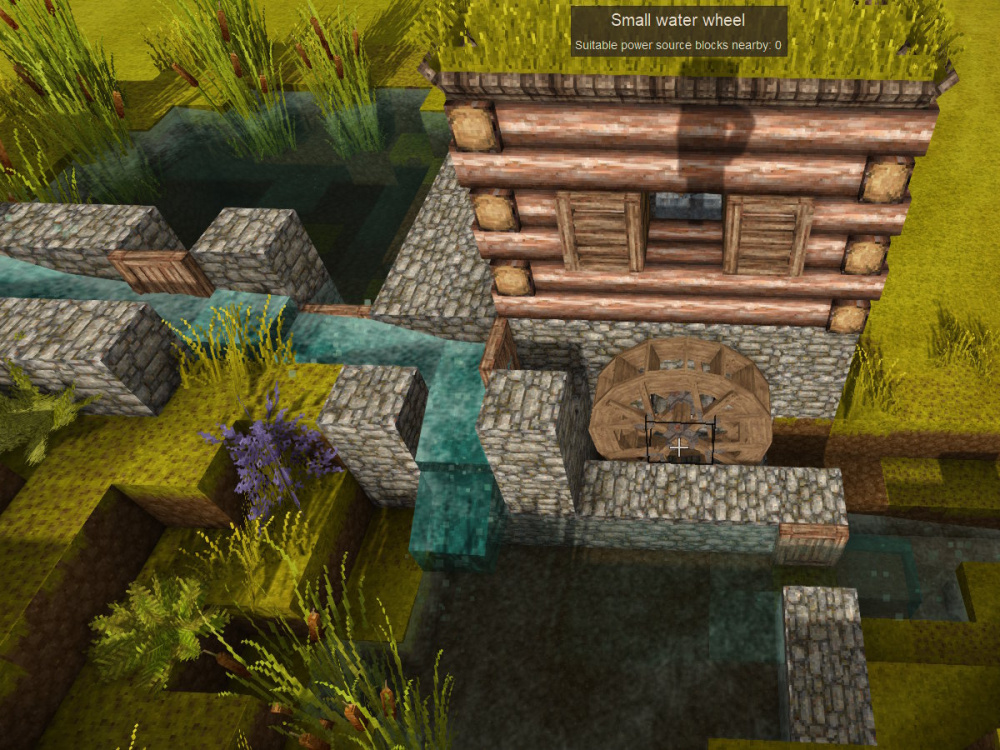
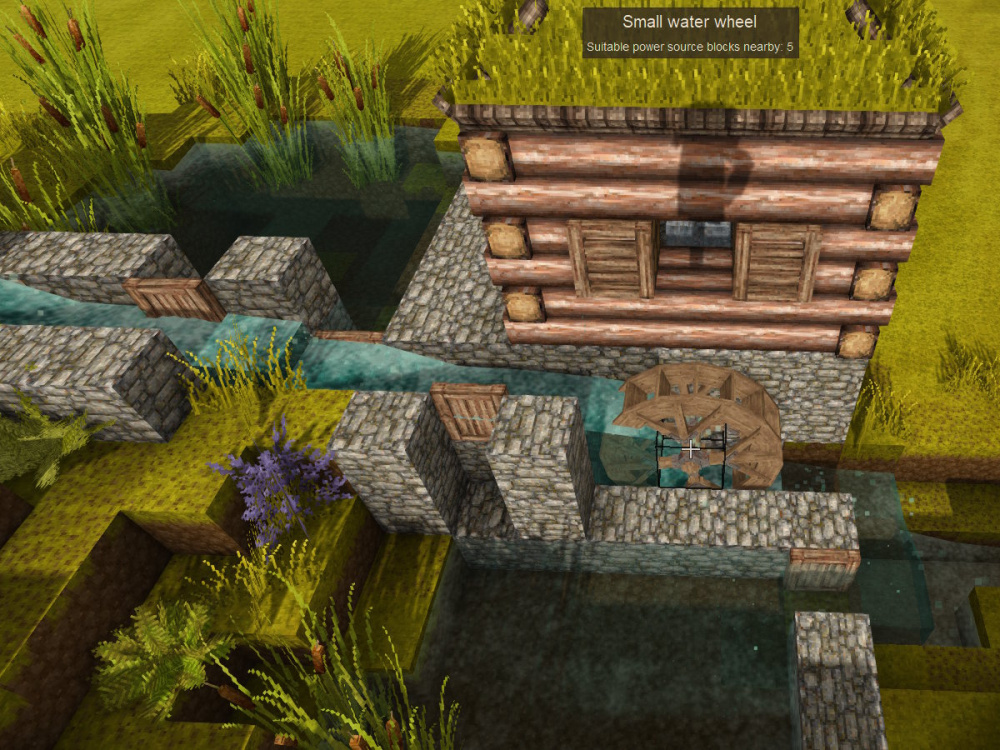
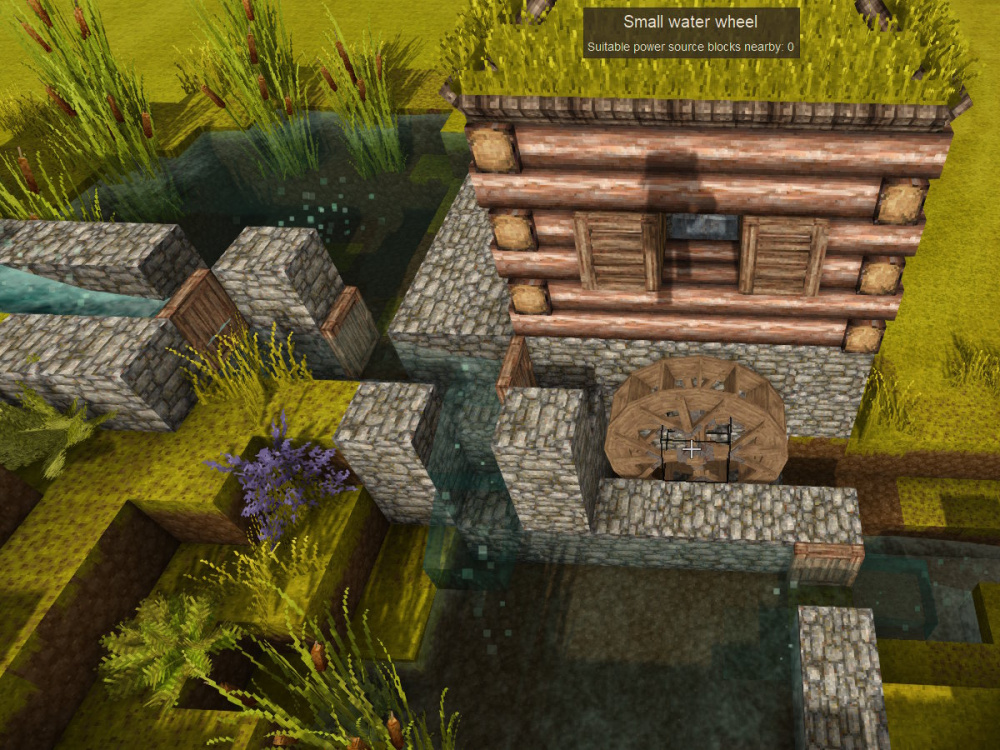
Maybe you have already found, but just in case, there is easy method to change direction of rapids or stop it: using full trapdoors working as sluices above a waterwheel. As the most primitive method, you may simply stop the water from flowing, replacing brake or clutch in early game by single trapdoor (and also sparing self of noise of the flowing water or of the waterwheel itself when not necessary, if you feel it annoying). If you want to be more fancy, you may make setup pretending that the rapids are filling a water reservoir above the waterwheel, or just go around the waterwheel by secondary trough. ( Made video on Tumblr too: https://www.tumblr.com/vrataf/816527092107902977/using-trapdoors-to-redirect-water-flow-and-to-turn )
- 7 replies
-
- 21
-
-

-
-
In general, new worldgen (rapids, berry bushes, dungeons) will activate in unexplored areas. Not sure about fish. In already explored areas, you may try to replace standard streams by rapids in creative, I'd not consider this a big cheating. You may also try to regenerate chunks (at least these that were not touched) or prune the world for untouched areas to be generated again, but this may be risky and create terrain walls on border chunks, especially if using worldgen mods. So to make a backup the world is necessary. (I have bad beginner's experience with regen when upgrading to 1.21 with red clay came and I was so eager to generate red clay deposits that I run to it without making backup, forgetting I use Plains and Valleys mod, so I created really ugly chunk walls quite nearby my base. Then I spent hours in creative by masking them as natural cliffs .)


