Bruno Willis
-
Posts
364 -
Joined
-
Last visited
Content Type
Profiles
Forums
Blogs
News
Store
Everything posted by Bruno Willis
-
 I would lock shutters behind saws. Door bars would have to be early game though. I'd say they could have a variety of different versions - Crude bars made with logs horizontally and a stone axe, which could bar any door, even a crude door. They'd have a durability, probably pretty high considering the resource cost, but when broken, would simply disappear. Milled bars, made with a single support beam and 2 nails/strips. They'd have a lower durability, but be able to be repaired by right-clicking a support beam into the bar housing. Metal lock, made with an iron bar and 2 iron nails/strips (or steel). They'd have no durability bar, and be permanent protection. When a drifter reached a door, it would have a small chance to try the door, like a 5% chance? Each time a drifter tried the door, it would nock 1 durability off the bar on the door, or open the door if it were unbarred (or destroy the door, if it were a crude door). That way having a bar on your door would feel like really good protection, as long as you remembered to use it, but it would still gradually wear down. I think that'd be fun game-play, personally.
 -
I actually love this idea, I've asked for it before. The way I'd get around it being a total nuisance is by adding "storm shutters" to the game. They'd be heavy wooden shutters which could be fastened outside, over windows (ideally you'd be able to slide your window open and close the shutters from inside). If there were shutters, then I'd say stones and bone arrows would break any sort of glass window, unless it were covered. It would be nice to have dedicated shutters anyway, and it would make the lore about the horrors line up with player experience. Think of how fun it would be, running around as the storm hits, closing all the shutters, and then you pause, rest in your safe little kitchen, have a bite to eat. There's a smashing sound from the room above. "Did I forget to close the bedroom shutters?" you think to yourself. Then the drifters start pouring in. I'd also love it if some drifters could open doors unless they were "bared." (a dedicated lock from the inside, which would look really cool/make lots of lore sense). That way if the drifters broke a window and got in, they might be able to open doors to get to you. Real horror. Ideally, shivers would also be able to climb, and squeeze, slowly, horribly, through one block wide gaps. That'd add some extra disgustingness to them, which I'm sure they'd love.
-
This looks sick! I don't know if you are drawing with a mouse, but if you are, that's the hardest way to draw. Good on you.
-
I personally hate seeing anything AI, it makes me feel sad, uncomfortable and slightly disgusted. That being said, I am currently using a mod which has an AI thumbnail. I'm a decent artist, and I should probably design them something. I'm sure there are plenty of us out here who can make good images, and it would be a lot easier for me if the mod creator said on their mod "Looking for thumbnail art - please send us something"
-
I'd quite like to see a dubious looking almanac with temporal storm predictions, suggestions to plant different crops at different dates, eclipse predictions, etc. Some of the predictions would be slightly off, but only by a day or two at worst. You'd be given one for free which would last you your first year, after that you'd want to buy one. And they would come from somewhere! Somewhere in the world there would be a room with a mechanical wood-block printing press and a little scholar with some Jonas tech devices and a telescope, writing out their predictions and sending them into the world via the merchants.
-
I wish I could be... When I started playing, I was very cautious around bowtorns, even after I killed them. The sight of that spikey rib-cage body slowly toppling towards me was a serious worry, but they're actually perfectly harmless once dead. What! If I'm stupid enough to stand under a bowtorn as it keels over and dies, I want to feel the pain of two or three metal and bone bow-limbs stabbing into me. The suggestion in plain language: When a bowtorn dies it should damage anything its corpse falls on. Cause it looks like it would hurt if it fell on you.
-
A General Discussion on the State of the Forums
Bruno Willis replied to Teh Pizza Lady's topic in Discussion
I was so surprised when I got onto the forums and realised some of the old guard hated the bowtorns. They'd only just been added, and I'd never experienced the game without them. I thought (and still think) the bowtorn are sick. So I guess, enjoy the game as it existed, but remember that newcomers only know the game as it exists right now, and their questions, complaints, and suggestions are going to come from that. It's not their fault. Actually, I think it's a very valuable way to see how the game reads without prior knowledge. -
This would be a lovely addition. It looked to me (on the recent V.S. video showcasing sharpening) that the Devs are working on moss at the moment. I'd love to see mossy patches on the underside of cliffs, dripping water which can be collected. That'd be very atmospheric.
-
With the addition of rapids, it seems like V.S. is taking another step away from using the water mechanics from the other block game. That's great, because TOBG's water makes no sense and doesn't look good. There are lots of other ways V.S. might change water to improve it. Waterfalls: At the moment, when water falls, it remains a full block of blue liquid, which looks nothing like a real waterfall. Characters can swim up it too. I would love to see waterfalls changed so that when water drops it gets a different texture, becoming white water, and turning to mist if it falls more than 10 blocks. If possible, it would be nice if falling water could fall in a sheet, rather than as a full block of liquid. It'd be lovely if when falling water hit a solid block at the end of its fall it produced a dramatic water splashing animation too. On top of that, I don't think the swimming up waterfalls mechanic needs to stay. It's not really that useful, and it seems like an emersion breaking hold-over from TOBG, rather than anything realistic or uncompromising. Swimming in Armor: At the moment there is no difference between swimming without any clothing and armor and swimming in full plate armor. There is no risk of drowning if you fall into water on accident. Water is not dangerous. I would like it if different sorts of armor restricted swimming in different ways. Textile armors would weigh you down but not prevent you rising to the surface, while chain and scale would make swimming back to the surface hard. Swimming in plate armor would not allow you to rise at all, except stepping up blocks (so you could walk along the bottom and make your way to the surface that way. I would like it if wearing bags and baskets restricted swimming in a similar way too. I know that would restrict underwater exploration, but now that we will be able to put down bags and access things inside them, I think it'd feel fine. You'd take your armor off, put it in your bags, and leave most of your bags on the shore when you dive. It would be interesting if currents and waves could be used to dunk characters under, making drowning more of a possibility. Water's edge: At the moment if you disrupt water sources by breaking a block, they will stay flowing endlessly, even if the body of water is massive, and the area it is trying to fill is a single block. I would like to see some way for these sorts of weird flowing water spots to heal naturally. They don't look good, and don't make much sense. When it rains, could the game check flowing water blocks, and if they're surrounded on all sides and on the bottom by either solid blocks, or water, replace the flowing water with a source block?
-
I use https://mods.vintagestory.at/stickydirt and I really really recommend it. It ties soil instability to the plants growing on it (the idea is their roots make the soil more stable).
-
I love that these meadows would form naturally via normal interactions. It'd feel so good to gradually see grassland change into a meadow as you mow it for hay each year. It might be good for artificial meadows to have a way to regress back into a wild state too though.
-
A General Discussion on the State of the Forums
Bruno Willis replied to Teh Pizza Lady's topic in Discussion
I've never used online forums before this, but I've heard rumors so I expected a level of conflict that's just never come up here. I felt really welcomed, and while I've witnessed a few arguments which got silly, I've always felt I could just post elsewhere. Things like the "humorous stories" thread help keep the forums feeling welcoming and cheerful. For the third pole I put "other", because I think arguments do occasionally devolve and get less than respectful still stay contained to V.S. things, and get personal only about people's positions on V.S., not on any outside life things. Most of the time, arguments seem to be between people who really care about V.S. and want it to be better, but have different ideas about what would improve the game. As long as we keep that in mind, that when people get passionate, it's cause they both really want V.S. to be better, then hopefully we can be understanding? Whenever something gets a bit intense, I always remember that there are quiet people who are interested in some of the less contentious aspects, and you can pull those things out and start a new, less contentious thread focused on one very specific thing. It seems like we get the most arguments when people are talking about big, overarching concepts and systems. Small, specific ideas seem to draw in people who are interested in workshopping the idea rather than criticizing. -
How to make traveling an empty world enjoyable
Bruno Willis replied to Bruno Willis's topic in Discussion
Thanks for the reminder about the cold vulnerability slider, I'll use that. This is definitely off topic now, but how about if the air timer for swimming stayed the same, but if you were wearing armor you got a little red tag saying "armor weighs you down" and were unable to rise (spacebar wouldn't let you rise to the surface). Perhaps the same could be said if you're carrying more than one bag, now that bags can easily be placed down? That way you might fall into water, realise you're too heavy to get out, and take your armor off, place your bags on the riverbed, and kick for the surface, then do a couple of rescue dives to retrieve your bags one by one. It'd make falling into water while unprepared a threat, but it wouldn't restrict exploring underwater much at all. -
I'd love to see a practical use for the planter pots in game already. It would be really cute to plant seeds in the planters (like 6 seeds per planter) and then remove them once they hit the first growth stage and re-plant them in your garden. If you just let them keep growing, one would dominate and you'd end up with a single crop even if you left all six seedlings in.
-
That's an excellent idea. It'd still need to be able to be placed on a farm plot with plants growing on it, but that'd be a nice change to ladders anyway. Maybe it would only work with the crude ladders (made with sticks).
-
How to make traveling an empty world enjoyable
Bruno Willis replied to Bruno Willis's topic in Discussion
Bit of a side note, but with the drowning, I really think environmental effects are pretty toothless in V.S. In NZ, there are no dangerous animals, but people still die in the wilderness because of how bad exposure is. In V.S. we get really really cold, and then eventually, eventually, we take a small amount of damage. Same with swimming, it's a crazy long air bar before we take any damage, which is neat, except that it removes the risk of drowning almost entirely. If you couldn't swim up while wearing armor, that'd be really interesting. Imagine seeing a nice flat bit of grass to make camp as you're traveling through the swamp, only to step onto it and find it's a layer of pond-scum over a deep pool, and now you're desperately pulling your armor off so that you can swim back to the surface before you drown.- 8 replies
-
- 1
-

-
- travel
- terrain generation
- (and 1 more)
-
Suggestions from an Athropology/Archaeology student.
Bruno Willis replied to Alexzandr's topic in Suggestions
It always seemed odd to me that you get the same amount of dried grass from a "very short" grass growth as you do from "tall grass." There's a whole set of different heights of grass, why not give more dry grass the taller the grass growth? -
I love the idea of trellis and frames for vines. It could be a two-tall block of sticks, which if placed free-standing on farm plot, would make a 2 tall cone of sticks, and if placed against a wall, would form a leaning frame, again 2 tall. Placing a trellis would work in a similar way to placing fertiliser, in that it could be placed on farm land, even with growing plants on it. I'd love it if an unoccupied trellis would work like a tool rack, and even an occupied one could have have sheer, or a knife, or a reed basket or watering can hung from the side. Trellises and tomatoes would add so much to the look of our gardens.
-
Some people find traveling in V.S. boring. I find it frustrating sometimes myself, especially if I die far from home, or see repeating areas of forest, then hills, then forested hills, etc. I do not think adding more ruins or villages, or any sort of structure, is the right way to add excitement to travel, they would just make the world feel weirdly busy. Everyone wants to see rivers added, and I think they're a really good way to improve travel, and we can learn from them to find other ways to improve travel. Rivers, if done well, can be 1: a barrier to travel, 2: an aid to travel, and 3: a landmark. A person might need to find a wide part of the river to ford it, or a narrow part to bridge it, or they might use a boat to row up or down it, depending on their intended direction. Finding a river makes travel more interesting because it adds a large-scale challenge, which can be turned into a powerful, travel related reward which helps add a sense of narrative to travel. Drawing from that, I think travel would be really improved by building challenges to travel into world gen., which have interesting solutions. Think about stories where travel is a key component. A mountain range becomes a serious barrier, and a pass or tunnel through it becomes a huge reward if found. A swamp becomes a terrible threat, unless one knows a safe way through. It seems like making rivers work will require a serious re-working of the world gen. system. I would love to see, alongside rivers: a system to produce good long mountain chains, which generate with exciting-to-find passes cutting through them. a system to produce swampy regions with sinking mud potential, and with safe paths through, which can be marked bit by bit, using trial and error. a system to produce rocky reefs and regions of stormy seas, with safe, deep channels threading through them. To make those challenges more interesting, I think we'd need to add: avalanches (as purely snow related mechanic separate from the messy sideways stability soil mechanic), some sort of challenging mud or deceptive pond scum, and faster drowning? (because drowning really doesn't feel like a serious threat at the moment), and the possibility for boats to take damage on collision (perhaps only during storms).
- 8 replies
-
- 11
-
-
- travel
- terrain generation
- (and 1 more)
-
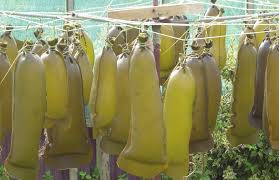
Big kelp grows in cold areas, and it's really useful for making carry bags:
-
Corvids would really suit the V.S. tone. The tropical version could be parrots, since they can be similar sized, and are also smart and curious and can learn to talk.
-
Hunting Needs to be Changed, Bows Especially.
Bruno Willis replied to OrangFriut's topic in Suggestions
From my experience, I shot a deer in the head and it ran a good 40 meters before sitting down, still alive (it was a very distressing hunting experience), and I shot a deer above the heart, in that artery dense area, and it dropped immediately and rolled down the hill, dead (a much better hunting experience). As a hunter, the current hunting experience in VS is a bit stressful, because you really don't want to be wounding an animal, but not killing it. Once I've hit an animal in V.S. I chase it all over the place and try to finish it off, because it seems cruel to leave it mortally wounded. I know that's not how animal health works at the moment, but that's how it comes across to me. I think these are good points: I'd love to see animals have a state between "calmly doing their thing" and "fleeing madly". Imagine if deer could hear you move through bushes, and would perk up, get alert, heads up, ears twitching, and they'd move off slowly towards denser forest. If you made another noise, then they'd bolt. I also think taking wind direction into animal's senses could be really cool. In real life, wind carries smell and sound, so if you're up wind of an animal, it will become aware of you quickly and move slowly out of the area. If you get downwind though, they can't really hear you that well, you can push through bush and move a bit faster without them noticing, and you can usually get into a better position. Obviously this would be a way cooler mechanic if wind direction could change in V.S. but I still think it could be cool. You'd think about terrain in a different way when hunting than when traveling, and you might feel more confident hunting when the wind was up a little. Actually, maybe decent winds should make projectiles less accurate, and animals keener to settle into sheltered spots. -
I'd like to see geese in the sky signaling seasonal changes, and little birds singing around ripe fruit trees and berry bushes, and falcons circling above corpses that haven't been harvested yet.
-
Hunting Needs to be Changed, Bows Especially.
Bruno Willis replied to OrangFriut's topic in Suggestions
To be a bit nit-picky, they really aren't. Compound bows are more about taking the weight off your arms when they hit full draw than about adding power, (although they can do do that), so that people can hold them at full draw for longer and aim in the way you aim with a gun. Traditional recurve bows can be outrageously powerful too, and just as accurate, but people usually draw, aim, and fire in one motion so they don't have to hold the weight very long. For aiming, it's like the difference between chucking a stone and using a slingshot. I'd say it's more likely that an animal drops dead / incapacitated, or you have to follow a blood trail for a long way. Hunters usually aim for an area around the heart rather than the head or spine, I think especially with arrows? I would say, I'm pretty sure medieval hunting arrows are really nasty, designed to work their way deeper as an animal runs, so there'd definitely be a blood trail, and probably a body at the end of it. Yes. I'd love a little instant kill box on all the game animals, which I've written about in this thread here: -
tempering Quenching-Tempering: Finding the best combination
Bruno Willis replied to Diregoldleaf's topic in Discussion
Much appreciated. I personally don't like the skill tree approach, I think it's better to design a system which is complex enough that players can actually develop player skills. I don't want to be told that my seraph is good at smithing now, I want to figure out how to respond to a poor tempering from previous experience. It's like smithing sheers - it feels really good when you learn how to make them from one ingot. I wouldn't want to be given that ability just because I'd smithed an arbitrary number of other items.