
IronOre
-
Posts
16 -
Joined
-
Last visited
Content Type
Profiles
Forums
Blogs
News
Store
Everything posted by IronOre
-
Latest Sky Astronomy Update Observations/Suggestions
IronOre replied to IronOre's topic in Suggestions
@Єгорія The way it is currently working (unless they changed it since I last looked) it wouldn't be very useful unless you just matched it up to the somewhat random pattern I outlined. It wasn't like it was just offset or anything, the correct behaviors were matched up in different ways with the wrong latitudes. What you could currently do is measure the shadow at midday and match it up to a table for different latitudes at each time of year, or also the angle/range of rising and setting positions on the horizon over the course of the year since those both are functioning in a more or less realistic way, but if you are working from scratch you'd have to get all the data together first (or like mentioned above if you had the variables you could do some math). That would yield decent functionality to an extent but might be unwieldy for some purposes. Still early navigators used all sorts of methods and it could all be fun! @EmperorPingu You are right if you mean that the axis of rotation is flat at 0 degrees along the horizon, with the points around which the axis rotates sitting directly north and south on the horizon from the point of view of the player. I was talking about the angle of rise/set for the stars. At the equator, if you look due east, the the stars in that direction will seem to rise straight up from the horizon, arc overhead, and set straight into the western horizon. As you look more toward the north or south those stars will seem to rise/set in a curve more and more around the north and south celestial poles, and every star will trace out a smaller and smaller half circle in the sky, spending half the time of the Earth's rotation above the horizon, and the other half below. -
Wow! You've really done your homework here. Lots of great ideas! I really like the idea of having the east/west position shift the sun according to local time. It would be amazing to use time keeping like you've outlined to determine longitude by the time offset just as they did in the real world once timekeeping technology was sufficiently advanced. Before that all they really had to work with was latitude. If I understood correctly, are you envisioning an option to keep the word generation to just one set of latitudes without repeating as you go north and south? I try to do that in my worlds currently but you have to start in a hot climate and the location is still randomized so there will be some overlap. I've always wanted a world generation game that wrapped the map so that it made some sense as a self-contained world at whatever scale. I've seen some test code for doing it for a voxel game that works in all directions, but I'd even be happy if the world just ended at the north and south pole edges and wrapped from east to west only. I searched a long time for a voxel game or a mod of Minecraft that had actual north/south climate effects and seasons, and one of the main reasons I started Vintage Story was after I heard that the sun actually changed position on the horizon according to the seasons. When I first saw that I was thrilled with the possibilities of using realistic skies to actual effect in the world (including navigation), but I was soon very confused by the stars and especially the moon. Still, I currently set my windows up so that then I open the menus the date and time are covered and I keep track of the year with sun rise/set horizon markers and counting stones. I also tell the approximate time of day with a mid-day shadow post with some measurement indicators on the ground for shadow length throughout the year. I love being able to look at the sun and orient myself just as I do in the real world. Here is a post I made on some of the basics we still need to see in the sky: If even that much can get started in a mod such as you are proposing, that alone would be an amazing start! I really do hope in the meantime that the devs get the stars working they way they'd planned. It seems like they had the right idea and that it would be an easy fix. With that I'd already be able to estimate my latitude even with no in-game tools. I don't know when the devs will move these things forward again. It seems they had some issue that required setting the moon back to a square but I think the phase is at least working more realistically. I really wish I had the skills to mod myself, there would be so many possibilities!
-
Not see the moon!? That is untenable! The previous moon was a bit of a mess, but it is greatly improved now and is giving me something much closer to the feeling I have in the real world when I watch the moon. I get what you are saying about the actuality of the flat plane and thee dimensional space of VS, but I am just so glad to have finally found a game that even attempts to simulate the sky in something that approximates how it works (I am really hoping they can get the stars fixed at the very least now). I spend so much time watching the real-world sky and studying the patterns that it is very familiar to me. I know what phase of the moon is current and can predict when it will rise in relation to the sun, I glance at the sun and shadows throughout the day and I am instantly oriented in time and space. When I play VS I can do many of the same things (I keep the date/time portion of that window covered by the stats window) and it all feels very natural. I love that!
-
Celestial Navigation (and primative cartography)
IronOre replied to EmperorPingu's topic in Suggestions
Yes I do plan to build one, but I'd rather use actual stone than cobble stone which is all I have access to right now, so in the meantime I put up logs as wooden posts. I also plan to build a passage tomb oriented on the winter solstice sunrise or somesuch. Your observations and instruments sound amazing. You should add some screenshots. -
Celestial Navigation (and primative cartography)
IronOre replied to EmperorPingu's topic in Suggestions
That is amazing and dedicated work you did to make your observations! I also made many in-depth observations since I've started playing. The movement of the sun on the horizon and its changing rise/set angle per latitude were one of the main reasons I was attracted to Vintage Story as I always wanted to play in a world where I could track time in the sky like the ancients. Archaeoastronomy is my scientific specialty. I even arrange my stats window to cover the date and the time. I set up horizon marker posts and watch shadows as well. I mark the sun on the meridian to see when I get to mid-day and it always keeps me oriented. I love the glass dome ideas, but I'm playing only in the stone age for now, so I have to keep things very primitive. Sadly even chiseling needs metal tools for some reason. I track the days by keeping a pile of stones in a reed chest with items representing winter, spring, summer, and fall. When the sun is setting due west at one of the equinoxes I start the count and transfer one stone from the pile toward the next section until they are all moved, them I'm at the solstice, repeat to the next equinox and the other solstice and then move back to the starting equinox. I too noticed the stars didn't change with latitude when I first started playing and the moon phases were very confusing since it wasn't illuminated by where it was positioned in relation tot he sun and always followed the exact same path in the sky instead of shifting along the ecliptic like the sun. When the release notes for the most recent update came out I was super excited and the moon changes are a great improvement. The stars now progress over the year (in the opposite direction as on Earth, but hey, maybe this planet is in a retrograde orbit) but although the update was planning to have the stars change appropriately to the change in latitude, it did not work, so hopefully that can get fixed. Here is a link to a post where I detailed what seems to be the current issue with the stars: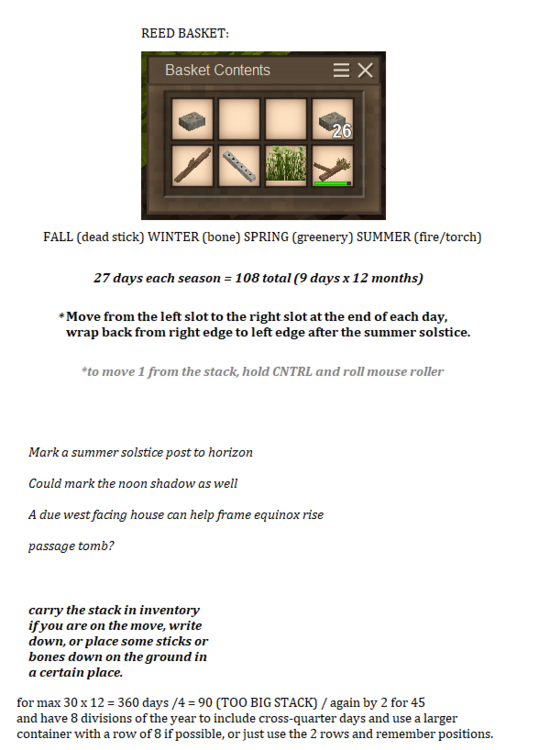
-
The most recent update has improved the astronomy greatly. The release notes planned to have the stars correctly rotated for latitude but unfortunately this is not working according to plan yet as far as I can tell. Once they get that fixed you really will be able to navigate by the stars per the OP. It will still not tell you exactly where you are in the world since it will render the same for the repeated latitude bands and if you lose track you won't know which one you are in. I usually set my worlds to avoid this by trying to spawn near the equator with a world size and polar distance that makes sure both poles end up on the map without too much more beyond that, but since the actual latitude of spawn is randomized I can't get it exact. It would be nice if they added a world generation option where you could set your polar distance, world size to match in both directions, and check a box that just put the equator exactly in the middle. Then once the star field rotation is corrected you'd have a single set of latitudes to always know where you are in the world relative to north/south with a simple measurement of the celestial pole altitude or the angle of the rising/setting stars. I also agree that some prominent polar stars would be ideal since the stars move slowly over the night making it hard to identify the celestial poles. I'd have a bright red star for the north celestial pole and a blue one for the south celestial pole (only visible from south of the equator). The star field is a bit busy, so it would be nice to have some brighter stars in some sort of more easily recognizable patterns to help orient oneself relative to the skies.
-
Celestial Navigation (and primative cartography)
IronOre replied to EmperorPingu's topic in Suggestions
I thought it was Earth but an alternate version of it? Either way after the catastrophe maybe the world was sucked through a worm-hole, captured by a different star, and either pulled in a new moon that was smaller (the moon and sun look about the same diameter as seen from Earth) or the original moon came with it but shifted out to a smaller orbit to appear smaller (and ended up orbiting in the ecliptic plane to greatly increase the frequency of annular eclipses). This would explain why the stars in our new location in space would look entirely different, but for navigation I wish they made some more prominent constellations with brighter stars to stand out from the fainter background which is very busy. At the very least for navigation I'd like a clear north and south polar star (maybe a red star for north and a blue one for south). The most recent update had a plan to tilt the stars appropriately for the latitude of the viewer and to have them shift around over the yearly cycle. The shift worked although it is going the opposite way they do on Earth, but that could be explained by a retrograde orbit relative to the direction the planet spins (again a possible effect from entering a new orbit). Stars working for the correct latitude is not working according to plan yet as far as I can tell. Once they get that fixed you really will be able to navigate by the stars per the OP. It will still not tell you exactly where you are in the world since it will render the same for the repeated latitude bands and if you lose track you won't know which one you are in. I usually set my worlds to avoid this by trying to spawn near the equator with a world size and polar distance that makes sure both poles end up on the map without too much more beyond that, but since the actual latitude of spawn is randomized I can't get it exact. It would be nice if they added a world generation option where you could set your polar distance, world size to match in both directions, and check a box that just put the equator exactly in the middle. Then once the star field rotation is corrected you'd have a single set of latitudes to always know where you are in the world relative to north/south with a simple measurement of the celestial pole altitude or the angle of the rising/setting stars. -
Yeah, that would probably be more straightforward and you could set it to have just one band of latitude from the north pole to the south pole, which in this case would wrap to each other. Still I think it wouldn't be too much harder to do it like the article showed. Then you could really navigate by the stars once they get that fixed. It was on the plan for the most recent update but it isn't working yet. It would be nice to known where you were on a finite world without getting to repeated latitudes. Even without map I usually set my worlds to avoid this by trying to spawn near the equator with a world size and polar distance that makes sure both poles end up on the map without too much more beyond that, but since the actual latitude of spawn is randomized I can't get it exact. I was thinking about those 8 empty spaces the demos in the article show for where 3 corners come together. Maybe those would have to be hard barriers you couldn't traverse, or they could just be voids rendered as sheer rocky walls with lava pouring into them from various fissures and if you jump in it just displays you falling for a while and then you die. It is interesting that in this case, even if a mini-map is used it doesn't always have to have north at the top (there could even be an option to rotate your map) so that the player could get a bit turned around, or if it auto-rotated to the way you are facing. Then you'd have to use the sky to know the actual direction, or use a compass. Per the OP it is great to see that the moon phases are now correct in relation to the sun since the latest update. I haven't yet taken the time to figure out the current eclipse pattern, but I plan to.
-
What if it actually was a wrapped cuboid that you could walk all the way around instead of a plane stretching out in all directions until a drop off edge? I'd love to see a voxel game try this sometime. I found an interesting article on it with some test windows you can play around in: https://www.redblobgames.com/x/1938-square-tiling-of-sphere/ https://www.redblobgames.com/x/1939-planetary-dungeon/
-
Ah, I see. Well in that case I'd love it since I am quite familiar with the constellations as seen from Earth. I'd be able to read the sky like a map! Perhaps in all the cataclysmic events the Earth was thrown from its orbit or sucked through a worm-hole and captured around a different sun. It must have entered a retrograde orbit because with the new astronomy update the stars do progress through the seasons but in the opposite direction (but there still seems to be an issue with the star field tilting correctly according to latitude). Maybe in its new orbit the Earth captured this smaller moon we see or the original moon came with it and moved further away (the actual moon appears roughly the same diameter as the sun in the sky). At any rate the moon is now orbiting fully in the ecliptic plane so that we get eclipses more regularly in a way that doesn't quite match reality, but I'm going to determine if there is a regular pattern with the new update so I can track/predict eclipse occurrences.
-
Astronomy is my scientific specialty, and the changing rise/set angle of the sun and movement along the horizon was one the the main reasons I was attracted to Vintage Story. Needless to say, When I first started playing I conducted an in-depth astronomical analysis and confirmed the EXCELLENT behavior of the sun, but of course I was quite confused by the moon and stars before the recent update. Previously the moon was rising the west and setting to the east and while that would be possible if the moon was moving VERY fast relative to the spinning of the earth, the illumination of the phases made no sense. It also always used to rise/set at the same place on the horizon no matter the latitude at a position just south of due E/W. The stars used to be globally static for a slight southern hemisphere location where they would rise in east slightly up and to the left, set in west slightly down and to the left. The celestial poles were always near the north/south horizons with South Celestial Pole a bit above the horizon and the North Celestial Pole a bit below the horizon. At the time the stars would rotate once per day to always come back to the same midnight configuration. When I saw the release notes for the v1.21.0-pre.1 - Story Chapter 2 Redux update, I was very excited to see the following: Moon and stars position now closer to a real astronomical simulation Moon phase now consistently correct Rendered moon orients itself so that the lit side precisely faces the sun current position Moon phase is correct based on relative moon and sun positions Moon apparent path through the sky is now close to the ecliptic Night-time star field rotates appropriately for the current latitude Night-time star field varies over the calendar year according to the seasons / zodiac* MOON Everything I was hoping for was addressed in the update. I was over the moon (pardon the pun)! When I got the update I went in to make new observations and I was so happy to see all the things mentioned for the moon working. I thought it might look a little better if the moon phase shadow would curve a bit to show a crescent phase instead of a straight line, but that is a minor issue and one I could totally live with in a voxel world. I want to be clear that I am thrilled with all the work put into this and to give a big thank you to all those involved. I just wanted to make this post to say that, and to suggest a few tweaks for the future, and I'm happy to help in any way that I can. I study this stuff so it is a lot of fun for me! STARS The main thing that didn't match the update plan was for the star field to rotate appropriately according to latitude, and I was very confused when I got in and made my initial observations. While the stars now do shift through the seasons as the update planned (*though they might be going the wrong direction unless this planet is in a retrograde orbit relative to the direction it spins), there seems to be an issue with rotating the star field correctly for the latitude. For almost all latitudes they are still rising up and to the right as you look eastward and this only changes after around 66 S (when this should be more and more vertical as you approach the equator where they should rise and set straight up and down (perpendicular to the horizon), and then start to rise up and to the left at steeper and steeper angles as you look eastward for all the southern latitudes until moving parallel to the horizon at the poles. Currently at the north pole (90 N) the stars should be rotating with the center position (north celestial pole) directly overhead and the stars near the horizon going around the horizon without rising or setting. Strangely the only place this happens is around 66 S. At the equator (0) the stars should be rising and setting straight up and down perpendicular to the horizon. Strangely this is occurring at around latitude 23 N. At the south pole (90 S) the stars should be rotating with the center position (south celestial pole) directly overhead and the stars near the horizon going around the horizon without rising or setting. Again, strangely the only place this happens is around 66 S. I think what is happening is that the sky is not spinning around a fixed point but the actual center points (celestial poles) are shifting, but not quite to a pattern I can determine. To fix this all that would be needed is to spin the star sphere such that just 2 points seem fixed (north and south celestial poles) and then tilt the star sphere according to latitude just as is done with the sun. This would shift the north celestial pole from directly above at the north pole (90 N) which would drop to the northern horizon at the equator (0) where the south celestial pole would start to be visible on the southern horizon. From there the north celestial pole would drop below the horizon, and the south celestial pole would start to be higher and higher above the horizon until it was directly above at the south pole (90 S). In other words, the stars should rise and set at the same angle as the sun for all latitudes. My only other suggestion would be to have slightly more exaggerated/recognizable constellations (not real ones, but something cool) as the star field is very busy and nothing really stands out. There could still be a lot of fainter stars, but some bright ones to form various patterns could contrast with the fainter background stars. Barring that, at the very least it would be nice to have very clear (large/bright) polar stars, maybe a red one for the north pole and a blue one for the south to help pick them out for visually checking latitude at night.
-
Astronomy is my scientific specialty! The changing rise/set angle of the sun and movement along the horizon was one the the main reasons I was attracted to Vintage Story. Needless to say, When I first started I conducted an in-depth astronomical analysis and confirmed the EXCELLENT behavior of the sun, but of course I was quite confused by the moon and stars. Previously the moon was rising the west and setting to the east and while that would be possible if the moon was moving VERY fast relative to the spinning of the earth, the illumination of the phases made no sense. It also always used to rise/set at the same place on the horizon no matter the latitude at a position just south of due E/W. The stars used to be globally static for a slight southern hemisphere location where they would rise in east slightly up and to the left (N), set in west slightly down and to the left (S). The celestial poles were always near the N/S horizons with SCP pole a bit above the horizon and NCP a bit below the horizon. At the time the stars would rotate once per day to always come back to the same midnight configuration. When I first hear about the new update (v1.21.0-pre.1 - Story Chapter 2 Redux) I was very excited when I saw this in the notes: Moon and stars position now closer to a real astronomical simulation Moon phase now consistently correct Rendered moon orients itself so that the lit side precisely faces the sun current position Moon phase is correct based on relative moon and sun positions Moon apparent path through the sky is now close to the ecliptic Night-time star field rotates appropriately for the current latitude Night-time star field varies over the calendar year according to the seasons / zodiac MOON Everything I was thinking would be addressed. I was over the moon (pardon the pun). When I got the update I went in to make new observations. I was so happy to see all the things mentioned for the moon working. I thought it might look a little better if the moon phase shadow would curve a bit to show a crescent phase instead of a straight line, but that is a minor issue and one I could totally live with in a voxel world. STARS However, the stars are still not working correctly and are very confusing. They do shift through the seasons as the update planned, BUT they are not rotating correctly for the latitude. For almost all latitudes they are still rising up and to the right (south) as you look eastward and this only changes after around 66 S (when this should be more and more vertical as you approach the equator, and then start to rise up and to the left (north) as you look eastward for all the southern latitudes. At the north pole (90 N) the stars should be rotating with the center position (north celestial pole) directly overhead and the stars near the horizon going around the horizon without rising or setting. Strangely the only place this happens is around 66 S. At the equator (0) the stars should be rising and setting straight up and down perpendicular to the horizon. Strangely this is occurring at around latitude 23 N. At the south pole (90 S) the stars should be rotating with the center position (south celestial pole) directly overhead and the stars near the horizon going around the horizon without rising or setting. Again, strangely the only place this happens is around 66 S. I think what is happening is that the sky is not spinning around a fixed point but the actual center points (celestial poles) are shifting, but not quite to a pattern I can determine. To fix this all that would be needed is to spin the star sphere such that just 2 points seem fixed (north and south celestial poles) and then tilt the star sphere according to latitude just as is done with the sun. This would shift the north celestial pole from directly above at the north pole (90 N) which would drop to the northern horizon at the equator (0) where the south celestial pole would start to be visible on the southern horizon. From there the north celestial pole would drop below the horizon, and the south celestial pole would start to be higher and higher above the horizon until it was directly above at the south pole (90 S). In other words, the stars should rise and set at the same angle as the sun for all latitudes. My only other suggestion would be to have slightly more exaggerated/recognizable constellations (not real ones, but something cool) as the star field is very busy and nothing really stands out. Barring that, at the very least it would be nice to have very clear (large/bright) polar stars, maybe a red one for the north pole and a blue one for the south to help pick them out for visually checking latitude at night. I started a discussion on this in the suggestion forum:
- 74 replies
-
- 10
-

-

-

-

-

-
Astronomy is my scientific specialty! The changing rise/set angle of the sun and movement along the horizon was one the the main reasons I was attracted to Vintage Story. Needless to say, I conducted an in-depth astronomical analysis and confirmed the EXCELLENT behavior of the sun, but of course I was quite confused by the moon and stars. I put up pillars to track the position of the sun on the horizon and to measure its height in the sky at midday. I also used piles of stones in baskets to keep day counts as I arranged the windows such that the actual date was covered by the character equipment window so when I press C it never shows me the date or time. I count out 4 divisions of the year from the equinox when the sun is setting due east/west through the winter solstice, the other equinox, and the summer solstice, and back to equinox again. Lots of fun. The moon was a bit messed up at the time, but has been greatly improved in the latest update. The update notes stated the intention to get the star field rotating correctly as well, but it still has some major issues, but I'm confident it will get fixed eventually. Then you could navigate by the stars as the celestial poles would be higher and lower on the horizon based on latitude. I do kind of wish the star field wasn't so busy but had more recognizable patterns, not necessarily the real constellations but something cool that would stand out with very bright stars in addition to all the little stars. These constellations could be might fit with the lore of the world!
-
Astronomy is my scientific specialty! The changing rise/set angle of the sun and movement along the horizon was one the the main reasons I was attracted to Vintage Story. Needless to say, I conducted an in-depth astronomical analysis and confirmed the EXCELLENT behavior of the sun, but of course I was quite confused by the moon and stars. The moon was rising the west and setting to the east and while that would be possible if the moon was moving VERY fast relative to the spinning of the earth, the illumination of the phases made no sense. It also always used to rise/set at the same place on the horizon no matter the latitude at a position just south of due E/W. The stars used to be globally static for a slight southern hemisphere location where they would rise in east slightly up and to the left (N), set in west slightly down and to the left (S). The celestial poles were always near the N/S horizons with SCP pole a bit above the horizon and NCP a bit below the horizon. At the time the stars would rotate once per day to always come back to the same midnight configuration. When I saw the reply to this thread in the previous message about the recent update (v1.21.0-pre.1 - Story Chapter 2 Redux) I was very excited when I saw this in the notes: Moon and stars position now closer to a real astronomical simulation Moon phase now consistently correct Rendered moon orients itself so that the lit side precisely faces the sun current position Moon phase is correct based on relative moon and sun positions Moon apparent path through the sky is now close to the ecliptic Night-time star field rotates appropriately for the current latitude Night-time star field varies over the calendar year according to the seasons / zodiac MOON Everything I was thinking would be addressed. I was over the moon (pardon the pun). When I got the update I went in to make new observations. I was so happy to see all the things mentioned for the moon working. I thought it might look a little better if the moon phase shadow would curve a bit to show a crescent phase instead of a straight line, but that is a minor issue and one I could totally live with in a voxel world. STARS However, the stars are still not working correctly and are very confusing. They do shift through the seasons as the update planned, BUT they are not rotating correctly for the latitude. For almost all latitudes they are still rising up and to the right (south) as you look eastward and this only changes after around 66 S (when this should be more and more vertical as you approach the equator, and then start to rise up and to the left (north) as you look eastward for all the southern latitudes. At the north pole (90 N) the stars should be rotating with the center position (north celestial pole) directly overhead and the stars near the horizon going around the horizon without rising or setting. Strangely the only place this happens is around 66 S. At the equator (0) the stars should be rising and setting straight up and down perpendicular to the horizon. Strangely this is occurring at around latitude 23 N. At the south pole (90 S) the stars should be rotating with the center position (south celestial pole) directly overhead and the stars near the horizon going around the horizon without rising or setting. Again, strangely the only place this happens is around 66 S. I think what is happening is that the sky is not spinning around a fixed point but the actual center points (celestial poles) are shifting, but not quite to a pattern I can determine. To fix this all that would be needed is to spin the star sphere such that just 2 points seem fixed (north and south celestial poles) and then tilt the star sphere according to latitude just as is done with the sun. This would shift the north celestial pole from directly above at the north pole (90 N) which would drop to the northern horizon at the equator (0) where the south celestial pole would start to be visible on the southern horizon. From there the north celestial pole would drop below the horizon, and the south celestial pole would start to be higher and higher above the horizon until it was directly above at the south pole (90 S). My only other suggestion would be to have slightly more exaggerated/recognizable constellations (not real ones, but something cool) as the star field is very busy and nothing really stands out. Barring that, at the very least it would be nice to have very clear (large/bright) polar stars, maybe a red one for the north pole and a blue one for the south to help pick them out for visually checking latitude at night.