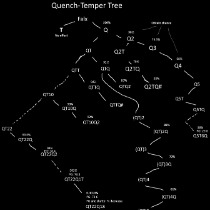
Diregoldleaf Posted February 23 Report Posted February 23 (edited) So I made a mini tree for quench-temper combinations. At the moment tempering is broken, but when it is fixed, we can mathematically calculate the best possible combination to get to a certain part of the tree. PS, yes in the handbooks says you can only go linear quench-temper-quench etc, but either they lied, it's bugged (thus I wasted my time), or they changed it in a pre release. Either way, this tree mechanic is WAY more fun than the boring linear thing. I've done some testing across the tree and I've got into the ballpark of what the shatter-chance and power-gain curves look like. Shatter chance is linear (gradient is 5), but for power-gain I highly suspect it isn't a single function, but multiple, and, using regression, I was only able to plot it semi-accurately to a quartic function. Different curves for different routes through the quench-temper tree. As for tempering, it looks like an exponential curve, though I couldn't match it completely. Green function is the power gain; red is the shatter chance. At the moment tempering is useless, broken, and harmful I made a post on it on discord, hope the devs see it. I put everything into tables. Here's some common obtainability chances after quenching a toolhead a certain number of times. Notice at 18 quenches in the far right table, the shatter chance and power gain drop, almost like a tempering mechanic. Not sure if this is intended but it fits into the quartic curve well. At 0.004% obtainability though, no one will ever have to worry about that (you've have to go through 250,000 tool heads) Plotting it on a graph shows us how unobtainable certain quench numbers are. We can use this to calculate how many toolheads we'd need to get to a certain obtainability. For example, if I want to do 6 quenches (and get 40% power gain), it is ~55% obtainability, meaning I'd need 1/.55 ~= 2 toolheads. We can also do this backwards. If I have 10 toolheads to sacrifice, how many quenches would I be able to get probabilistically? 1/10 means I'd need at least 10% cumulative shatter chance, and we can see about 11% gives us 10 quenches. 9 tools shatter, 1 remains, giving us ~58% power gain. And finally, the chart for how many toolheads you'd need for different number of quenches (Q#, no tempering). Please devs show me the functions you used for shatter chance, power gain etc. I spent too long on this If I'm able to get the exact functions, I will use it to write a python code that gives you the best possible path to get to a certain part of the tree. Some changes I would make to the system -Return metal from shattered toolheads -Allow removal of toolhead from tool to allow re-quenching. This would make the whole system more dynamic. Edited February 23 by Diregoldleaf 1
MKMoose Posted February 23 Report Posted February 23 27 minutes ago, Diregoldleaf said: PS, yes in the handbooks says you can only go linear quench-temper-quench etc, but either they lied, it's bugged (thus I wasted my time), or they changed it in a pre release. It literally doesn't say this, unless it's grossly mistranslated in whatever language you might be using. 6 minutes ago, Diregoldleaf said: Please devs show me the functions you used for shatter chance, power gain etc. They can be found based on the code for the Quenchable behavior, most notably the applyTemperedStats() and applyQuenchedStats() functions. Though those are quite likely to still change if the current balance is deemed unsatisfactory. As I see it, the maximum buffs obtainable through quenching are way too high. It's supposed to improve the tool, but the likes of 50% power gains are borderline absurd. I would much rather take a more skill-based mechanic with a lower but more consistent ceiling. 3
Diregoldleaf Posted February 23 Author Report Posted February 23 3 minutes ago, MKMoose said: It literally doesn't say this, unless it's grossly mistranslated in whatever language you might be using. Did you read it with your eyes closed, or your mind 5 minutes ago, MKMoose said: They can be found based on the code for the Quenchable behavior, most notably the applyTemperedStats() and applyQuenchedStats() functions. Though those are quite likely to still change if the current balance is deemed unsatisfactory. Thank you so much, I will look into this 7 minutes ago, MKMoose said: As I see it, the maximum buffs obtainable through quenching are way too high. It's supposed to improve the tool, but the likes of 50% power gains are borderline absurd. I would much rather take a more skill-based mechanic with a lower but more consistent ceiling. I haven't played it in survival so I'm only talking from theory, but the way I see it, you'd need 8 toolheads and a load of spare time. If someone manages to make a tool with 50% power gain, they deserve it. I can see where you're coming from though, a copper falx with 50% dmg bonus is stronger than steel. I would agree this is OP. What I'm more worried about is the tempering mechanic not being fixed
MKMoose Posted February 23 Report Posted February 23 1 minute ago, Diregoldleaf said: It effectively says that you can temper an item as many times as you wish, at any point, as long as that number doesn't exceed the number of times that you've quenched it. It doesn't match the in-game behavior because there's actually just no check comparing the numbers in the code, but it's not locked into a linear process either. 1
Diregoldleaf Posted February 23 Author Report Posted February 23 7 minutes ago, MKMoose said: It effectively says that you can temper an item as many times as you wish, at any point, as long as that number doesn't exceed the number of times that you've quenched it. It doesn't match the in-game behavior because there's actually just no check comparing the numbers in the code, but it's not locked into a linear process either. Fair enough, I must've heard it from a youtube video or read it somewhere. Either way, it's wrong. As you can see from the tree, I've tempered many many more times than the tool has been quenched, as well as vice versa, albiet in creative mode (someone tested it in survival mode) I wouldn't trust the handbook though, the tempering and quenching pages aren't written well and are not very clear, and there are errors. Here it's supposed to say "if your quenching", not tempering image.png 2
Teh Pizza Lady Posted February 24 Report Posted February 24 7 hours ago, Diregoldleaf said: Please devs show me the functions you used for shatter chance, power gain etc. I spent too long on this If I'm able to get the exact functions, I will use it to write a python code that gives you the best possible path to get to a certain part of the tree. Not a dev... well I am a dev, but I don't work for Anego. Anyway I found the code you were asking for. public float BreakChancePerQuench = 0.05f; public float TemperShatterMultiplier = 0.8f; public float TemperPowerMultiplier = 0.92f; public float GetShatterChance(IWorldAccessor world, ItemStack itemstack) { return itemstack.Attributes.GetFloat("shatterchance", BreakChancePerQuench); } // some extra code here not related to quenching private void applyTemperedStats(IWorldAccessor world, ItemStack itemstack) { int temperIteration = itemstack.Attributes.GetInt("temperIteration"); //starts at zero? float effectiveness = 1f / (1f + (float)temperIteration * 0.05f); float newShatterChance = GetShatterChance(world, itemstack) * GameMath.Mix(1f, TemperShatterMultiplier, effectiveness); float newPowerValue = GetPowerValue(world, itemstack) * GameMath.Mix(1f, TemperPowerMultiplier, effectiveness); SetShatterChance(world, itemstack, newShatterChance); SetPowerValue(world, itemstack, newPowerValue); itemstack.Attributes.SetInt("temperIteration", temperIteration + 1); applyBuffs(itemstack); } private void applyQuenchedStats(IWorldAccessor world, ItemStack itemstack) { bool num = itemstack.Attributes.GetBool("clayCovered"); int quenchIteration = itemstack.Attributes.GetInt("quenchIteration"); float shatterChance = GetShatterChance(world, itemstack); SetShatterChance(world, itemstack, shatterChance + BreakChancePerQuench); if (num) { float dbonus = GetDurationBonus(world, itemstack); SetDurationBonus(world, itemstack, dbonus + 0.2f / (1f + (float)quenchIteration * 0.2f)); } else { float powervalue = GetPowerValue(world, itemstack); SetPowerValue(world, itemstack, powervalue + 0.1f / (1f + (float)quenchIteration * 0.2f)); } itemstack.Attributes.SetInt("quenchIteration", quenchIteration + 1); itemstack.Attributes.SetBool("clayCovered", value: false); applyBuffs(itemstack); } If you need help reading the C# code, just let me know. I am an expert.
Enderminion Posted February 24 Report Posted February 24 9 hours ago, Diregoldleaf said: meaning I'd need 1/.55 ~= 2 toolheads That's not how that works. The chance of each toolhead breaking is independent. For this example two toolheads is only 79% confidence of getting at least one with six quenches. For a 95% chance of getting a six quench with 55% chance of success per toolhead you would need four rather than two, and there's still a one in twenty four of not getting it. The follow up example is worse, you are not owed one working of ten attempts. In fact with 11% obtainability ten attempts has a 31% chance of not producing a single toolhead to the desired specification. In fact you would need twenty six toolheads for 11% obtainability to have a 95% or greater chance of producing a single functional toolhead. However, that's still one out of twenty one attempts failing completely.
Teh Pizza Lady Posted February 24 Report Posted February 24 38 minutes ago, Enderminion said: That's not how that works. The chance of each toolhead breaking is independent. For this example two toolheads is only 79% confidence of getting at least one with six quenches. For a 95% chance of getting a six quench with 55% chance of success per toolhead you would need four rather than two, and there's still a one in twenty four of not getting it. The follow up example is worse, you are not owed one working of ten attempts. In fact with 11% obtainability ten attempts has a 31% chance of not producing a single toolhead to the desired specification. In fact you would need twenty six toolheads for 11% obtainability to have a 95% or greater chance of producing a single functional toolhead. However, that's still one out of twenty one attempts failing completely. I think your math is off, too. the break chance per quench is 5% additive. so on the first quench it's 5% then 10, then 15%, etc. From the code, we can see that it's tied to the item, specifically so the chance of it breaking varies from item to item. After 6 quenches, your chance of breaking is 30%. Tempering messes with this math a bit. Tempering multiplies the chance of breaking by some number and LOWERS the chances of it breaking again by about 80-ish percent. So if you quench a blade 6 times and then temper it, you get a roughly 24% chance of it breaking. The data looks like this just using the formulas presented in the code: Hope that clears things up for you. 2
Enderminion Posted February 24 Report Posted February 24 5 minutes ago, Teh Pizza Lady said: Tempering multiplies the chance of breaking by some number and LOWERS the chances of it breaking again by about 80-ish percent. So if you quench a blade 6 times and then temper it, you get a roughly 24% chance of it breaking. Not the point I was attempting to make. The OP's probability math was egregiously wrong, I just took their numbers for breaking chance at face value because that doesn't matter for the point I was making.
Teh Pizza Lady Posted February 24 Report Posted February 24 4 minutes ago, Enderminion said: Not the point I was attempting to make. The OP's probability math was egregiously wrong, I just took their numbers for breaking chance at face value because that doesn't matter for the point I was making. Taken as single events, sure, but for each event to happen on a single tool, you're looking at about a 30% chance of getting a tool with 6 quenches. That lowers to about 24% chance if you want to temper it after. That is the probability of all 6 quenches and 1 temper on a SINGLE tool, despite the individual chances of each even succeeding. You have to multiply them together to get the probability of all 7 events happening in succession. That's just how the math works. I'm not sure what math OP was doing but it doesn't look right. I shared the game's code and provided some real data if you quench a tool and then temper it. Your math was off because it was based on OP's numbers. Re-work your numbers with the formulas given in the code, please.
MKMoose Posted February 24 Report Posted February 24 (edited) 7 hours ago, Enderminion said: That's not how that works. The chance of each toolhead breaking is independent. For this example two toolheads is only 79% confidence of getting at least one with six quenches. For a 95% chance of getting a six quench with 55% chance of success per toolhead you would need four rather than two, and there's still a one in twenty four of not getting it. Disregarding for now whether the math for a single tool is correct or not, this depends entirely on what you're trying to calculate. If you have a 0.55 chance that the tool head doesn't break, then on average you will get one finished tool after processing 1 / 0.55 = 1.82 tool heads. What you're claiming to be more correct is a fundamentally different calculation, because you're effectively saying how many tool heads you'd need to get at least one finished tool with a certain minimum probability. Processing four tool heads to reach 0.95 confidence will on average give you 0.55 * 4 = 2.2 finished tools. Which of those numbers is more important here depends entirely on how many tools the player needs to use. If they're only ever gonna need one, then the probability of getting at least one tool is important. But if they're gonna burn through many tools, then the average return might be worth paying more attention to. 5 hours ago, Teh Pizza Lady said: I'm not sure what math OP was doing but it doesn't look right. I fail to notice any discrepancies between the code I've pointed to and the OP's data (the raw data at least) except the matter of whether the first quenching can shatter the item (it seems to me like it can based on the code, but it's not communicated in the tooltips and the handbook also seems to imply that it can't). Note that most of the OP's numbers appear to be based on items which are only tempered a number of times after the first quenching, which is why it may seem odd. Edited February 24 by MKMoose
Diregoldleaf Posted February 24 Author Report Posted February 24 (edited) 7 hours ago, Enderminion said: That's not how that works. The chance of each toolhead breaking is independent. For this example two toolheads is only 79% confidence of getting at least one with six quenches. For a 95% chance of getting a six quench with 55% chance of success per toolhead you would need four rather than two, and there's still a one in twenty four of not getting it. Firstly, my maths was off, not sure where I got the obtainability graph but it's clearly wrong starting at 2 quenches with 99% obtainability. You are right saying 50% shatter chance doesn't guarantee 2 tool heads because of different outcomes, but I am not guaranteeing an outcome, just working on simple averages. Basically what I'm saying is, with an obtainability of 50%, 1/2 tools will shatter therefore you'd need an average of 2. You could have different success rates like 95% 80% etc, which is what you're saying All off the maths is based off of early (and wrong) assumptions as well as testing, everything looks a whole lot easier to calculate from the code 6 hours ago, Teh Pizza Lady said: Taken as single events, sure, but for each event to happen on a single tool, you're looking at about a 30% chance of getting a tool with 6 quenches. That lowers to about 24% chance if you want to temper it after. That is the probability of all 6 quenches and 1 temper on a SINGLE tool, despite the individual chances of each even succeeding. You have to multiply them together to get the probability of all 7 events happening in succession. That's just how the math works. I'm not sure what math OP was doing but it doesn't look right. I shared the game's code and provided some real data if you quench a tool and then temper it. Your math was off because it was based on OP's numbers. Re-work your numbers with the formulas given in the code, please. Not sure what you are trying to say here as you'd never end a tool in a temper. But let's say you did 5 Quenches, Temper, then Quench, .95 * .9 * .85 * .8 * .75 * .71 which is 31%. Makes sense that the obtainability would be higher after a temper Great chart btw, very helpful. I think the numbers are a little off though, at 0 quench 0 temper, the shatter chance should be 5%. I think it also does matter which route you take, looking at the code. The reason I assumed shatter chance was 0 with a new falx is cos you can't temper it. If it's at 5% they should change it so you can temper before 1st quench Edited February 24 by Diregoldleaf
MKMoose Posted February 24 Report Posted February 24 28 minutes ago, Diregoldleaf said: Firstly, my maths was off, not sure where I got the obtainability graph but it's clearly wrong starting at 2 quenches with 99% obtainability. It seems to exactly match the table you titled Q-T22-QUENCH. Tempering 22 times is not exactly practical for most people, and it may get patched out if they end up adjusting the in-game behavior to match the handbook guide, but regardless the graph appears to be correct for that scenario.
Diregoldleaf Posted February 24 Author Report Posted February 24 12 minutes ago, MKMoose said: It seems to exactly match the table you titled Q-T22-QUENCH. Tempering 22 times is not exactly practical for most people, and it may get patched out if they end up adjusting the in-game behavior to match the handbook guide, but regardless the graph appears to be correct for that scenario. Yes maybe > Tempering 22 times is not exactly practical for most people, and it may get patched out if they end up adjusting the in-game behavior to match the handbook guide ATM tempering is harmful/useless due to the cumulative shatter chance and you shouldn't temper at all (I used the old maths so could be wrong here)
Diregoldleaf Posted February 24 Author Report Posted February 24 5 hours ago, MKMoose said: Note that most of the OP's numbers appear to be based on items which are only tempered a number of times after the first quenching, which is why it may seem odd. The reason for this is you can't temper an item without quenching it first
Teh Pizza Lady Posted February 24 Report Posted February 24 2 hours ago, Diregoldleaf said: Great chart btw, very helpful. I think the numbers are a little off though, at 0 quench 0 temper, the shatter chance should be 5%. I think it also does matter which route you take, looking at the code. The reason I assumed shatter chance was 0 with a new falx is cos you can't temper it. If it's at 5% they should change it so you can temper before 1st quench the 0% at 0Q0T is because you have made a brand new tool. Your shatter chance is zero, because there is no chance of a tool breaking until it is quenched or tempered. The shatter chances aren't applies until you begin quenching or tempering. According to the handbook you cannot temper more times than you have quenched so I did not extend the graph beyond that. But my numbers are off because for the first temper I mistakenly started the temperIteration at 1 instead of 0. It appears the iteration does not go up until after the break chance has been applied. Here's a new chart: Hope that clears things up.
Diregoldleaf Posted February 24 Author Report Posted February 24 15 minutes ago, Teh Pizza Lady said: the 0% at 0Q0T is because you have made a brand new tool. Your shatter chance is zero, because there is no chance of a tool breaking until it is quenched or tempered. The shatter chances aren't applies until you begin quenching or tempering. According to the handbook you cannot temper more times than you have quenched so I did not extend the graph beyond that. Ah I see what you are doing, thought the values were referring to the next quench shatter chance. The handbook is either wrong or the game is bugged cos atm you can there's no limit on tempering 16 minutes ago, Teh Pizza Lady said: But my numbers are off because for the first temper I mistakenly started the temperIteration at 1 instead of 0. It appears the iteration does not go up until after the break chance has been applied. Here's a new chart: Great table again, though this is only 1 pathway through the tree. There's still the ability to do things like QQQTTTQ or QTQQTTQ, and they will have different obtainabilities and shatter chances I suspect temper limit is intended to only apply to Durability Quenching to prevent OP durability gains (though imo having absurd durability on a tool doesn't make it OP). It makes little sense to have a limit on Power Quenching considering cumulative shatter chance.
Teh Pizza Lady Posted February 24 Report Posted February 24 7 minutes ago, Diregoldleaf said: Great table again, though this is only 1 pathway through the tree. There's still the ability to do things like QQQTTTQ or QTQQTTQ, and they will have different obtainabilities and shatter chances I suspect temper limit is intended to only apply to Durability Quenching to prevent OP durability gains (though imo having absurd durability on a tool doesn't make it OP). It makes little sense to have a limit on Power Quenching considering cumulative shatter chance. Yes. I suspect the best route would be QTQTQTQTQT.... because according to my calculations after 20 iterations of QT, the break chance is 34%. By all means, if you have enough resources to commit to that, then go ahead and make yourself an OP tool/weapon, but I think in the end the cost might outweigh the benefits. 9 minutes ago, Diregoldleaf said: Ah I see what you are doing, thought the values were referring to the next quench shatter chance. The handbook is either wrong or the game is bugged cos atm you can there's no limit on tempering Likely a bug or oversight. You are correct that there is currently no check in the tempering process. Am I going to be the one to submit that bug report? No, because I am not at that point in my game. I have only been progressing enough to test the capabilities of my mods which have nothing to do with the new forging processes.
LadyWYT Posted February 24 Report Posted February 24 Does there really need to be a hard limit on tempering? It might be possible to get an OP tool/weapon with some dedicated effort, however, the time and resource investment seems big enough that most players probably won't be doing that other than maybe once or twice.
Diregoldleaf Posted February 24 Author Report Posted February 24 55 minutes ago, Teh Pizza Lady said: Yes. I suspect the best route would be QTQTQTQTQT.... because according to my calculations after 20 iterations of QT, the break chance is 34%. Yes, mathematically this is the best route. You are lowering the next shatter chance by 1% each time but if you do multiple in a row, it lowers by an additional 0.8% then 0.64% etc each time. Unfortunately by limiting the tempering you are forcing this linear QTQTQ gameplay
Diregoldleaf Posted February 24 Author Report Posted February 24 30 minutes ago, LadyWYT said: Does there really need to be a hard limit on tempering? It might be possible to get an OP tool/weapon with some dedicated effort, however, the time and resource investment seems big enough that most players probably won't be doing that other than maybe once or twice. I completely agree with you here. The hard limit on tempering shouldn't exist for Power Quenching so we can have the complex and non-linear tree above. For Durability Quenching, since there's no punishment for tempering (unlike with Power Tempering where you lose Power Gain), you can temper so many times and lower the shatter chance a lot, meaning you can quench an absurd number of time without worrying about shattering, thus increasing the durability by a lot. It sounds OP to have high durability tools, but having high durability only increases convenience rather than being OP. I hope they don't introduce the tempering limit for either.
LadyWYT Posted February 24 Report Posted February 24 19 minutes ago, Diregoldleaf said: It sounds OP to have high durability tools, but having high durability only increases convenience rather than being OP. I would be inclined to say limit how much a tool can be tempered, however, getting incredibly high durability on a tool or weapon is still going to require a lot of time, as well as fuel and fire clay. While increasing durability might be easier than increasing the power, it's still a pretty big investment. Given that a somewhat frequent player complaint is tool breakage, being able to have a low-risk way to significantly increase the lifespan of a tool is quite nice. 1
Diregoldleaf Posted February 24 Author Report Posted February 24 4 minutes ago, LadyWYT said: I would be inclined to say limit how much a tool can be tempered, however, getting incredibly high durability on a tool or weapon is still going to require a lot of time, as well as fuel and fire clay. While increasing durability might be easier than increasing the power, it's still a pretty big investment. Given that a somewhat frequent player complaint is tool breakage, being able to have a low-risk way to significantly increase the lifespan of a tool is quite nice. Agree with everything here. On top of everything you said, it makes tools with excessively high durability into optional collectibles. 1
williams_482 Posted February 24 Report Posted February 24 For singleplayer right now having a super fast tool or super powerful weapon is a total luxury item that most probably won't bother with at all, so this brinksmanship lottery of higher and higher tool stats is a pretty harmless thing. I do worry about what it does to any kind of PvP multiplayer setup, though, where a stronger weapon actually would start to matter. This sounds like it would create a miserable extended gambling minigame of cranking out steel falxes in bulk and quenching them over and over again in an arms race for better and better equipment. It's also not realistic for infinitely more quenches to continue to improve material characteristics. I'm not an expert (although I have some limited blacksmithing experience), but it doesn't look like quenching something more than two or three times is a normal thing for smiths to do. Capping the number of quenches at three cuts down on the slot machine elements and gives you a meaningful maximum damage figure for a triple-quenched steel falx that other stuff can be balanced around. 2
kal_culated Posted February 24 Report Posted February 24 (edited) I agree with MKMoose's earlier comment that quenching and tempering does allow some pretty ridiculous stats, and I'd rather something more methodical and less RNG. I think that'd be more in line with Vintage Story's ethos, as well, but I can't offer any good ideas, maybe beyond able to spend more resources to slowly quench and temper an item up with minimal loss risk but more time and items. An rng system like Materia overmelding % chance from FFXIV is not something I'd ever like to engage with again, lol Especially with a full tool loss when a quench fails, I'd still like to get bits or broken tool heads in vanilla one day instead of tools just disintegrating. Mixed with the state bellows are in currently, if quenching / tempering becomes expected for future content, blacksmithing could become very tedious. But we're still in preview builds, so I hope for better number and mechanic tweaking. Edited February 24 by kal_culated 1

Recommended Posts