Teh Pizza Lady Posted February 26 Report Posted February 26 31 minutes ago, LadyWYT said: The true test of skill, I think, will be figuring out how to smith a 4-way iron hub from three ingots instead of four. Ez, just smith it part way and then then use creative mode to exchange it for the rest.
Diregoldleaf Posted February 26 Author Report Posted February 26 On 2/24/2026 at 5:29 AM, Enderminion said: That's not how that works. The chance of each toolhead breaking is independent. For this example two toolheads is only 79% confidence of getting at least one with six quenches. For a 95% chance of getting a six quench with 55% chance of success per toolhead you would need four rather than two, and there's still a one in twenty four of not getting it. The follow up example is worse, you are not owed one working of ten attempts. In fact with 11% obtainability ten attempts has a 31% chance of not producing a single toolhead to the desired specification. In fact you would need twenty six toolheads for 11% obtainability to have a 95% or greater chance of producing a single functional toolhead. However, that's still one out of twenty one attempts failing completely. I'm curious about these numbers. You did 1-(probability of failing) ** n = (success chance) and solving for n, where n is the number of heads needed, right? Seems correct to me
williams_482 Posted February 26 Report Posted February 26 (edited) On 2/24/2026 at 1:53 PM, LadyWYT said: A fair point, but if the players aren't having fun grinding like that, that seems a pretty good way to get the faction's players to leave for other factions where they have more fun. Quality weapons do make fighting easier, but body count can't be ruled out either. A large faction with average weapons will likely triumph over a smaller faction with high quality weapons, just due to sheer numbers alone. There's also the player skill factor, in that the quality weapons are going to be most effective in the hands of the highest skilled players, since those players are better at fighting and less likely to die. Which could also be a real problem when it comes to faction stability, since everyone is going to want the best weapon but only the best players are going to actually get one. If the players have a choice of either 1) do the un-fun thing that definitely works, B) not do that, go do in-game stuff they like more, and occasionally get beat up by someone who decided to stick with the un-fun thing, then you're dealing with a significant risk that they actually choose option III: go play another game where they don't have to make that choice. I don't think I can emphasize enough how bad it is for the best equipment to be balanced only by how much of a miserable slog it is to acquire. On 2/24/2026 at 1:53 PM, LadyWYT said: From the blacksmith's standpoint, it also seems a prime opportunity to create a faction devoted exclusively to crafting high quality weapons, and then sell to the factions who'd rather fight than craft. Factions who help keep the smiths supplied could potentially receive discounts, and factions who decide to try to take the smiths' work by force could find themselves cut off from the trade entirely and/or having to fight multiple other factions who don't appreciate their convenient trade getting disrupted. It seems far, far better to have mechanics such that the blacksmith faction could be formed of players who have personally gotten good at an in-game forging system with many subtleties (such as precise temperatures and time in those temperatures having meaningful effects on stats produced from a limited number of successive quenches). In the current system the primary skill of blacksmith faction members is tolerance for doing the same process over and over again, hoping that this time, their 4% (or whatever) chance at a 50% stronger falx will pan out. There are people who will tolerate that kind of grind in support of a community goal, but I doubt there are many who will actually enjoy it. Edited February 26 by williams_482
LadyWYT Posted February 26 Report Posted February 26 3 minutes ago, williams_482 said: If the players have a choice of either 1) do the un-fun thing that definitely works, B) not do that, go do in-game stuff they like more, and occasionally get beat up by someone who decided to stick with the un-fun thing, then you're dealing with a significant risk that they actually choose option III: go play another game where they don't have to make that choice. I don't think I can emphasize enough how bad it is for the best equipment to be balanced only by how much of a miserable slog it is to acquire. Sure, but I was thinking dogpile/zerg strategy, which as I understand it is a real balancing issue when it comes to PvP circumstances. One faction rises not because they have the best fighters or gear, but rather because they have the most bodies to throw at their enemies. From there things just kind of snowball. 8 minutes ago, williams_482 said: It seems far, far better to have mechanics such that the blacksmith faction could be formed of players who have personally gotten good at an in-game forging system with many subtleties (such as precise temperatures and time in those temperatures having meaningful effects on stats produced from a limited number of successive quenches). In fairness though, I'd rather see a bit more skill to the system too.
kal_culated Posted February 26 Report Posted February 26 (edited) Skill system is a whole other topic, though I'd love classes just being starting equipment and perks with +/- bonuses being something you earn... As for the topic, I'm not much of a game designer, but I really would take anything over % fail chances. Maybe different visuals / sounds to imply a part is quenching poorly and you have to stop and reheat it and try again. The more times its been quenched, the more likely it'd fail and you'd have to stop the quench, and maybe the time to stop in time shrinks. Edited February 26 by kal_culated
LadyWYT Posted February 26 Report Posted February 26 1 hour ago, kal_culated said: though I'd love classes just being starting equipment and perks with +/- bonuses being something you earn... The problem with that is that classes actually have specific lore tied to them. It's not just a choice of buffs/debuffs. If it were just a choice of equipment and traits then every character would have the same experience, rather than special class-related interactions. That being said, I recall one of the ideas floated for a status effect system being that the player could potentially earn new traits over time, both good and bad. So it may be possible to earn additional good traits or lose bad traits in a future game version.
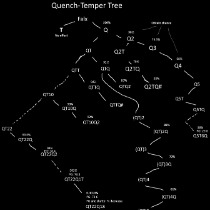
swifteralex Posted March 9 Report Posted March 9 (edited) We found an optimal result using statistical analysis and wrote a paper about it here: https://www.overleaf.com/read/xfmgpchwdczp#09b79b The best sequence for maximizing power and minimizing risk of breaking is "quench, temper, quench." Additional data showing the top 20 sequences based on expected damage: Edited March 9 by swifteralex
MKMoose Posted March 9 Report Posted March 9 15 hours ago, swifteralex said: The best sequence for maximizing power and minimizing risk of breaking is "quench, temper, quench." You're not maximizing power and minimizing risk. You're maximizing the expected total damage per unit of metal, which, to be honest, isn't a very useful metric. 15 hours ago, swifteralex said: Additional data showing the top 20 sequences based on expected damage: You can remove the sequences that end with tempering, because in the current balance it's strictly a loss to temper and not quench afterwards. Also, I haven't checked exactly, but it seems to me that your quenching power multiplier is 0.2 while it should be 0.1. The power ratio between QQT and QQ being ~0.98 also seems odd.
Diregoldleaf Posted March 9 Author Report Posted March 9 17 hours ago, swifteralex said: We found an optimal result using statistical analysis and wrote a paper about it here: https://www.overleaf.com/read/xfmgpchwdczp#09b79b The best sequence for maximizing power and minimizing risk of breaking is "quench, temper, quench." Additional data showing the top 20 sequences based on expected damage: I haven't read the full paper but look at your maths you have very similar outcomes to graphs I made on desmos a while ago Black is Power Gain after Quenching, green is Power Gain after Tempering, red is Shatter Chance after tempering. There was some other stuff I did in Python to find if tempering really is useless but alas, there will be no further change so I gave up. Can't believe it's been 2 weeks already
swifteralex Posted March 9 Report Posted March 9 2 hours ago, MKMoose said: You're not maximizing power and minimizing risk. You're maximizing the expected total damage per unit of metal, which, to be honest, isn't a very useful metric. Why not? 2 hours ago, MKMoose said: You can remove the sequences that end with tempering, because in the current balance it's strictly a loss to temper and not quench afterwards. Good catch; those can definitely be omitted. 2 hours ago, MKMoose said: Also, I haven't checked exactly, but it seems to me that your quenching power multiplier is 0.2 while it should be 0.1. The power ratio between QQT and QQ being ~0.98 also seems odd. That doubling in ratio comes from the fact that actual damage is 2 * power. Since that table displays damage, it looks like 0.2. Same for why QQT/QQ is ~0.98. Their damages follow that ratio, but subtracting 1 and then dividing by two for both gives the actual powers instead of the damage multipliers: 0.168665/0.183335 = 0.92 almost exactly.
swifteralex Posted March 9 Report Posted March 9 (edited) 1 hour ago, Diregoldleaf said: I haven't read the full paper but look at your maths you have very similar outcomes to graphs I made on desmos a while ago Black is Power Gain after Quenching, green is Power Gain after Tempering, red is Shatter Chance after tempering. There was some other stuff I did in Python to find if tempering really is useless but alas, there will be no further change so I gave up. Can't believe it's been 2 weeks already This is interesting analysis. Do these graphs assume a sequence is all tempers or all quenches (like QQQQQ..., TTTTTTT..)? Or does this work for mixing and matching like QTQQT? Of note, I see some sliders for Q and T there. Falx's with the same # of tempers and quenches can have different stats depending on how you get there. For example, the sequences QTQQ and QQQT produce different stats but each falx will say 3 quenches and 1 temper. Edited March 9 by swifteralex
MKMoose Posted March 9 Report Posted March 9 3 minutes ago, swifteralex said: Why not? Mainly because damage is heavily affected by breakpoints (e.g. the 5 damage breakpoint is extremely valuable for ferrous spears). Even when breakpoints are so high that they barely matter, damage can easily be much more valuable than durability and material savings by increasing DPS, not just total damage. 6 minutes ago, swifteralex said: That doubling in ratio comes from the fact that actual damage is 2 * power. It's bugged in some way at the moment. Damage should be proportional to power as far as I can tell based on the code, but the buffs currently behave in a number of clearly unintended ways. 31 minutes ago, swifteralex said: Same for why QQT/QQ is ~0.98. That has literally nothing to do with the other issue. But I goofed on this one in a rush, so you can disregard it.
Diregoldleaf Posted March 10 Author Report Posted March 10 (edited) 10 hours ago, swifteralex said: This is interesting analysis. Do these graphs assume a sequence is all tempers or all quenches (like QQQQQ..., TTTTTTT..)? Or does this work for mixing and matching like QTQQT? Of note, I see some sliders for Q and T there. Falx's with the same # of tempers and quenches can have different stats depending on how you get there. For example, the sequences QTQQ and QQQT produce different stats but each falx will say 3 quenches and 1 temper. Short answer, QQQ..., TTT... etc. Long answer, it works for mixing and matching. The graph shows the multiplier for each iteration as per the c# file. Note the temper curves need to move 1 place to the right; you can see at 0, temper PG or SC is not 0 In general, for quenching, we add PG to Qnew - Qold For tempering, we multiply PG by Tnew/Told Example (QT)2Q = QTQTQ Q1-Q0 * T1/T0 + Q2-Q1 * T2/T1 + Q3-Q2 (.10 - 0.00) then * (.92 / 1.00) then + (.183333 - .10) then * (.8499 / .92) then + (25.476 - 18.333) (QT)2Q: 23.3% The sliders mean nothing, they're there for the equations Edited March 10 by Diregoldleaf
Schroedingers_Hat Posted March 26 Report Posted March 26 (edited) If I didn't make any dumb errors, this is a depth first in python search to find highest survival for a target power, or the highest power for a given survival. Credit to swifteralex for the nice summary and writing it down as a recurrence relation: def lerp(a, b, t): return a * (1 - t) + b * t initial = { "power": 0, "shatter": 0, "quench": 0, "temper": 0, "survival": 1, "history": "", } def quench(state_in): state = {} state["history"] = state_in["history"] + "Q" state["survival"] = state_in["survival"] * (1 - state_in["shatter"]) state["shatter"] = state_in["shatter"] + 0.05 state["power"] = state_in["power"] + 0.1 / (1.0 + 0.2 * state_in["quench"]) state["quench"] = state_in["quench"] + 1 state["temper"] = state_in["temper"] return state def temper(state_in): effectiveness = 1.0 / (1.0 + 0.05 * state_in["temper"]) state = {} state["history"] = state_in["history"] + "T" state["quench"] = state_in["quench"] state["survival"] = state_in["survival"] state["shatter"] = state_in["shatter"] * lerp(1.0, 0.8, effectiveness) state["power"] = state_in["power"] * lerp(1.0, 0.92, effectiveness) state["temper"] = state_in["temper"] + 1 return state def work(state_in, min_survival=1 / 2): # Function to recursively work the item by quenching or tempering. # First quench is free, always do it. if state_in["quench"] == 0: return work(quench(state_in), min_survival) # Heuristic of maximum for tempers of 4 or 1/4th of quenches. # Forces running in polynomial time. # Results matched empirically, but you'd take it out for general correctness. if state_in["survival"] <= min_survival or state_in["temper"] >= max( min(4, state_in["quench"]), state_in["quench"] / 4 ): return state_in worked_1 = work(quench(state_in), min_survival) worked_2 = work(temper(state_in), min_survival) if worked_1["power"] >= worked_2["power"]: # I think you can't ever get back to where we are if we overshot. if worked_1["survival"] <= min_survival: return state_in return worked_1 if worked_1["survival"] <= min_survival: return state_in return worked_2 def power(state_in, min_power=0.5, min_survival=0.2): if state_in["quench"] == 0: return power(quench(state_in), min_power, min_survival) # Need additional base case for min survival to avoid fruitless paths. if state_in["power"] >= min_power or state_in["survival"] < min_survival: return state_in worked_1 = power(quench(state_in), min_power, min_survival) # Same heuristic. if state_in["temper"] >= max(min(state_in["quench"], 4), state_in["quench"] / 2): return worked_1 worked_2 = power(temper(state_in), min_power, min_survival) if worked_1["survival"] >= worked_2["survival"]: return worked_1 else: return worked_2 for w in range(0, 9): print(f"Best strategy for {2**w} ingots", work(initial, 1 / 2**w)) for p in range(3, 15): print( f"Best strategy for achieving at least {p * 0.05:.2f} power", power(initial, p * 0.05, 0.001), ) state = initial for q in range(20): state = quench(state) print("YOLO strategy", state) I added a couple of heuristics after observing on the first run that it didn't temper very much. It seems to strongly prefer doing one or two tempers early and doing one or two quenches between tempers, which roughly matched my intuition. The 'for ingots' also isn't technically quite optimal. Specifically it would be optimising for finishing on average with k/n weapons given you start with k ingots. The true optimal strategy for finishing with one tool will change with each quench based on how you roll your shatters and requires deeper analysis. It won't be very different though. Output: Best strategy for 1 ingots {'history': 'Q', 'survival': 1, 'shatter': 0.05, 'power': 0.1, 'quench': 1, 'temper': 0} Best strategy for 2 ingots {'history': 'QQTQTQQQ', 'survival': 0.5250374484694957, 'shatter': 0.2552380952380952, 'power': 0.38985782312925177, 'quench': 6, 'temper': 2} Best strategy for 4 ingots {'history': 'QQTQTQQQQQ', 'survival': 0.2716712818058456, 'shatter': 0.3552380952380952, 'power': 0.4769790352504639, 'quench': 8, 'temper': 2} Best strategy for 8 ingots {'history': 'QQTQQQQQQQ', 'survival': 0.14359332481401604, 'shatter': 0.42999999999999994, 'power': 0.5337335442335444, 'quench': 9, 'temper': 1} Best strategy for 16 ingots {'history': 'QQQQQQQQQQ', 'survival': 0.06547290750000002, 'shatter': 0.49999999999999994, 'power': 0.5841144966144967, 'quench': 10, 'temper': 0} Best strategy for 32 ingots {'history': 'QQQQQQQQQQQ', 'survival': 0.03273645375000001, 'shatter': 0.5499999999999999, 'power': 0.61744782994783, 'quench': 11, 'temper': 0} Best strategy for 64 ingots {'history': 'QQTQQQQQQQQQQ', 'survival': 0.020003698893190952, 'shatter': 0.58, 'power': 0.6340311632811634, 'quench': 12, 'temper': 1} Best strategy for 128 ingots {'history': 'QQTQQQQQQQQQQQ', 'survival': 0.0084015535351402, 'shatter': 0.63, 'power': 0.6634429279870457, 'quench': 13, 'temper': 1} Best strategy for 256 ingots {'history': 'QQQQTQQQQQQQQQQ', 'survival': 0.004221933002592695, 'shatter': 0.6600000000000001, 'power': 0.6805064200505377, 'quench': 14, 'temper': 1} Best strategy for achieving at least 0.15 power {'history': 'QTQ', 'survival': 0.96, 'shatter': 0.09000000000000001, 'power': 0.17533333333333334, 'quench': 2, 'temper': 1} Best strategy for achieving at least 0.20 power {'history': 'QTQTQ', 'survival': 0.8900571428571429, 'shatter': 0.12285714285714287, 'power': 0.2334031746031746, 'quench': 3, 'temper': 2} Best strategy for achieving at least 0.25 power {'history': 'QQQ', 'survival': 0.855, 'shatter': 0.15000000000000002, 'power': 0.2547619047619048, 'quench': 3, 'temper': 0} Best strategy for achieving at least 0.30 power {'history': 'QQTQQ', 'survival': 0.76038, 'shatter': 0.18, 'power': 0.30259523809523814, 'quench': 4, 'temper': 1} Best strategy for achieving at least 0.35 power {'history': 'QTQTQQQ', 'survival': 0.6457564380174927, 'shatter': 0.22285714285714286, 'power': 0.3514587301587302, 'quench': 5, 'temper': 2} Best strategy for achieving at least 0.40 power {'history': 'QTQTQQQQ', 'survival': 0.5018450032593086, 'shatter': 0.27285714285714285, 'power': 0.4014587301587302, 'quench': 6, 'temper': 2} Best strategy for achieving at least 0.45 power {'history': 'QQTQQQQQ', 'survival': 0.34567483104, 'shatter': 0.32999999999999996, 'power': 0.4536053391053392, 'quench': 7, 'temper': 1} Best strategy for achieving at least 0.50 power {'history': 'QTQQQQQQQ', 'survival': 0.21672647732736003, 'shatter': 0.38999999999999996, 'power': 0.5019386724386725, 'quench': 8, 'temper': 1} Best strategy for achieving at least 0.55 power {'history': 'QQTQTQQQQQQQ', 'survival': 0.10418045386413348, 'shatter': 0.45523809523809516, 'power': 0.5511548594262881, 'quench': 10, 'temper': 2} Best strategy for achieving at least 0.60 power {'history': 'QQTQQQQQQQQQ', 'survival': 0.04256106147487436, 'shatter': 0.5299999999999999, 'power': 0.6027811632811634, 'quench': 11, 'temper': 1} Best strategy for achieving at least 0.65 power {'history': 'QTQQTQQQQQQQQQQ', 'survival': 0.01098558012017472, 'shatter': 0.6133333333333334, 'power': 0.6513086876242339, 'quench': 13, 'temper': 2} Best strategy for achieving at least 0.70 power {'history': 'QQQQQQQQQQQQQQ', 'survival': 0.002062396586250001, 'shatter': 0.7000000000000001, 'power': 0.7058873724314901, 'quench': 14, 'temper': 0} And I'm not sure if LadyWYT's concerns about people grinding are going to turn out overly important. 0.66 power is about as hard as a full set of plate, and (unless I made that dumb error) no amount of grinding is going to push it much past 0.84 which puts the difference between moderate effort and using all of the iron within 10,000 chunks at about 20% extra damage. I think my biggest criticism is how little difference tempering makes vs. just YOLOing it with all quenches and agree that a more skill based/finite system would be cooler. It would also be interesting if there was a seed (or possibly even seed an location/time) based component for that last couple of percent so you would have to learn what is optimal for each world rather than looking it up on the wiki. Edited March 26 by Schroedingers_Hat 1

Recommended Posts