Vratislav
-
Posts
322 -
Joined
-
Last visited
-
Days Won
1
Content Type
Profiles
Forums
Blogs
News
Store
Everything posted by Vratislav
-
As I have tried to play in pre- releases and testing mods I use in my long time world, yup: there were a lot of changes under the hood, and mods that are not updated will mostly cause problems. For the most popular mods with dedicated developers, they will surely update to 1.22 stable soon and we should be deeply thankful to them. For other cases, I can recommend from my experience mostly with worldgen mods: Check if the latest version of the mod was updated at least to 1.22-pre 8/10 version. Woldgen mods from 1.21 will surely not work correctly, even mods updated to pre- 4-5 version may fail as the worldgen was modified due to elements like berry bushes and dungeons. Some mods that are no longer being updated, could be forked and are maintained by other people, e.g. Natural Trail Mod has at least third fork already. If you are able, the abandoned mod is simple and the fix is possibly easy, you may try to update it for yourselves (not that I do it, but there are many players who are capable of it.)
-
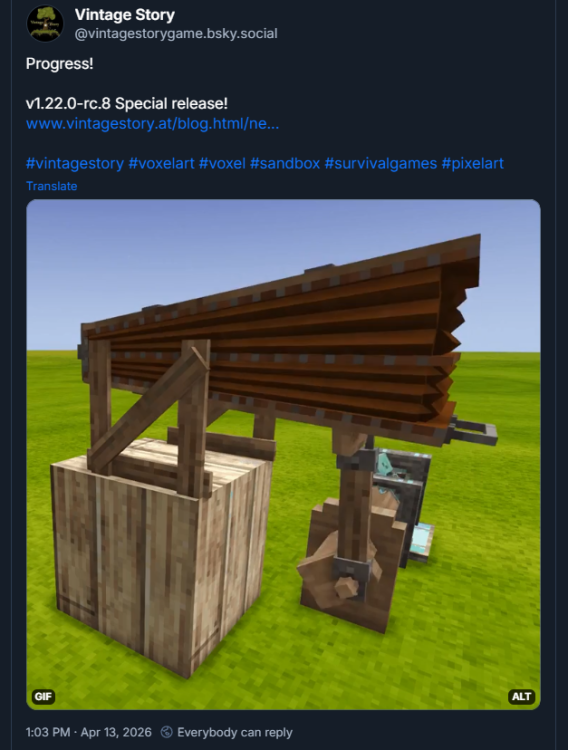
But I was not able to replicate in .rc.10...
-
It did not compensate?
-
As there are problems to use the schematics in later stable versions: The schematic was generated in version 1.21.5 and the worst offender of problematic blocks is probably Natural Trail mod CUPdated, that I am not fully sure with version used. But it should be either https://mods.vintagestory.at/trailmodcupdated 1.2.1 or rather its 1.3.0 fork Natural Trails updated here: https://mods.vintagestory.at/show/mod/29192. I will generate new version of the schematics after I successfully upgrade the world on 1.22 stable.
-

Experimentation with rapids: Waterwheels and aquaducts
Vratislav replied to Tam Hawkins's topic in Discussion
It seems that "symmetric" layout (water from the top to the middle or all 8 covered) means that the wheel cannot decide, where to rotate and how to calculate the output. Seems logical. However, I was surprised that the relation of the number of active blocks and of the output is not linear. -
Experimentation with rapids: Waterwheels and aquaducts
Vratislav replied to Tam Hawkins's topic in Discussion
Have you checked number of active block powering the waterwheel? I did some experiments earlier to realize that "low water" has usually 3 active blocks, but with high water, you may get up to five active blocks powering the waterwheel. However I haven't tested for the difference in power output.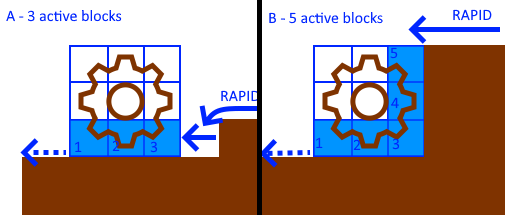
-
Yes, most advice was already said: Starting from small and expanding slowly, leaving enormous detailing (and chiseling) for later, designing in creative, (ab)using MC tutorials and using real buildings, MC builds or even builds from other games for inspiration. In addition to this, I'd really emphasize designing, starting from rough paper sketches (paper with 5mm grid is your best friend) and then in more detail in creative. You may test general proportions of the building just by sketching it on the paper. Then, in creative, you set up colors and details: which local stones fit with local wood types, what is the good window frame design (by putting several ones put side to side), elaborate crazy ideas, and decide then if to build it. It can be tweaked in survival a bit, so even the creative designing does not need to be too meticulous. From my personal experience, in two 1.22 testing worlds, I was lazy to do the design on paper or in creative and started building bases without designing: oh, I was disappointed with the results...
-
There are actually some mushrooms that are slightly poisonous when raw or cooked briefly, but perfectly fine if properly processed. So it should depend on the realworld behaviour.
-
I know the place and I did not explore it happily.
-
Didnt know you can setup helve hammers like this
Vratislav replied to yacine_cnbl's topic in Videos, Art or Screenshots
Are they synchronized? -
This will be feat and I am very interested! (Also, greeting from fellow Greek temple builder, despite in TOBG. I tried Artemida's Epehesus temple. The construction was easier, of course, as I had to fit to the whole block column sizes and distances, but the result was like 95% close to 1:1 so I was satisfied.)

-
bug? 1.22 Medium fertility farmland(?)/flax(?) nerfed/bugged?
Vratislav replied to Calmest_of_lakes's topic in Discussion
And this is the core of the problem. The grow speed should be at least some kind of continuous function to reflect the worsening nutrients conditions, not containting these jumps that simply double the growth time for last two stages. Then the growth speed would decrease step by step and the lasting of the next stages would be more predicable. I have made some wild assumptions and did not bother to find exact numbers, so do not take following table as valid. It is possible example of crop stages on medium 75% moisture, in current model and if we do not decrease growth speed from 58% to 29% when the fertility decreases from 20,1% to 19,9%. If the speed was distributed more evently the long growing crops were less exposed to the risk of prolonged last 1-2 phases.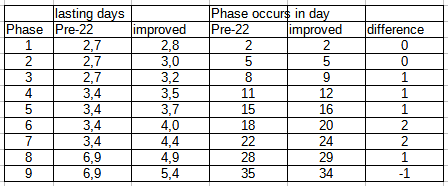
-
Well, the stability itself is not bad, but as other say, there is a bit more bugs than is acceptable for smooth gameplay.
-
I also confirm bugged traders in 1.22-rc2. I have this experience in one PC. I got some "asset XYZ not loaded" warnings in the loading screen, then traders did not appear in their outposts. In other PC, I got the traders appearing in rc2 just fine. The problem might be caused by stacked installation of several pre- and rc- version to the same spot without full removal of the previous ones, as I did this without care with aforementioned result.
-
Welcome to the forums! I am sure that more veteran players will extend. First, surely good you are enjoying the game. About travelling, not sure, how far are you with the story content. You will get access to faster travel device (mount) after finishing chapter one. Also, there are translocators you may use if you find (and fix) them underground. You may find mods to utilize these tranclocators to be more convenient, if you want (like move them to desired locations). It is valid to point out some unpolished areas (particularly caves), it partially goes to the early access stage of the game. Some things will be reworked for sure. Partially, the feeling of empty wilderness fits well to the survival aspects of the game. I have learned, that one is not ever lucky enough to find the landscape he desires, and wordgen may be sometimes directly evil to the player. As the game is heavily configurable and there is great support for mods, you may try to adapt almost every aspect of the game to your needs. If things seems to far away, you may half distance to the story locations. You may change the size of generated landforms or use worldgen mods to change the feel of the landscape. There is great mod Better Ruins that adds a lot to the exploring, there are mods adding various flora, fauna and even geologic variety. Some mods may be added to existing worlds, just check the mod library, you will not miss with these most commonly used. So if you get unsatisfied with a vanilla run, there is lot of things to try to change. Still, starting without many mods is a good way how to enjoy the game at least for the first time.
-
Hopefully. I was in the same stage and got to collect dead plants in December...
-
The change was that amount of nutrients consumed by crops made medium soil very exhausted for last 1-2 stages of growth. That made the last growth phases several times longer. But it was in pre-1, haven't tested these changes in latest releases as it requires 20+ hours of playing.
-
It also improves chance to get at least one linen sack pretty soon, as it requires only 20 flax fibres to make. Find 10 patches of flax with 1-3 mature flax spots and you are at home.
-
It is unpleasant. I have experienced item vanishing from the crafting grid output, then apearing several minuts later (when attempted another crafting). For the exact number of items, it looks like there was added new recipes with the same spatial distribution but smaller amount of required resources, that makes crafting grid confused as it cannot decide, which one you want to craft if you put bulk of resources there (e.g. rope is 3x 2 cattails horizontally, but newly craftable headband is 3x 1 cattail horizontally, good luck with ANY number of cattails bigger than 2 put into particular grid windows...). However, as the crafting is somehow unwanted mechanics, it is question, what is the best way to get from this mess.
-
herobrine When will Vintage Story have it's own "Herobrine" creepypasta? :)
Vratislav replied to DUCATISLO's topic in Discussion
Dave is not enough?- 20 replies
-
- 1
-

-
- seraph
- creeypasta
- (and 3 more)
-
Actually, aged torch holders are still where they should be in pre4, just started new game in pre4, was lucky to find underground ruin next to the spawn and found fully movable classical aged torch holder there. If you remember, sometimes, only extinguished torches are on ruin walls. This is the place I assume ruined torch holder may occur in standard ruins. And of course, in these procedurally generated dungeons.
-
I'd prefer the complex system, as similar systems already exists for beehives (they count flowers around) and currant bushes may be planted in lines IRL (we have a red currant shrubbery by our cottage). Also, we need SOME way to make decorative shrubberies!
-
About berries, we were warned, that the mechanics is temporary and will be changed significantly, especially to stop convenient but unrealistic method of replanting bushes next to the base to get second harvest there in the first year. I did not have time yet to check, but is there already known, which particular fertilizer berry bushes will require? For early game, P would be convenient, but whatever. Also, I haven't seen if it was mentioned anywhere in forums, crops actually grow very long time unless they are fertilized on medium fertility soil. The medium soil is now very depleted before the last phase of growth and the phase 9 takes forever (speed around 0,2). This limits harvests to only one in the first season (tried to plant crops in August as usual, and got to collect dead plants mostly in phase 8 in December). To have only one crop harvest per season is not as bad as mechanics. I see the problem that first 7 phases now take similar time as the last two, that makes the crops growth unpredictable for unexperienced players, so the implementation is a bit lacking here.
-
What do you do with all your excess leather?
Vratislav replied to Broccoli Clock's topic in Discussion
I do it usually on the spot if there is demand for particular product. When I am not lazy, I make also some black leather, which expands opportunities (same for linen, as blue and brown cloth are component usable even for non-taylors). -
What do you do with all your excess leather?
Vratislav replied to Broccoli Clock's topic in Discussion
Just sell it. In my late game, leather became one of three main resources of gears (together with linen and cast bronze tools). Also flax fields are the base element of being rich as Flax fields -> linen -> linen products, like clothes -> gears Flax fields-> autofed pigs -> leather -> leather products, like aprons and boots -> gears