Bruno Willis
-
Posts
364 -
Joined
-
Last visited
Content Type
Profiles
Forums
Blogs
News
Store
Everything posted by Bruno Willis
-
While we're talking about manure, I'd love to see bats and sea birds in the game, along with guano in big fly-swarmed piles in the places where they nest. That'd make the sea-side feel more sea-like, and caves feel more nasty and dangerous, and give us access to a very valuable fertilizer. Guano! Guano! Guano!
-
Fishing flies would be cool, but I think a down duvet would be a really cool way to add sleep duration to a bed when you want it (winter with long nights) and take it off again when you don't want it (short summer nights). At the moment I use a hay bed to sleep most of the time, and a real bed only in winter. I'd prefer to have one bed which lets me sleep 6 or so hours, and then put an extra feather duvet over it in winter to sleep 8 hours. It'd also add a good cozy feeling to winter if you had to go and pull your feather duvet out of storage and put it on your bed for winter.
-
The design on these outfits is just exceptional. I keep being blown away by how much love and work has gone into this game. Great to see them set up like this.
-
The benefit of the instrument sound vocals + written dialogue is that it should be rather easy to add and expand dialogue. I'd love to see more dialogue, and more of the recent world stories told through traders. Imagine running into one rare trader who's an elderly gossip, who can tell you about the nearest two traders: "Oh Thrift. Yes yes, she came here only eight years back, fleeing her hateful family she said. Except she had some very nice pieces to sell, right away. A matching set of plates and cups, heirloom, you know. Wonder where that came from, eh?" I wonder if when setting the personality, alongside giving the traders a bit of different dialogue, it could add something to their structures: if they're dreaming of living off the land, give them a small farm plot too, or a couple of goats. If they're the remnants of a ruined settlement, surround them with recently burned ruins, etc. That'd mean even if you saw the same trader structure, it'd have even more uniqueness (they already get different decorations for each trader type, which works great). I'd love it if each personality had some unique dialogue tree, which if negotiated cleverly could let you figure out a way to get discounts from the traders. You'd only need about 6 of those to get a really cool effect, like you're getting to know the trader and get on their good side. I'd also love it if traders would offer a loaf of bread or some basic snack if you reached them and were close to starving to death. Human compassion, you know. I would also like to be able to bring them wines and share a jug with them.
-
That's one shifty seraph! I think this would really be the more fun way to do this, but I heard the devs talking about putting bandits in the game in an interview, and I wouldn't want to be running around killing folk, so I'm trying to subtilty influence them to having bandits be people you can talk to. If I were to put thief-shifty traders in the game, I'd love to add dialogue that shows them being uninterested in the history of the things they're looting. I.e. "Place was a mess when I found it, mold everywhere. Burned the tapestries and bookshelves and things to keep warm, but I kept these little beauties... what'll you offer me for them" I wonder if there would be a way for these sorts of traders to scam players. Something like "I can offer you a special deal today though. Nomads dropped this off to me, they didn't know what they'd got their hands on..." shows metal scraps. "A rope and stick and this trick I'll teach you, and you could make one of the most powerful weapons, right out of our brutal history. Only 5 gears and I'll teach the trick to you, what-da-ya say?" It's not exactly a lie, but they're taking advantage of ignorance to get a good price. I think that'd be fun.
-

Looking for Island/Archipelago Seeds and/or WorldGen Help
Bruno Willis replied to Eilean Obrien's topic in Discussion
I really really recommend: Landcover: 40 Landcover scale: 145 Landform scale 120 (optional, makes each island feel quite different from last). This gives you a good mix of islands. I aimed for islands as large as I could get, while still being fun to navigate the world by boat. I did a bunch of testing, and these settings will probably spawn you on quite a small island, in a world which is mainly large islands with enough space between them that you can navigate fairly confidently between landmasses. Nothing is large enough to really feel like a continent though, but it's the best I've been able to do. -
Oh I'd love to see nomad bands who have unique scrap tools and weapons as ceremonial/valuable equipment. It would be so cool to see a different sort of culture to the more typical (but still very unique and interesting) settled cultures currently in the game. I think it would be really good if humans almost never killed each other. Even the bandits would be going round threatening and extorting, rather than killing. What's the point in killing, unless you really really have to? The world is so empty, anyone you find is at worst, a resource, and at best, a close ally and friend. Having reputation would be a fantastic option. This seems like a really helpful scenario for players who want to be thugs, they can threaten and get their temporary benefit, without resorting to full-blown murder. I've been playing a bit of Disco Elysium recently, and the dialogue in that can be very fun: it's tied to a random role + a stat, (the stats are very weird), and it lets you do this sort of thing. At the moment, V.S. dialogue is essentially pick a path storytelling, which works great. I would love to see what it would be like with challenge rolls applied though. I think that might make conversations more fraught and fun, at the cost of needing a bit more work to fill out the possible outcomes of a successful or failed dialogue attempt, and it might feel a bit odd when it'd be the only thing like that in the game. Actually, scratch that, you are never sure your fruit tree cuttings will take, likewise, you're never sure your threat will take. Instead of stats, if V.S. wanted to add a challenge roll mechanic to dialogue, I would assign a stat point to each piece of clothing and gear that can be worn openly. Malefactor facemask: +1 skullduggery? Clockmaker's apron: +1 craft-talk. Blackguard's armor: +1 soldier's solidarity. Courtier's pantyhose: +1 flamboyance. This is sort of an alternative to the quite cool way the game currently recognizes your background and automatically opens up special lines of dialogue for you because of that. If we used challenge rolls and improvements to the chances of some challenges based on gear, we'd instead get to open up those dialogue options if we could pass a semi-risky check. It would give more fluidity to your character - have you changed? You've gravitated towards your same old equipment so no, or you're wearing noble's clothing now, and lots of bling... +4 Oldmoney, you don't look like a malefactor anymore. But it would make conversation a challenge rather than a natural, non-stressed way of telling the story. That's a design choice for the devs, I think, rather than a hard and fast one is better than the other decision.
-
Just because they don't say they're robbing you, doesn't mean they're not robbing you. Imagine giving them some food, expecting the clink of gears in return, but you get none, and the commander just does that laughter animation. What do you do? exit the conversation and fight them? They attack you if you havnen't given them enough. If you keep buying from them, and they keep not giving you anything, they're essentially robbing you anyway, and don't need to resort to violence. I really like this read of bandits. I think they'd be a much higher threat to traders than a seraph, although I imagine they might want to find your house and rob it, but I think that would be too far for a game like this one. Yeah, I was imagining how concerned I'd be meeting a well armed, small squad of soldiers asking about any settlements in the area. I'm not telling them! I imagine them as a looting party for some large and aggressive society far far away, but it would make more sense if they were just well armed, traveling traders.
-
I love the new trader houses. They seem well defended and well thought out, as well as very very cozy. What remains is an issue that I've felt since I first started playing: frequency of traders. Why are there so many, when I'm the only person they can trade with? Where do they get their food from? Did they grow up wanting to live alone and isolated, and then leave their parents and go out into the wild and just wait? For who? Me? Obviously, they're this frequent so that they can be found, but it feels quite odd. I think there are two parts to the solution for this, and both would be cool in their own right. It may be very unrealistic, but I thought I might as well throw it out there and see what sticks. Traders know each other: Each trader would know the location of a nearby trader with a different trade to them. If asked about other people like them, a trader would say "do you have any... (X very specific food)" If you brought it to them, they'd tell you that you should offer it to (name of nearest trader), as "it's their favorite food." They would mark the location of the new trader on your map. If you know the favorite food of a trader and bring them some when you visit, they give you slight discounts. That way, it becomes a method to find new traders, or a way to learn the favorite food of a trader you already know about. Half of the current trader generation locations are replaced with empty camp-sites. It might be built in a ruin, or be an empty, old camp-fire and a hidden stack of aged firewood, or any number of things. The camp sites would ideally be claimed, but still allow players to use the firewood and firepits (if possible?). During the spring, summer and autumn, there is a good chance a traveling group will generate in one of the camp sites. Once they've generated in, they move to the next closest camp sight or trader each day, tracking in a general direction until they've traveled maybe 6 stops, before disappearing (they'd only actually appear if the player generated the spot they're supposed to be in). Hopefully that would simulate them traveling across the map, without any need to have them actually walk. There would be a whole lot of different traveling groups, but each would have a commander/elder/spokesperson who would offer limited trades for food, a specific want, or the location of a distant trader, and a small group of unfriendly (not speaking much) companions. Groups: Most travelers would be stone-age nomads. Their elder would pay 1 gear for full, sealed crocks, and 2 gears for any metal object, of any metal variety. (not a good deal, but they're poor). The elders would share the locations of traders freely. Other less likely travelers: Refugees. Their spokesperson would pay 1 gear for any cooked food, any sort (an excellent deal, they're starving). and 2 gears for any metal weapon. They would share the location of a distant trader for 3 gears. They'd accept donations. If you could tell them the location of a certain hospitable story location, they would give you a piece of "precious" jewelry, like a crown or neckless, in thanks. Bronze-age nomads. Their elder would offer a bronze knife for 2 pies of any sort, and sell furs for gears. They would share the location of a distant trader for free if the player made a trade with them. Soldiers. Their commander would pay 2 gears for 64 grain (sad soldier rations). They would ask about the locations of any traders or story locations, and pay 2 gears per location given up. The soldiers would keep their spears leveled at the player, even during negotiations. If spoken to, they'd all say variations of "You're ordered to speak with the commander, then leave." Bandits. similarly aggressive body language as with the soldiers. Their commander would have obviously questionable dialogue, and would pay 3 gears for any food type, but not actually pay when the trade button was pressed, just take your offering. Would offer jewelry and ruins loot for gears. Would offer to pay 6 gears per location of traders or story location given up, but would ultimately not give away the gears. If the player made more than 3 transactions with them (remembering they rarely give what they say they'll give) then they'd just let the player go. Otherwise, after leaving the conversation, the bandits would attack the player.
-
I think that if root vegetables produced really abundantly if planted in quality soil, and grains cared less about soil quality, that'd be alright. In that situation, you're using your scythe to a few dozen rye plants, and then dipping into your kitchen garden and digging a couple of turnips up, and getting similar yields. This is coming from an interesting point MKMoose made in this thread:
-
I really share your goal with this suggestion, but I don't think we need to change so much to get there. I think the current nutrient system is a real strength which can be worked with. I particularly like your idea of separating out bulk, low maintenance plants, and cared for, garden plants. That feels really right to me. Here's an alternative way to get there: Add weeds, and tie weed growth to quality of soil and proximity to grass and weeds: the better the soil the faster weeds spread across it. The Closer grass is, the more likely a weed will generate in one of the garden plots. That would mean potentially any crop could be grown intensively on quality soil, but would require tilling. It would also mean bulk crops planted on lower quality soil would be more resistant to weeds, especially if you edged the outside of your bulk field with stone walls or paths (as a later game improvement). That's not a change in the plants themselves, nessisarily, just giving a sort of value to low fertility soils. They become good for set and forget farming. Tilling, as you suggest. As you suggest, make crops like cabbages really thrive (and possibly continuously produce) when kept in good quality soil. Do realistic hydration. We really need a way for rain to be enough, in a normal year, to keep gardens at a reasonable hydration level. I'd say that's a combination of making more hydration good up to a point, with reducing rates of return, and then eventually getting worse again (see diagram), and also adding more light rain potential in the early early mornings. It'd be good if a really rainy year could have some consequences too, but that's an added extra. The main thing is to allow realistic gardens. You don't need, or even want, water sources right up against your garden plots. Give animals food preferences - drawing on what you suggested, have animals prioritize specific foods. Hares would really go for cabbages and more delicate greens, but would ignore grains once they get past the first stage of growth. That way the only animals you're worried about grazing on your unfenced field of rye are deer and goats, which themselves are an asset, something good to hunt, if they come wandering close to your bulk fields. As you said, nitrogen fixing crops/plants would be a good addition. Manure... I really don't know. I've played with a mod which added it, and it was pretty over-involved, which maybe contributed to it being less fun. I think if it needed to be piled up, like bones can be, but when it reached max, it would turn into a full block of manure which could then be used, that might simulate letting the manure develop, without adding too much unintuitive gameplay. I don't think manure is quite as critical as you're suggesting though. Useful, but not the end of the world if you don't use it. I don't think diseases are the best idea, except maybe in glass houses? If we add diseases, farming will get more fun and more realistic, at the expense of the rest of the game? Saying that, I do really like the idea that rye grown in over-soggy soil might develop a psychodelic mold on the grain, which when eaten could have effects like the liberty cap, as a slightly inaccurate reference to the dancing plague of 1518 https://retrospectjournal.com/2025/03/30/dance-until-you-drop-the-dancing-plague-of-1518/ (I tried to make your quote hide so that people didn't need to read it twice, but now it's extra hidden and I don't know how to fix that, so... oops.)

-
Oh sick, yeah that's worth bringing up! Okay, here's an option: 1. the payer would fill a cooking pot with 2 slots of rye grain, and 2 slots of water, then leave it for 12 hours, after which it would become pumpernickel dough. 2. they would "seal" the cooking pot with a daub of clay, and put it in a hot, but not too hot, clay oven. 3. the tool tip would note the heat of the cooking pot, and it would stabilize at the good temperature, and stay that temp a long time (that'd be a special property of putting cooking pots in the clay oven, simulating extra thermal mass). Up to four cooking pots could go in the stove at one time. That seems hard enough to justify a good high nutrition value and long storage time, but interestingly enough, it doesn't even require metalworking to get to that stage, just patience and lots of grain.
-
Maybe instead of adding pumpernickle bread explicitly they could give rye and rye bread a longer shelf life but a slightly lower nutritional value than spelt bread. It'd give the grains a little more identity. It could be quite a small difference initially, just enough to hint that rye lasts longer, and then charred rye bread could have a crazy long shelf life. I wouldn't worry about an iron baking tin, or sourdough, as a gate to pumpernickel since, IRL, if you can make a type of bread in an iron baking tin, you can make it in a clay tin, or without any tin at all, with very little recipe change, and bread currently doesn't use yeast to make, which implies that we're already making sourdough bread or using natural yeasts, and the method has already been simplified for gameplay purposes. Actually, as another option the devs could add an extra stage to rye bread, so that it goes from: rye dough -> part baked rye bread -> rye bread -> pumpernickel -> charred pumpernickel. The pumpernickel stage would have decent nutrition and a very long shelf life, and the charred pumpernickel would be essentially useless as a food.
-
Perhaps this could be made to happen deliberately during temporal storms, with a bit of extra rust, just for fun.
-
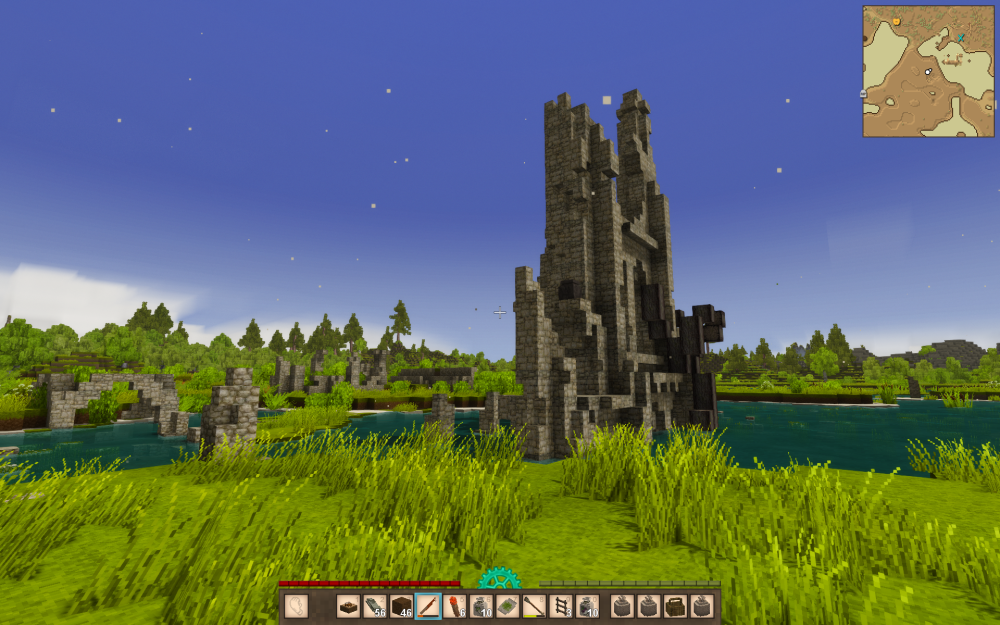
I've been playing V.S. obsessively for the last few days, without better ruins, and really enjoying my ruin looting adventures. I thought I would screenshot the best ruin so far (probably best of 30 ruin sites) to show what vanilla ruins can be: Looks like there's some interesting underground/underwater rooms which I haven't explored yet, but I'm very excited to. I also set surface copper to very rare, and then looted a copper pick from one of the ruins, so I'm a very happy seraph at the moment.
-
I enjoy the subtle difference between some types of berries (cranberries last longer, but have lower nutritional value for example), and I'd love to see that for mushrooms too. King bolete look so big and tasty, but I'm pretty sure they're the same as the woody shelf mushrooms when it comes to both nutrition and how long they can be stored. I'd love to see fleshy mushrooms like bolete, field mushrooms, red-wind caps, etc. have a quite short storage potential, but lots of nutrition, and woodier, more easily dried mushrooms, tinderhoof, reishi, could have longer storage potential, and lower nutrition. Then you'd be able to offer special mushrooms, like shitake, which might have the extended lifespan of the tinderhoof, but a normal amount of nutrition, and King bolete, which might have just a whopping amount of nutrition for a mushroom, and a normal storage potential. It'd also be interesting if some mushrooms gave 1/2 and 1/2 vegetable and protein nutrition, as the thing which makes them special. This isn't an important suggestion, but I think something like this would add a lot to the experience of harvesting and cooking with mushrooms.
-
I am having such a blast with this update. The world is just feeling so wild and alive, with all the different goat and sheep varieties, the berries, the new vegetables and fish. I've been loving this game ever since I got it, but this update has given it a really noticeable step up in quality. I'm so pleased, so thank you! Well done!
-
Or give you the status effect: Horrible Itching Pain. Which would occasional and randomly damage you a tiny bit, (very distracting), and also cause your seraph to stop what they're doing and scratch themselves every now and then (sort of like when you're in the desert and you raise your arm to shelter your eyes, but more annoying).
-
I'd also love to fall into a dense tangle of nettles while running away from a bear. That sounds like a perfect V.S. experience.
-
Damn, I'm completely wrong. Hand-axes were just the convenient way to make a very early knife, they weren't used to cut down trees, there's no historical reason why they could take the place of both a knife and an axe. Apparently they were used for digging though, so there's our stone shovel-knife! I really like the idea of the stone age tools not fitting neatly into the exact same categories as the metal tools though. I like the idea of a wooden shovel+hoe, and a stone knife+hand shovel+axe head. I'd also like to see antler get more uses. It would be lovely if knifes could be handled with bone or antler all the way through the metal ages as well as the late stone age. Apparently you can get a good knapping effect with wood as well as with antler, although I'm guessing it's a very hard wood, not your average pine branch.
-
This is a really good point, if early game is supposed to teach lessons which become more relevant later. It'd be pretty cool to get a flint knife out of a ruined pot and realize it not only looks way nicer than your glorified sharp stone, but it's way more effective. Then you'd wonder how to get there. I also think if early early stone knapping gave you a hand-axe instead of an axe or knife. It would work as a stone knife currently does, but could also be hit with a club to cut down trees. (teaching about the off-hand mechanic later used for chiseling). You'd have an early early tool which can do a lot, and looks very different to the later stone knife you get from ruins/antler knapping. You'd also get your first weapon (the useless club) as a by-product of wanting to cut down trees, ensuring everyone has a weapon when night falls. I also really like the idea of carrying antler late game, (cause you found it, cause you want to make a really nice antler handle for a knife, etc.) and when a metal tool breaks, just knapping up a really nice stone version with the antler, instead of falling right back to the bottom of the progression tree with the crappiest stone tools.
-
That sucks, really. Here is a way for you to get into the game again, using vanilla mechanics: When you make a world, customize it. Go into the "Player Spawn and Death" section (it should open automatically when you press customize). Click "Grace Timer" and decide how many days you want before monsters start showing up. It sounds like you're pretty experienced, so I would recommend 1 to 2 days grace timer. It could make the game a lot more fun if you're feeling the pinch in the early game but still want the challenge when you're a bit more prepared. The other one you might want to change is under "Temporal Stability" you can change the frequency and intensity of the storms too, so you've got a bit longer before the first one hit. I used to do that every game. Use the tools it offers to change it until you're happy with how it plays. Adjust to your tastes. It's a wonderful game like that.
-
I've just started playing with the new bushes, and I couldn't be happier. They are so fun to find, they look so good, and it's just added so much interest to the world, wondering if that bush is a special one? what about that one? I bother checking bushes without fruit, just incase I want to come back and propagate it later.
-
Thinking about if Water could not be Destroyed only moved.
Bruno Willis replied to Emeal's topic in Suggestions
These would be great, and clay as a subsoil is an excellent idea. It seems really realistic to have some regions where there is a small layer of topsoil and then clay for 4 or more blocks before you hit stone. I grew up in an area IRL which has about a finger's depth of topsoil, and then clay down for meters, and it's like that for kilometers around. -
Allow us to place a door in the middle of a block
Bruno Willis replied to ParallaxError's topic in Suggestions
I'd use the placing system for pots and bowls, where you can click in a corner, and start placing the bowls in each corner, or you can click in the center and place a single bowl in the center. For doors, you'd have, I guess, five placement locations. You could click close to any of the four faces of the floor block, to get the door to place close to there, or you could click in the center of the block, and the door would be placed in the center oriented to block you. (give me a minute, I'll try and draw a diagram). The only issue I can see is that when a center placed door opens, it's going to open beyond the block it's been placed on. Trouble.