DarkGold
-
Posts
130 -
Joined
-
Last visited
-
Days Won
3
Content Type
Profiles
Forums
Blogs
News
Store
Everything posted by DarkGold
-
Hopes & Dreams for Changes to Combat
DarkGold replied to e8747e6c4e0ceedb55ae841fe9's topic in Suggestions
How do you feel about parrying mechanics? I'm thinking about games where parrying is optional rather than necessary to kill enemies, but rewards higher skill and gives players a choice between a risky play (with a big reward if they time it right, if they time it wrong, the penalty is usually pain) or just playing it safe? Also curious how people feel about things like more damage if you stab the enemy in the back/when they have their guard down. Backstabbing the enemy is usually paired with stealth mechanics, but not always necessarily so; it just really emphasizes positioning and has additional rewards if you stun or otherwise lock down the movement of the enemy. It also requires enemy movement to be very responsive by default, or else it's easy for the player to exploit the enemy's positioning. I suppose a lot of these mechanics require the game to be very responsive to work in the first place. They might not be very viable on servers, but would work well in single player, and since Vintage Story supports server play, might not be strong additions to the game. -
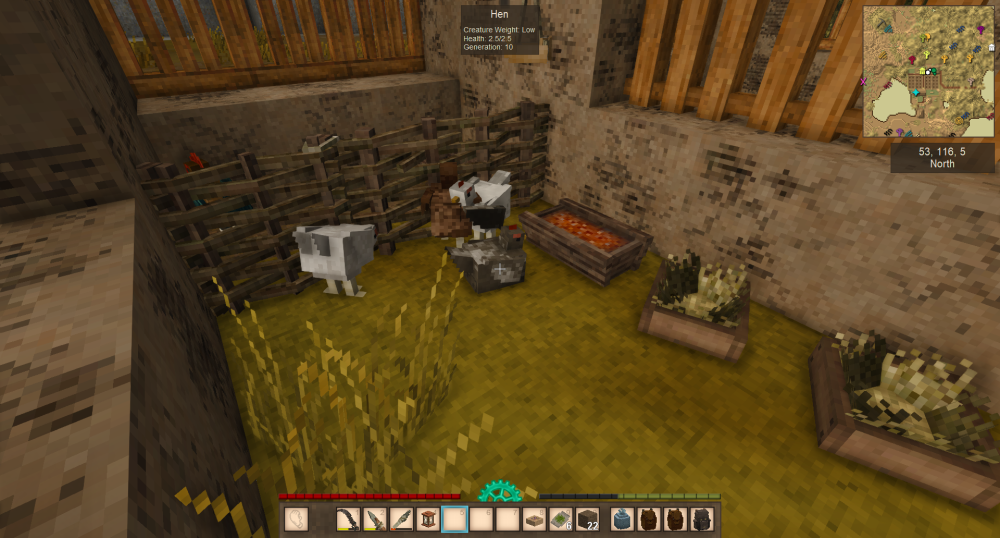
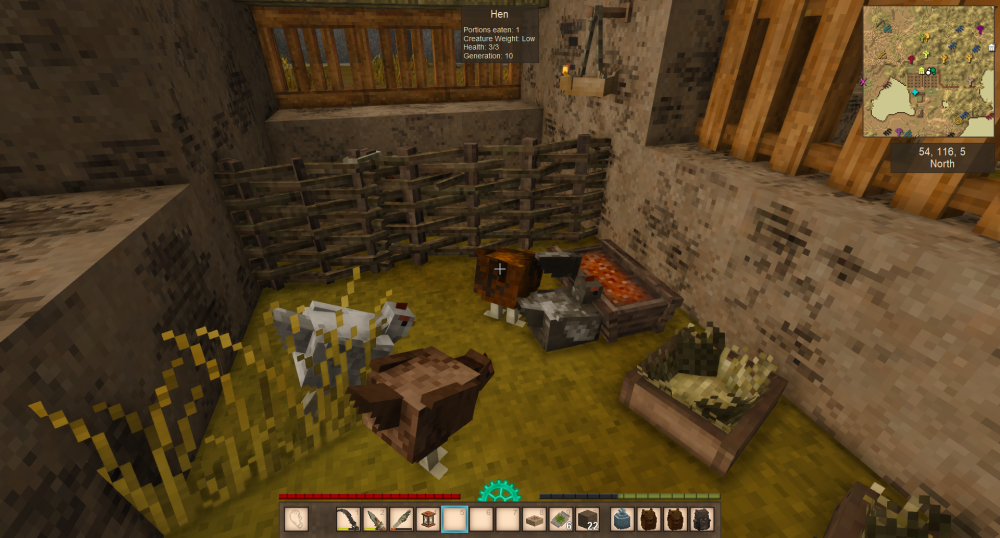
Sadly, the new chickens don't seem to want to eat either. Although I did notice that the new chickens have the new HP values, whereas the old chickens have the old HP values. Even though the old chicken in the screenshot says "Portions eaten: 1" that has not updated recently; they just don't eat anything out of the small trough or gain weight.
-
I've been investigating how I might been able to spawn new chickens (because I would really prefer not to have to breed them back to gen 10 from scratch, especially if this could happen again). I see on the wiki, this command is provided... /entity spawnat [entitytype] [amount] [position] [radius] ...but it may be easier to spawn chickens from creative mode (/gamemode 2) than try and figure the entitytype out. And then one would follow it up with this... /entity cmd l[] setgen 10 ...to set the generation of the creature I'm looking at to 10. I'm going to give this a go and see if the new chickens eat...
-
Should VS embrace the Immersive Sim in its Story?
DarkGold replied to Perdido Street's topic in Discussion
I had only been playing 1.21 for a while before 1.22 came out and I wanted to regenerate my seed to see what had changed. In 1.21, I completed chapter 1, had chapter 2 marked on my map, but had not yet set out for it. I didn't want to start from scratch, since replaying that part of the game so soon wasn't interesting to me, so I copied my base using the blueprints tools and pasted it into a newly generated world using the same seed. I found the map to the first and second story location carried across, and using the maps worked. I used creative mode to visit the first location, and it seemed to be in the right place (the coordinates were the same as last time, the location did in fact generate there). I presume this means I can go to the second location while skipping re-running the first location in this world? Will this break the game/miss showing me options? Maybe? I might have to use some creative tools to quickly complete the milestone bits of chapter 1 again if I don't want to repeat it the long way. Edit: What I wanted to share in bringing this up is that because the time investment players might have in their world is quite high, and the world is worth regenerating every now and then to experience new content, it is great to have tools like the ability to copy your base across. It could also be good to have the ability to play locations out of order for the scenario of players moving worlds after updates, mid journey. Maybe there is already some command that a player can run that sets their story checkpoints forward without having to repeat content?- 16 replies
-
- 2
-

-
- immersion
- simulation
- (and 1 more)
-
Thanks for the advice @LadyWYT, and for verifying @MKMoose. Great to know it's possible to take an elk with you, but reading some of the stuff on the forums about potential translocator bugs, and thinking about the dimensions of the elk, has definitely made me think twice about the wisdom of the act. If I attempt it, I'll be sure to plan well ahead of time that there is enough space on either end, and be prepared to use command tools to correct anything that might go wrong in unexplainable ways.
-
Hopes & Dreams for Changes to Combat
DarkGold replied to e8747e6c4e0ceedb55ae841fe9's topic in Suggestions
This resonates with me. It does make me think that combat situations in the game are quite diverse, but the enemies between those situations are often the same. Situations: Surface spawns of drifters and bowtorn. Usually lower stakes 1 on 1-2 fights. Fighting bells. Pick off a bell from outside its activation range, so as not to trigger summons or run right at it and prioritise killing it as fast as you can before dealing with whatever it summons. Temporal storm hordes. Dealing with an evolving fight, probably more than 1 enemy, probably tough. Spelunking. Maybe 1 tough enemy at a time if you are lighting the path as you go and progressing slowly, or possibly finding yourself in the middle of a group of tough enemies if you are just running into a series of dark tunnels with only a lantern in your hand. Ensuring choices are interesting in all situations with all the same enemies will be an interesting challenge. I wonder if more enemy types or different behaviours depending on whether enemies are in groups/alone/higher tier will be important. -
I posted this in support a while back, and haven't got any replies yet, so maybe that was the wrong place to ask. Posting here to see if anyone has an answer. So a while back (after I made a new 1.22 world, pasted my base from 1.21 across, spent some time playing 1.22) my gen 10 hens stopped eating. They were initially eating, then one day I noticed they were low weight despite still having about half a trough of food. This is inconvenient since they won't breed or lay eggs any more. My rooster and elk are still eating, it's just them (all 3 hens) not eating. I'm playing the latest version of the game. I have tried moving the trough and replacing the flax. I have tried closing/reopening the game. Neither worked, nothing in their enclosure has changed between them not eating any more. This has persisted over several play sessions. Has this happened to anyone else? Is there a way to fix this? Can I use a command to spawn in gen 10 chickens (assuming there is no fix and I need new chickens)? Your help is greatly appreciated.
-
How does it work for: 1) base return teleporters? 2) translocators? I haven't been able to build a base return teleporter yet, but I'm wondering if it will send my elk back with me if were to use one. If it won't, that's going to change how much I value trying to make one and the strategies I employ in the future.
-
The mandatory fighting in certain story locations certainly leans this way, when it comes to playing through the story. I've just looked through the other game modes to see how they tweak the experience. Exploration mode makes creatures passive, so one would be unlikely to die unless they starve or fall to their death. They may still need to change their respawn points, so demand for gears doesn't disappear. Monsters still spawn so they could go and beat them up without them fighting back to easily get gears in this mode? If that's a little too easy, Standard lets one boost player health and weaken enemy strength down to 25%, so they can certainly make combat easier if they wanted an experience where enemies still attack, but it wouldn't be so hard to survive and kill them. It seems like there are decent number of options baked into the game at the moment. In the cases where temporal gears are still in play, it seems like the game still wants you to do the same actions you would be doing by default to get them, but you could make combat easier, if not the other 2 sources. This doesn't so much make temporal gears more plentiful for players, but it does make it easier to handle combat. I guess it's fair to say that if you want something as tailored as a higher drop rate for temporal gears, when the game is providing other difficulty adjustments already, you could look for that in a mod, rather than the base game. I do think, given the wide variety of player expectations, it's fair to expect players test the standard experience, find it doesn't suit them in one way or another, and decide to modify the settings after some time in game. It looks like you don't have to start a new world to change any of the survival settings in your world, and they are all pretty clearly labelled, so that experience isn't bad.
-
I agree, that would be a problem if a) all outcomes were equal and b) this was the default mode of the game. I would not want this as the default setting for the version of the game I play. This is why I framed it as a setting that could be modified, like the spawn distance of locations, which the game currently supports. Instead of all outcomes being equal, you could either: Raise the drop rates of all equally, so panning is still a lower drop rate than fighting a high tier creature, but all rates are higher than base. This still incentivizes fighting over panning for convenience. Have a separate setting for each source. I believe players are likely to choose 1 strategy based on their preferred play style. Or at least favour 1 strategy as their primary means of acquisition for significant periods of the game. The problem we are trying to address by adding this setting is that some players simply do not want to engage with the existing options at all, because they don't find them fun. Panning has always been an option that is safe. Why do people still not have gears if they can do the safe thing? Because spending time to do that isn't fun. It's more fun for them to entirely skip the challenge (and use creative mode or a mod to solve the problem instead). By attempting to add an optional setting or an alternative source, we look for a solution that isn't "skip the content entirely" and instead makes it more rewarding to engage with content, or lower the barrier to entry. Eg; fighting is currently very rewarding. If players fundamentally don't want to fight, that means they won't get gears from this source. Or if they do, it feels like pulling teeth for them. If instead of trying and failing to kill the hardest enemies or having to kill 100 basic enemies, they could just kill 1 or 2 basic enemies (a high effort task for this player, comparable to a much harder task a more combat centric player could complete with the same effort), would they not feel more rewarded for their troubles? Would they be more interested in attempting to engage with this part of the game rather than simply ignoring it? This is the principle all difficulty settings in games work on, right? Make it easier or make it so you have to do less of the thing you struggle with. And in a single player game, difficulty settings are generally a positive?
-
I believe (based on the background the developers have in modding, and the positive experiences they have regarding mods) modding is an intended option for the game. This is also a strategic move for the game as a product being sold by a business; having a vibrant modding community is good for the product, good for sales. Mods definitely support this. Having multiple ways to solve a problem in game supports this too. Agree, "intended" does not equal "correct" or "only way". However, Vintage Story is still a game (with a story), and not a pure sandbox compared to a product like Gary's Mod (which is closer to a set of tools one uses to make games). It is still designed with the intention that players can play it without being required to add anything further to it for it to function and be fun. The developers still deliver "their vision" of the game. Their vision has been expressed to be a work in progress. One of the other benefits of having mod support is that while a game doesn't have as much content as you envision for it to have, and your development resources limit how quickly you can add content, others can provide content that can entertain the community while you focus on developing your vision of the game. When developers are building a game that does not require mods to function, they are actively setting challenges for players to solve and giving the players tools to solve them. If the game can have bugs, we acknowledge that the game has intended behaviour. We can take this further by saying if the game has a puzzle, the devs probably designed one or more ways to solve that puzzle (or maybe that part of the game isn't finished yet, if a game is in active development). If the game is not fun, we can acknowledge either A) we are not the intended audience (Elden Ring is not everyone's cup of tea, despite being a game many people enjoy and not a broken or unfinished game), or B) the design of the game could be improved to be more fun. Most developers are probably trying to produce a product where the design of the game supports a lot of fun without the player being required to modify the game. In either case, if you want to buy the product and modify it to suit your tastes, and doing that is fun for you, fabulous; money and time well spent. If you want to buy the product and play it without modifying it, that should also be a fun experience, and if it's not, you could look at refunding the game or modifying the game to make it more fun. Or you could wait and see how the game evolves since it's in active development, maybe send suggestions to the developer since they have a place for you to do that.
-
By intended, I just mean "supported and encouraged by the base game". By all means, you can play however you want, and that can involve modding the game to avoid certain challenges or create new ones. I can fill my a lot of my inventory with temporal gears, it just creates the logistical challenge of not being able to carry other things that I might want to. Sometimes that will be a frustration players want to grapple with. Sometimes there might be a different way to solve the problem that avoids that frustration. I like to play the game without mods (on my first play through at least) because I like to try and solve the problems the devs designed with the tools the devs provided. The game is still unfinished (most of the story is not implemented yet), so it's possible (maybe even likely) there will be other ways to solve problems in the future, and creative mode is always an option, but I am interested in playing the standard version of the game. You could say I treat the game as a series of puzzles to be solved, and I presume the puzzle designers wanted me to have fun while solving it. So if the first way I come up with to solve the puzzle isn't very fun, I look for another way to solve it that is more fun, without trying to change the bounds of the puzzle.
-
This is something that makes me think. Firstly, if this was the intended strategy, it would be nice if the game let me stack temporal gears. Carrying 3 on my elk and 1 around my neck is nice, but far less than the 10 I'd want to carry. Secondly, this is what has led me to try and build a terminus teleporter; to avoid spending that many gears. I have relatively high confidence that I could get to my destination without dying too frequently, which means that it would cost me less gears to respawn when I die than to preemptively reset my spawn point every so many thousand blocks or so, to avoid retreading ground if I die on the journey. The problem I see is that if I change my respawn point at the destination of a story location (because I expect it to be dangerous), I can no longer use a base return teleporter to get back to my base. Which means I have a choice: Do not reset my spawn at the destination, be prepared to foot the cost in temporal gears when I die several times. Do reset my spawn at the destination, be prepared to take the long journey back, employing the incremental respawn update strategy to make the cost of retreading ground on death lower. This ignores the challenge of making these machines in the first place, which is no small challenge, as you can't choose to hunt for specific Jonas parts. I am 1 part away from being able to build a terminus teleporter, so I'm interested in trying to get that final part. I don't think I'm close to being able to build the base return teleporter. It would be nice to be able to set the base return teleporter to a specific block, rather than wherever the respawn point is currently set to.
-
A thought... So the problem with acquiring temporal gears is that it's really unlikely to find them if you aren't quite invested in trading or fighting things. Trading is something some players might not be drawn to (lack of interest), so is combat (lack of skill means lack of enjoyment and rewards). What things do players that don't like trading or combat do in the game instead of those things? Surface exploration? Fishing? Would these be good places to introduce temporal gear sources without trivialising the game for other players? I was thinking about the vessels you find in surface ruins that have ore or seeds, etc. Could there be something like a vessel that has temporal gears? Could you have a low chance to fish up a gear (or maybe find one when you cut a fish up)? Would these methods be viable and fun for players that like to spend their time doing these safer activities without disincentivising the more involved activities the game currently supports? Or does panning gravel/sand/bony soil already sufficiently fill this niche? Is it reasonable to just have a setting that lets players do less of any of the 3 possible activities (fighting, trading, panning) and get the same result as players that like to do more of those activities in much less time (eg, drop rate is increased, treasure hunters guaranteed to always be selling temporal gears)? This doesn't introduce any new sources, it just limits the amount of the game players don't enjoy that they have to engage with, and they can change that amount according to skill (if players get really good at killing things later in the game, they can change the setting back to normal). I assume this would be a world setting mostly experienced in single player (so has no effect on other players' enjoyment), but I don't see why it couldn't be a player specific setting on servers, like standard/creative game mode is. This approach would not impact the believability of the game world (it is clear the world should be harder, a player chooses to make it easier). Is it necessary to force players to get better at fighting, since story content is gated behind fighting things?
-
I feel naturally incentivized to have 1 base (because I want all my collected resources to be on hand). The only way having multiple bases feels incentivized for me is if you either force certain resources to be necessary to farm in multiple locations (so I have to manage more than 1 location, not just collect things and take them back to base) or if you were to reduce the cost of travel to a trivial level (eg, portals in Valheim make moving between locations a breeze, so there is no disincentive to move between multiple locations). I distinguish bases from outposts in this regard; I define an outpost as somewhere I will spend more than 1 night at, but not permanently accumulate resources at. Outposts store food for the time I am in the area and allow safe/convenient sleeping/heating. Good for mining or exploration in an area far from base, but then I'll take all the resources I gain in this area back to base when I am finished my expedition. I am incentivized to make a bunch of outposts. I think this is probably common for anyone not fighting in storms or trading a lot. I certainly tried to get to the iron age as quickly as I could as a new player (it still took me until the end of year 3 though; spawned in the middle of an ocean, there were new player challenges), but I also focused heavily on trade (since I wanted to accumulate rusty gears in a safe way to buy things from traders). So I ended up with maybe 5 gears, probably 4 from trade, before the iron age, then I stopped trying to get more because I had nothing to spend them on (wasn't resetting my spawn or dying much). If I hadn't focused on trading, because my play style was not to go around hunting things that would drop temporal gears, I would have had very few gears. To me, it seems the game provides 2 main ways to get temporal gears (trade, combat). If players aren't getting them, it's either: An information issue: players don't know how to get them. An enjoyment issue: players don't enjoy doing what they know lets them acquire them. A skill/tuning issue: players know how to get them, try to get them, are chewing through them faster than they can amass them. Given players are able to respawn at world spawn if they run out of temporal gears respawns, and farm gears at world spawn, the game makes it possible to accumulate gears without requiring you to spend them at the same time. This means being unable to meet demand could be an issue where high demand is being driven by strategy (how often a player chooses to use a gear), rather than a fundamental issue caused by lack of supply. These issues all have different solutions. To find the right solution for any given player, the issue that player is facing needs to be addressed. I presume for many players it's probably mostly an enjoyment issue, since trade doesn't require the same kind of skill as combat, nor does panning. Players aren't forced to engage in skillful play. So how can temporal gear acquisition be made more fun for people who don't like the existing options?
-
Maybe not a major source, but for me it's been several small sources that add up, dependent on play style. I've got maybe 6 temporal gears sitting in a box at my base and 3 strapped to my elk. I've spent at least 5 (3 on a translocator, at least 1 in C1, 1 when I returned to base after finishing C1) during play, probably a couple more. I've had lots of opportunities to buy gears from Treasure Hunters, and haven't taken the opportunities because I've already had at least 4 gears sitting at base and no machines to power with them. I haven't tended to die very often after getting leather armor (I travel carefully and typically avoid/run from dangerous creatures), so I don't go through gears respawning quickly. Because I didn't do any dungeon delving until after C1, but I had stuff I wanted to buy from traders, I did a lot of trading to earn rusty gears. Because I was doing a lot of trading, I was frequently seeing temporal gears for sale from Treasure Hunters, and frequently could afford to buy them. This was source 1 for me. Source 2 has been fighting drifters and bowtorn as they become a nuisance that I want to remove rather than avoid; if I want to potter around near my base and they are sending projectiles at me. I have a 3 high fence around my base and lanterns to keep them from spawning in my base (my base includes my farming fields), so I normally ignore them. This is only an occasional source; of the maybe 15 temporal gears I've acquired in game, maybe 2 have come from this. Source 3 has recently been intentionally fighting high tier creatures that remain after temporal storms end (so that I'm not dealing with more spawning/a horde, just 1 tough enemy at a time), with the intention of trying to get a Jonas part to drop. Again, not a big source, but the higher the tier of the creature, the better the drop chance of temporal gears, so it happens more regularly than fighting the normal surface spawn. Source 4 has recently been intentionally going into underground caves to find and break locust nests and search for treasure in ruins (again, looking for Jonas parts). I recently stumbled across a bell during my search, which was an intimidating problem to solve, but I was incentivized to kill it because it might drop a Jonas part. Because it summoned a bunch of enemies, I ended up killing a bunch of enemies, and at least one of them dropped a temporal gear. So source 4 is rooted in a mix of sources 2 and 3; incidental and intentional combat while seeking Jonas parts. So in my experience, from doing a lot of trading and from doing careful combat, and not spending them quickly, I've ended up with a surplus of temporal gears. It's true that setting a new spawn point is costly if you have few temporal gears, but if you have an excess of them, it becomes very easy; the challenge is directly proportional to the challenge of acquiring temporal gears at a rate you aren't running through them. I think acquiring the gears can be more or less easy depending on play style. Trading heavily or fighting tough enemies makes acquiring gears more likely. If you don't want to engage with either of those systems, you are right, it's really hard (or rather tedious) to come by them. You can pan for them (which isn't difficult, very safe), but drop chance is low, so it's not a fun strategy to rely on. So should it be easier/quicker to get temporal gears? I think it depends on how you like to play the game. Some players won't find it hard to source them. Others will find the available sources not fun for them. This might just have to be something players try and see what works for them? I'd be interested to hear ideas for alternative sources that would make their acquisition easier for more play styles. Would having the option to increase the drop chance of the gears for various existing sources in settings solve the problem?
-
I've completed chapter 1 but not started the chapter 2 journey yet (chapter 2 location is marked on my map, haven't set out, got distracted prospecting for cinnabar and pentlandite). After hauling all the loot from chapter 1 back to my base, I figured doing the same in chapter 2 would be more of a pain, so I initially stopped between chapter 1 and 2 to progress from iron to steel so that I could put sturdy saddlebags on my elk. I'd already come up with a compact outpost design for chapter 1, that required about 20 slots of inventory to carry the materials for it (cobblestone, bed, door, storage vessel, etc). Refining that design a little further, to reduce inventory needs and add a stable, is something I will do before I leave. The goal being it fits it in my elk's bags. This is part 1 of my journey plan; construct a couple of outposts along the way. But this alone doesn't seem like it will make hauling several trunks of loot back painless, so that's why I've been distracted searching for pentlandite. I see cupronickel is useful in building some things I think might make life easier (haven't built them yet, not sure, I've just been looking at the Jonas parts I've found so far and seeing what the handbook says about what I can build with them). I am 1 Jonas part and some cupronickel away from a very interesting item I would like to try building that might trivialise return trips. I think I'll need to power it with temporal gears, but I have been trading with Treasure Hunter traders for a long time now, building up my rusty gears by selling them longbows and buying temporal gears off them when they have them for sale. I have also had to build up the courage to explore some underground caves and ruins to try and find that final Jonas part I need. I even decided to carefully pick some fights with some really tough monsters who stuck around a short while after temporal storms in the hopes they dropped the part I was looking for. I usually don't fight fair. Fences are useful for fighting Shivers. Bows (which I tried and found underwhelming at the start of the game, so put away in a box for years) turn out to be very useful for fighting Bells. I have found these intermediate pursuits pretty engaging, so in my experience, I'm excited to eventually see what chapter 2 holds, but didn't feel the need to rush straight there from the end of chapter 1.
-
I wanted to share the work of 2 artists I found, as I was exploring artistic styles. Amok Island: https://www.amokisland.com/ Sarah Abbott: https://sarah-abbott.co.uk/flora These artists are working in styles that align with a digital collage aesthetic, which I felt combined all the things I was initially drawn to in mosaic and inlay. I like: A focus on geometry (reflecting the simplified shapes in block based games) Flatness + Layering (reflecting the way the flat color of the pixels are assembled in a 3D world) Depiction of natural forms and color palette Repeating patterns Strong composition These elements also seem like they could lend to a strong logo design. This style is quite different to the painterly style of the original Vintage Story logo, and the new proposed one. I wonder whether or not it will resonate with people. Edit: I think these styles also feel like a contemporary take on the Arts & Crafts movement, which evokes a vintage feeling. I think the Arts & Crafts movement, might be why some of the hand drawn imaginings of the logo, like the one LadyWYT shared here, seem so fitting. Previous post where I was looking at style:
-
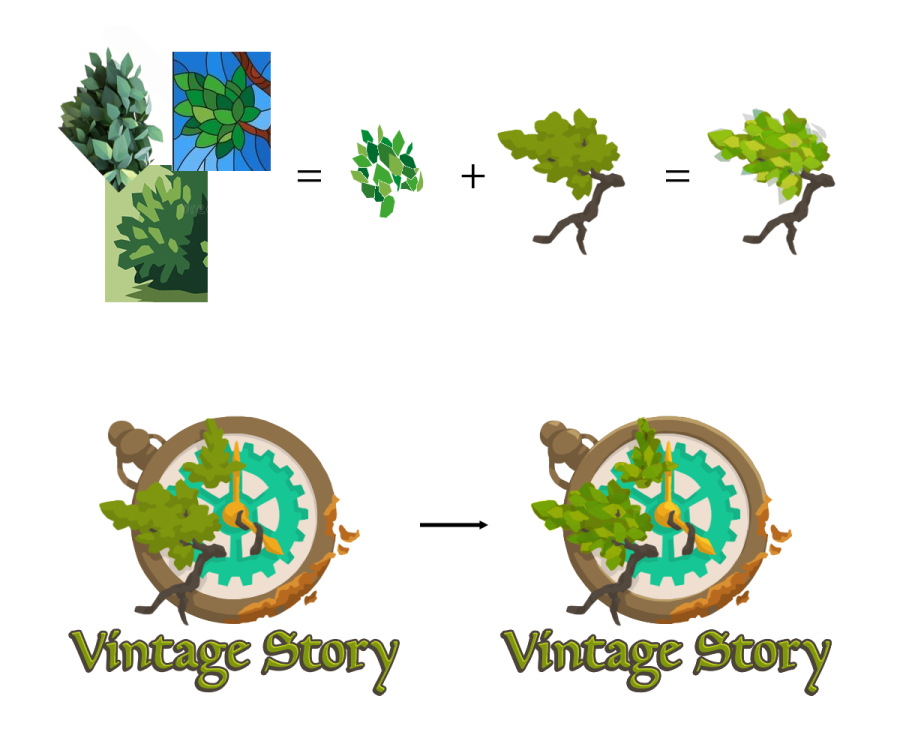
When I moved from the sketch to the colored concept of my logo design, I thought about how I wanted the texture of the leaves to be geometric. With some discussion leaning away from the cut-out style of the new proposed logo, and towards the current logo's painterly style, I wanted to reflect the distinct color blocks of pixels, but in a more organic way than cell shading and squares. I had a vibe in mind, but I wasn't exactly sure what that looked like, so wasn't sure how to go about rendering it. Over the last day or so I've been able to figure out what that style looks like and apply a mock up of that style to the logo I designed (not a proper rendering of it, with every leaf where it should be, just rough version to get an impression, since the rendering style is time consuming). I wanted to share what it looked like in case it resonated with or inspired anyone else. My thoughts: In order for the extra detail to work in the foliage, I had to boost the fidelity of the highlights and shadows in the more metallic surfaces. This is less cohesive with the minimal bevel highlights on the text, compared to the flatter version of the logo, but I think it still works together. The contrast of the green shades has been kept relatively low, so that the detail gets lost in the color block at smaller logo sizes. Overall, I'm not sure it's an improvement to my logo, but I was glad I was able to experiment with the style. It could be something that works in other contexts. In trying to describe this style after the fact, in order to find well executed examples of it to draw inspiration from, I stumbled across brilliant examples of mosaic and inlay that inspired me. I like the way mosaic is frequently made up of tiny geometric tiles. I like the way inlay uses texture in panels to great effect and is absent of the grout that creates a line art like effect in mosaic. More food for thought. Original post:
-
Yeah, I shared this impression, I like that idea. I'm really glad you shared a version that didn't include a clock, because it was good to see what it looked like without one and let me consider whether I felt the clock was a more essential element or not. I think there are 2 time related mechanics, but they aren't the usual time mechanics of pausing, running out of or rewinding time that you see in games; they are less direct. Seasons, and how you really need to farm around them, is something I consider a mechanic that relates to time. The way respawning is canonical has a Groundhog Day kind of aspect to it; the seraph is brought back time and time again, even if the world doesn't seem to reset like in Groundhog Day. Things that happened in the past are also important to the narrative. And the typical journey of a seraph to follow the narrative might take years (as they are tracked in game), so outside mechanics, there's a very narrative element of time present. I had considered playing with the visual depiction of seasons in place of a clock, but I couldn't think of an elegant way to do it in a logo that didn't stray towards accidentally being interpreted as elemental (winter, ice), or think of a good color palette. I feel we see elemental magic a lot in fantasy games and it's nice Vintage Story is operating in a very different design space, so didn't want to drag any impressions of an elemental design space in by accident.
-
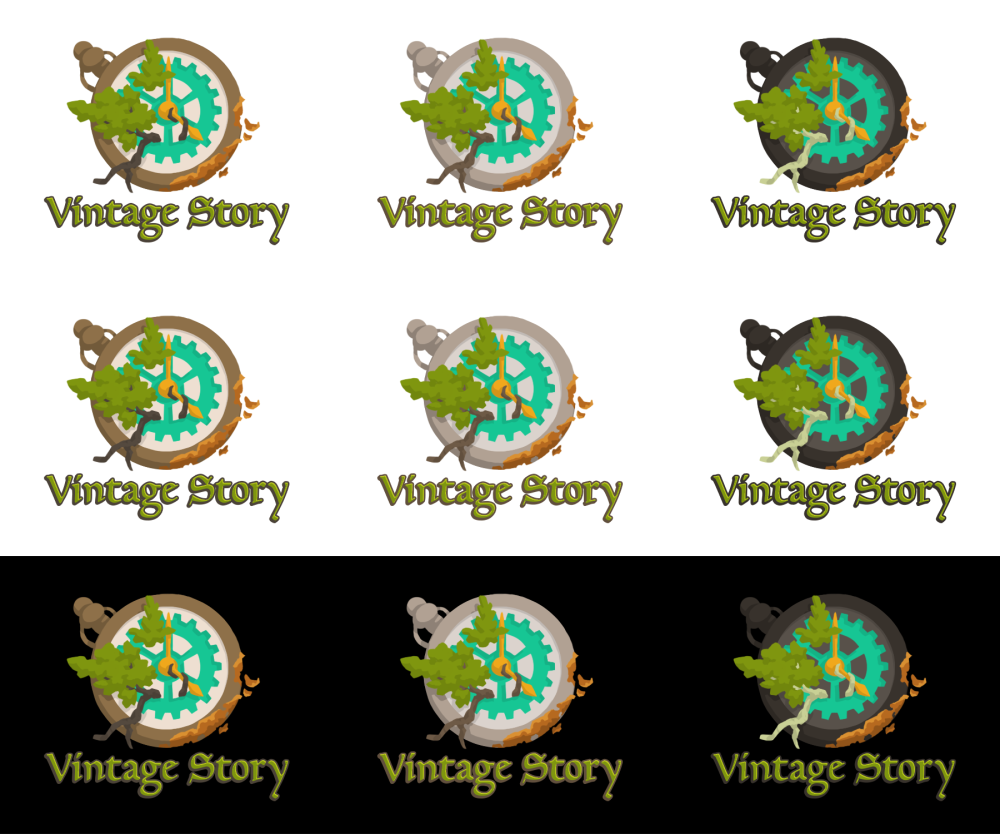
Third pass. Original colors, tiny tweak to face color A version with a silver edge (root saturation boosted to compensate for lack of saturation in frame) A version with a dark edge and a dark face (root lightened to compensate for darkness in background) Overall, I prefer the earthy tones of the original. It's hard to go metallic without losing warmth (and I think those warm tones feel more "vintage" and evoke earth). This is about as far as I can take this, with the skills I have. Would be happy to see others experiment. Original post: Second pass with a little polish after feedback:
- 322 replies
-
- 12
-
-
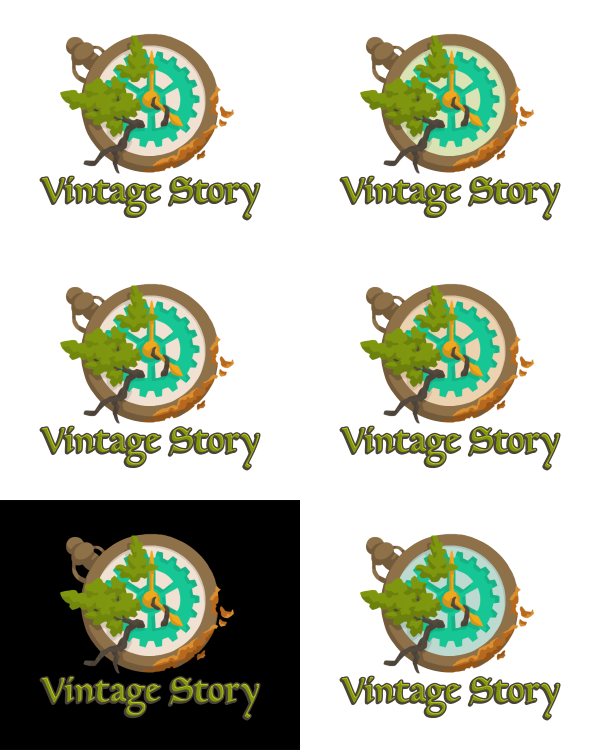
Received uniform feedback that the darker roots were preferred so iterated on that one. A little polish, and trying some different colors for the face as per coolAlias and Nicodemus's feedback. On the left is the color closest to white on different backgrounds. On the right are 3 hues (green, brown, blue, from top to bottom), a bit darker and more saturated. The shadows in those leaves are also darker in order to compensate. Darker colors than that had trouble next to the roots/leaves/gear.
-
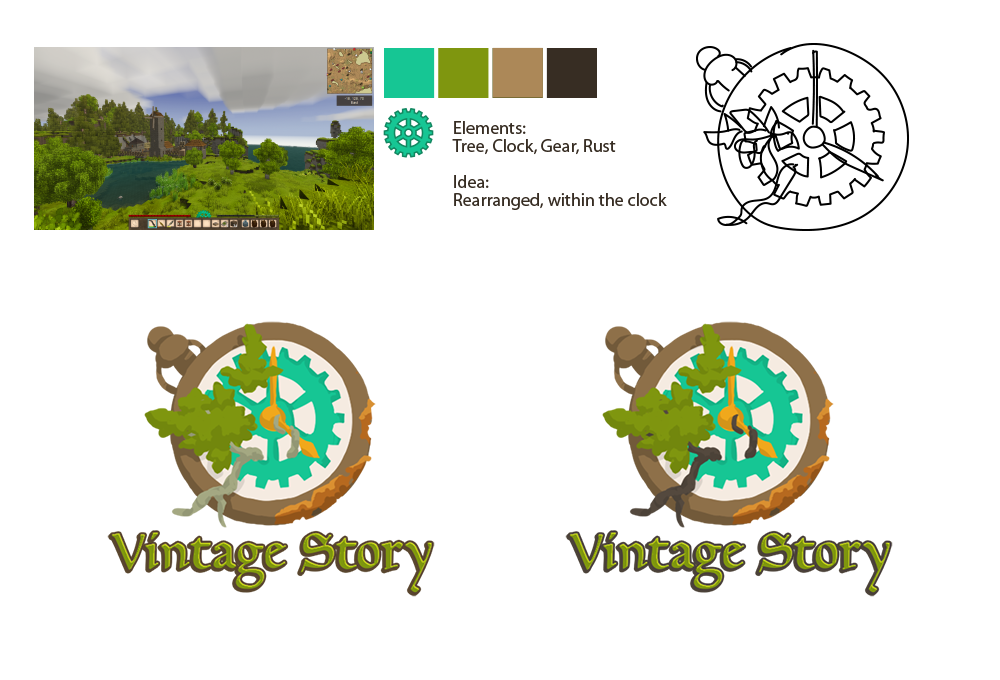
I like how @Zorkman rearranged the elements in this design. I wanted to see what a version that put everything inside a clock (a fob watch, to feel more "vintage") looked like, so I did a sketch. I also wanted to see what it would look like without line art, and block colors, so I did a couple of versions exploring that.
-
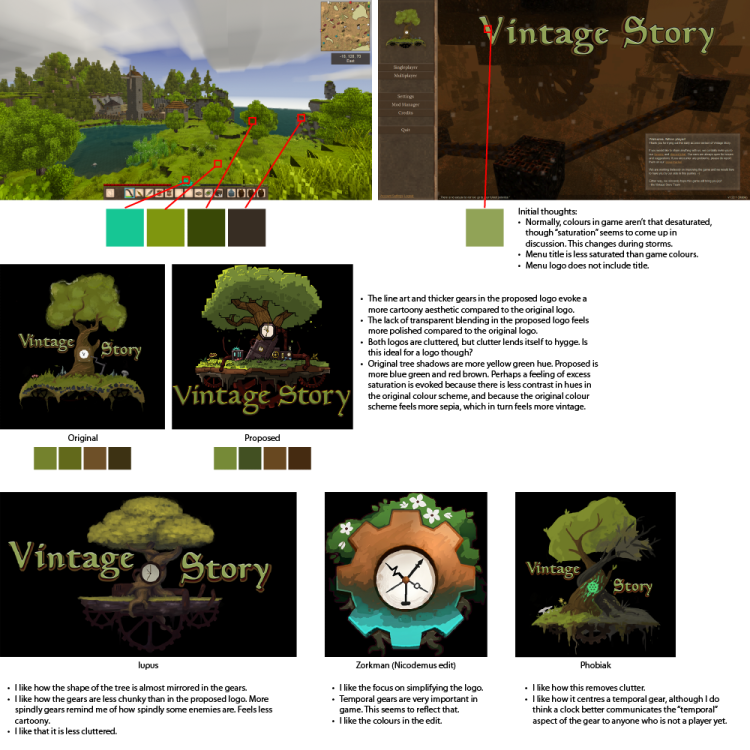
Just some thoughts I had as I was reading through the discussion. I think the clock is an interesting element of the logo, because despite clocks not being present in the game (so far as I have seen by the end of chapter 1), time is so important in the game, and clocks symbolically communicate the importance of time. The passage of time, the slow pace of the game, the relevance to "temporal gears". A clock, as a symbol for time, captures this well.
-
I agree... ...it certainly does seem like the normal bread recipes assume natural yeasts and that a clay container could replace an iron one, so it shouldn't inherently be gated behind the iron age. I would say the only reason that pumpernickel should not use exactly the same recipe as normal rye bread is because the pumpernickel with a 6 month shelf life is distinguished by a few things in its creation not present in the standard bread recipe: Grain instead of flour, a closed vessel the bread is baked inside to prevent the exit of steam, significantly more patience than normal bread (more like making charcoal than baking bread and watching it rise). For these reasons, even if we were to say the player did not need to make an iron tin (and assuming natural yeast), I still think it would be interesting to have a method that puts water and rye grain (rather than flour) in a lidded clay vessel, and cooks it over a much longer period. The problem with simply sticking that in the oven is that the oven doesn't currently have a low and slow mode, so normal oven temperatures are either too high for the creation of pumpernickel or not held at a low enough temperature for long enough. Perhaps the oven might be upgraded through the addition of an iron hatch (as used on the coke oven), so that it can gain a second cooking mode that operates with the door closed? I want the strong benefits of historical pumpernickel (incredible shelf life, nutritional density) to be present in game without making it the only strategy worth pursuing in the early game. By increasing production time (and maybe fuel costs), I hope there will be sufficient reason players don't default to it when not travelling, rather than by reducing nutrition compared to spelt. When one is at base, storing flour and making bread on demand (rather than pumpernickel) should be preferable.