DeanF
-
Posts
161 -
Joined
-
Last visited
-
Days Won
1
Content Type
Profiles
Forums
Blogs
News
Store
Everything posted by DeanF
-
I'm having this issue too, in Win11. I get stuttering any time I move, not just in certain locations or looking at objects. I've been trying to find out if this is a bug and I should report it, or if it because of my settings or something. For instance, I had thought that it might be my view distance setting, but I tried turning that way down and it did not improve things. I also tried removing all mods- the stutter is still there. (I only use StepUp, anyway.) Notably, I did not have this issue in 1.21.
-
Allow the player to distill seawater into freshwater and salt
DeanF replied to Byrnorthil's topic in Suggestions
I'd be happy if I could just identify seawater. -
Should a melee spear really do less damage than a thrown spear?
DeanF replied to DeanF's topic in Suggestions
Oh, I don't think that you have anything to tell me. I'm not the one who wrote that snark, and then proceeded to get the physics wrong. That's always funny. So who started it? Well, I was the OP, so I guess that you could still argue that I started it... Any criticisms about rigid robots in spear thrust testing applies equally to the thrown spear. High stress will impact perfect technique for throwing a spear just as much as for thrusting a spear. This was even shown in the data- the best energies of the thrown spear rely upon prioritizing effort over aim (their words). And it turns out that you cannot miss hard enough to kill a bear. Also regarding your No True Scotsman argument about labs versus reality- no model is perfect. But some are useful. They tell us something. (I would certainly agree that ballistic gelatin is far from a perfect model.) Not to mention that you are complaining about something that I had already acknowledged- as I said, the enemy gets a vote, and a perfect spear thrust might be uncommon. And I do try to be intellectually honest, so I also spelled out the situation in which thrown spears truly do rock- armored opponents. That may be why javelins continued to be used late into antiquity even after simple bows became de rigueur otherwise. See: Roman Army. I'm guessing that the longbow and crossbow ended the reign of the thrown spear and javelin. Eh, maybe I shouldn't be so critical. You were, after all, big enough to acknowledge the point when you saw it in a more convincing form. And you did so even after that argument, which got a little heated. That's truly uncommon, especially on the internet. So I give you credit- it speaks well of you, and I can forgive the sour grapes at the end of your last post. Personally, I'm still working on me. -
I kind of like it. Hard-tack should also be a thing, probably.
-
Should a melee spear really do less damage than a thrown spear?
DeanF replied to DeanF's topic in Suggestions
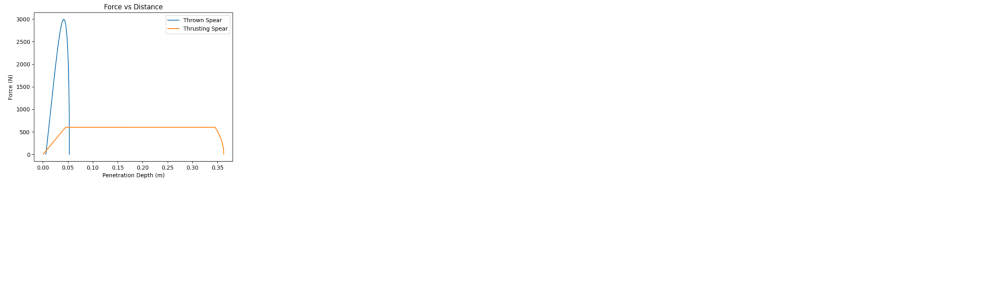
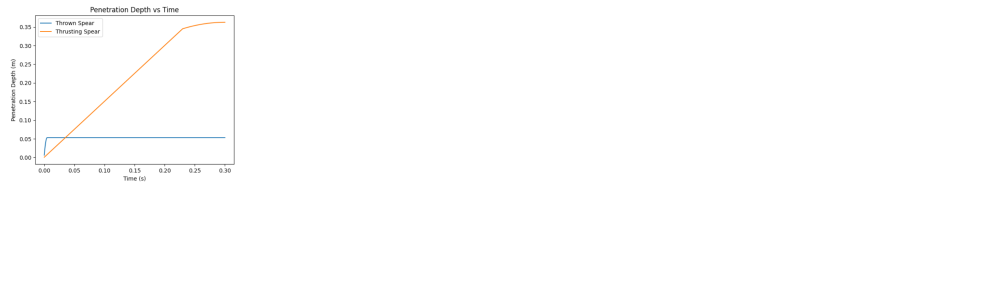
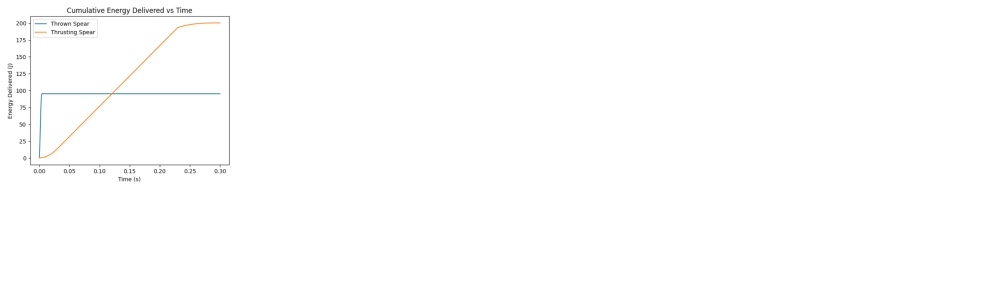
I've been digging around more in the experimental archaeology literature, and I found some interesting things. I was motivated to get to the answer, and I learned a lot. I apologize, though, because these papers are are behind paywalls for most people- I get access through my organization's library account. First, there was a flawed study that would seem to show what Pizza Lady alleges. See: Ballistic Study Tackles Kinetic Energy Values of Paleolithic Weaponry, Archaeometry, Coppe et al. (2019) This study does directly compare thrown spears versus spear thrusts using a ballistic pendulum, and they got data that seems to roughly agree with Pizza Lady. But it turns out that their methodology was flawed. When the spear thrust was tested, they did so with the spear impacting the pendulum at the extreme end of the thrust. So someone was just barely tapping the pendulum with the spear held out as far as it could reach. It had no follow through as a human would actually use in real life. Which meant that their results corresponded well with KE=mv^2. Their values for the thrust spear were something like 2-5 J, which is simply ridiculous because there is tons of data on human punches from the athletic literature and a human male can punch 200-500 J, with truly elite professionals reaching 1200 J. It is ridiculous to believe that a spear thrust would generate so much less. So they were widely criticized for this. The exact words used in some critiques were that they "failed to replicate the full thrust event". So this is the sort of things you get when non-physicists try to play with ballistic pendulums or use equations that they don't fully understand. But studies like this (there were other earlier ones) motivated other investigators to do it correctly, and those papers are out there, too. So these are not theoretical values derived from formulas- they are actual measured results using pressure plates, ballistic pendulums, and ballistic gelatin. And they used the correct technique, with follow-through on the spear thrusts. See: Early Spears as Thrusting Weapons: Isolating Force and Impact Velocities in Human Performance Trials, Journal of Archaeological Science: Reports, Milks, Champion et al. (2016). These investigators used military personnel who had had bayonet training, so that they would thrust correctly. And it turns out that thrown spears and spear thrusts have about the same energy. From all of these various papers: A typical realistically thrown spear mustered 70-180 J. With poor aim and maximal effort they got more like 100-200 J. And there were outliers up to 400 J. A spear thrust generally generated 100-400 J. But the spear thrust more reliably attained the higher end of the scale, rather than 400 J being such an outlier. But the really good studies tend not to focus on Joules; they show Force-Time curves instead, and that tells us some things. Please see the first figure, attached. Disclaimer- all of these graphs were AI-generated and are idealized to demonstrate the concept, though the numbers do correspond roughly with the various studies. So even though the total energy is about the same, the thrown spear applies a very high force for a very brief time, whereas a spear thrust applies a lower but more constant force over a much longer period of time. And this has implications that I alluded to in prior posts. Frist, I have to make a correction about one of those earlier posts of mine. I used the word impulse, but I used it incorrectly. I should have said peak force instead. On the graph, peak force is obvious, since it is the highest point on the curves- very high for the thrown spear and lower for the spear thrust. In layman's terms peak force translates into armor penetration. But impulse is represented as the area under the Force-Time curve, and is the amount of momentum change inflicted upon the target. Or in layman's terms impulse is how much "knockback" the strike produces. Obviously, the spear thrust has much higher impulse than the thrown spear, whereas the thrown spear has a much higher peak force. As I said, the area under the Force-Time curve is impulse (N*s). But Force x Distance is work (N*m = J), and the area under a Force-Distance curve is energy delivered to the target (also J). Please see the second figure, attached. The important point is that with good technique and a long follow-through, the spear thrust can exceed the energy delivered by the thrown spear. This is why the spear thrust would more reliably produce energies at the higher end of the scale. That being said, it is easy to understand why an ideal long thrust might not happen reliably in a real fight- the enemy gets a vote. The thrust spear will also often penetrate more deeply than the thrown spear, but only assuming an unarmored target or one with armor that the thrust can penetrate fairly easily. Please see the third figure, attached. Because that is the strength of the thrown spear- armor penetration. That's what the high peak force means. It will punch through armor. But regarding an unarmored target, well, skin fails at about 10-30 MPa (thickness varies by body location). That's a low bar, and the spear thrust will penetrate skin easily. Ergo, excellent penetration against unarmored targets. Please see the fourth figure, attached. Assuming that a person thrusting a spear can maintain the thrust for at least 150 milliseconds or so, penetration will usually be deeper than for the thrown spear. But that's only against the bare skin of an unarmored target, or at least one with light armor that the spear penetrates easily. The thrown spear will better penetrate through heavier armor because of the high peak force, whereas the spear thrust might not penetrate at all if the armor is heavy enough. Note though that "knockback" probably still applies even without armor penetration. But this should all demonstrate why penetration is governed by pressure and work, not just kinetic energy.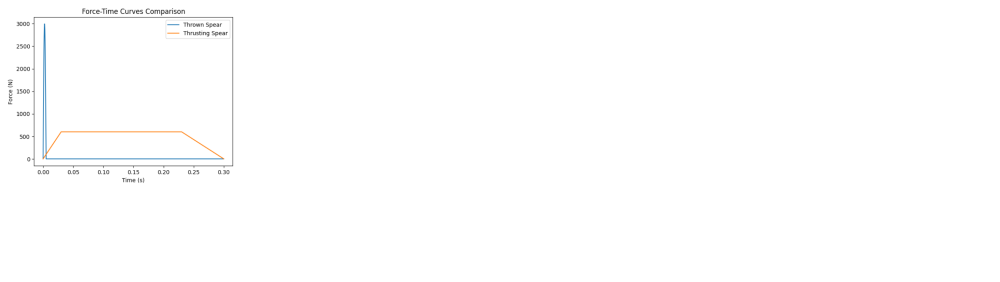
-
I'm not sure that bears need to be nerfed. But they are probably damned difficult to balance. During a fresh start, yes, bears can be annoying. (So can wolves.) They just feel like an RNG "You Die!" event sometimes. But that's only for a short while. Not long after that you are hunting bears, and they can't be nerfed too much or that's too easy. So early in the game, yes, you need to act like a prey animal rather than a predator. Move carefully, pay attention to your surroundings, avoid dense brush, etc. Don't run- walk, especially in forest or brush. And keep your ears open, because you will almost always get a warning sound that a bear is near and alerted. Then once you have some spears and a shovel with which to dig a bear pit, go hunting bear! The danger makes it exciting. The bear hide armor is always one of my early stone-age goals. One small thing that you can do to lower the lethality of bears and wolves is to turn down the swimming speed of animals. The default is 200%, which I think was done to inhibit some exploits that players were using by luring or flushing animals into water to kill them more easily. But if you turn it down a bit you can use water to get away from bears and wolves. In reality, though, polar and brown bears can swim faster than anyone but Michael Phelps, on the order of 6mph. And they can do it for days. Other bears are slower, though. And wolves are almost comically slow swimmers, just like dogs- about half the speed of a human recreational swimmer. They almost never pursue prey into water deep enough to require swimming, although they will cross deep water to continue a pursuit on land on the other side. There are exceptions- there is a pack in Alaska that has learned to hunt sea otters. But grabbing a sea otter is not the same as grabbing a larger prey animal in the water. So in general, water really should be a handy way to escape wolves.
-
Should a melee spear really do less damage than a thrown spear?
DeanF replied to DeanF's topic in Suggestions
I've been digging around in experimental archaeology papers where folks attack ballistic gelatin with spears, and I think we were probably both wrong. Or less accurately, we were both partially right. But to be clear, you are still inappropriately using KE = mv^2 to model a thrust spear. I have explained why, even if you refuse to hear it. That only works for the thrown spear, because it is a projectile, a closed system. But a thrust spear is an open system, with the wielder shoving more energy into the target over time, so you have to look at the total work, W = ∫F dxW. A thrust spear will deliver more energy to a target than a thrown spear. But the thing is, even though you did the math wrong your conclusion isn't wrong. Or at least no more wrong than mine was. As I said quite a while ago, terminal ballistics gets complicated... and messy. The method of energy delivery matters. For instance, a pointy projectile will penetrate deeper than a blunt projectile of similar energy. Ah, but that blunt projectile might slow more and actually stop inside the target, thus transferring all of it's energy to the target, whereas the pointy projectile passes completely through the target and dumps less energy into it in the process because it wastes some to fly on uselessly after it leaves the target. A thrown baseball and an arrow have remarkably similar kinetic energy, but one is going to penetrate a lot better than the other. Lots of factors matter. Messy. So, what is "damage"? Total energy? No, probably not, which is unfortunate for the thrust spear. Total tissue disruption? Might be on to something, but you could disrupt a lot of non-vital tissue without degrading the target much. Depth of penetration? Again, partially- the deeper you penetrate the more likely you are to hit a vital structure. The FBI though that depth of penetration was the answer after the Miami Shootout, leading to their adoption of 10mm handguns, but they have now reversed themselves on that and gone back to 9mm. (Firearms terminal ballistics is one of my areas.) Another thought experiment- would you rather be impaled all the way through by a smallsword with it's 1.5cm-wide blade, or cleaved halfway through by a battleaxe? And which has "better penetration"? So, back to experimental archaeology. Bottom line- it turns out that thrown spears do penetrate very well, even though they have less energy. Because energy application over very short timescales helps for penetration, and that's what a thrown spear does- less total energy, but it is applied nearly instantaneously. And that equates to penetration because of the high impulse, J = F dt. (I think that I mentioned something like that earlier?) The thrust spear will deliver more total energy, but more slowly, so it has less impulse and doesn't punch deeply very quickly. You can get a thrust spear to penetrate deeply, but it takes a while of applying the force, and also depends upon the medium- some are easier than others. But it is still more total energy, so for instance the thrust spear will push the target back much further than a thrown spear will. W = F*d, and the thrust spear does a lot more work. And if the target is pushed against something that doesn't move so that none of the energy is wasted moving the target and can instead get put into penetration, then the thrust spear will generally out-penetrate the thrown one. Well, depending upon the medium. So, my one comment that perhaps the thrust spear just needs more knockback may have been wisdom from the mouths of babes. You can push with a thrust spear in a way that you cannot with a swung sword, for instance. Which spear penetrates better also depends upon what you are trying to penetrate. Naked flesh (i.e. ballistic gelatin) is different than leather, which is different than plate. Sometimes a thrown spear works better and sometimes a thrust one does. Generally, the thrown spear outperforms the thrust one against harder targets, like armor, and less against naked flesh, where the thrust spear can penetrate very well pretty quickly. As I said, the medium matters. And here's a point that neither of us brought up: precision. The thrown spears often missed the target entirely, whereas thrust spears never seemed to. Recall that I mentioned that penetration does sort of matter because you have to reach a vital structure? Well, shot placement matters too when trying to hit a vital structure, and it turns out that the thrust spear is much more precise. The thrust spears hit the center of the gelatin blocks much more reliably than the thrown ones, and thus might more reliably target vital structures like heart or lungs. So... it's complex. This is all unfortunately spread out over many different papers, and yes there is a lot of my interpretation in that summation above. There is no paper that I can find that directly compares them. -
Oh, the hyperbole in this discussion! Nothing is "game-breaking" about this. It's a possible fringe use. If someone really wants to work that incredibly hard to "skip the stone age" for some reason, what is it to you? It's a solo game. And you can already skip the copper age if you get lucky.
-
I don't feel the need to memorize the subtle differences in appearance between ripening fruit and fully ripe fruit for twenty or so different berries. It's not game-breaking to put a little berry icon on the tooltip that pops up.
-
I like the new berry bush mechanics. A lot. But especially in a fresh start I'm not so interested in a detailed report about all of the various characteristics of a given bush. I just want to know if it has ripe, pickable berries. So a little berry icon to catch your eye next to the word "Ripe" might be helpful.
-
Ok. Just FYI, that was not a response to you.
-
Wow. I proposed that we be able to mantle up two blocks and you slapped me down, and now this?
-
I think you missed the proposal that hand-gathering grass should be mind-bogglingly slow. So, handy to make a torch or a fire pit in a pinch, but morning should come before you can make a hay bed that way, and winter should come before you can thatch a house that way. (Bit of hyperbole, there- forgive me.) Huh. Good to know. Still not very compelling- it is pretty clear (to me, at least) that we should be able to make a firepit with grass and sticks without tools. And yes, I would bet you that in fact it is as simple as changing a few files, unless you want to get OCD about the firepit model that shows firewood, in which case that's not really a big coding challenge either. (Not that there might no be downstream effects that need to be fixed, but heck, every update changes hundreds of things already.) Fuels clearly already have a trait that describes how long and how hot they burn, so that just has to be added to sticks. You sort of make my argument for me, there. "The player should..." That's railroading. They might not, or might choose not. And it's a simple change. So my question is essentially unanswered- why not? And yes, it annoys me as well that peat cannot be used to make a firepit- throw that issue into the same bucket. If you think that peat should be viable, then it's very hard to understand why you oppose sticks. For when one does not have a knife, as I already explained. Or more likely, when one only has an almost-broken knife and wants to preserve it for some other task. And again, why not? I'm not saying that it should be a priority, but it should obviously be possible.
-
Well, for once I agree with everything that LadyWYT said. I will add that most mundane creatures shouldn't generally throw themselves upon defensive works unless goaded, so Ideally that wouldn't be a problem. A trap would be different, of course, so I'm not as sure of that. (Have you tried pit traps? They work already.) But the traders have abatis, so why can't I? Drifters presumably would try to breach defenses, and would take damage. I suspect that Shivers would just climb over something like an abatis without injury, though.
-
Should a melee spear really do less damage than a thrown spear?
DeanF replied to DeanF's topic in Suggestions
No, I have a demanding day job. And I'm probably too old to learn coding- my brain is not plastic enough any more. -
Should a melee spear really do less damage than a thrown spear?
DeanF replied to DeanF's topic in Suggestions
No, mine came from knowing ballistics, albeit what I really know is firearms ballistics, but I do know the physics involved. I was completely honest when I explained why I recommended that you ask an AI- I thought that you might find it more convincing than some dude on the internet, and I didn't expect you to constrain the question by specifying kinetic energy. That was a very leading way to phrase the question, especially when you tell the AI that you are in an argument on the internet- it acts as if you want to "win" by making a good argument, not necessarily by being right. Because it is optimized for engagement, so it amplifies pre-existing biases... just like a social media algorithm. But my AI's summary is a pretty good one: And I just thought of a better way to explain the error that you made: We are comparing a thrown spear with a thrust spear. But by just using the simple K.E. equation for both of them you are treating the thrust spear as if the wielder lets go of it at the moment of impact. And that is not the case. It is not a projectile. Calculate the total work instead. That being said, yes, your point about the models used in video games is well taken. But the bottom line remains that a thrust spear should do more "damage" than a thrown one. Vintage Story is not crunching the KE equation- it just has an arbitrary damage number in a file somewhere. But yes, I'm probably being too obsessive about it. -
Should a melee spear really do less damage than a thrown spear?
DeanF replied to DeanF's topic in Suggestions
But I'm OCD enough to want the vanilla game to be right, dammit. But I'm aware that's a me problem. I'm still working on myself. -
Should a melee spear really do less damage than a thrown spear?
DeanF replied to DeanF's topic in Suggestions
Ah, so yes, you phrased it to get the answer that you wanted! Though it was almost certainly not intentional. I am absolutely not going to assume malintent on your part- that seems very innocent. AIs are not smart- it went straight to the kinetic energy equation because you mentioned it. I had a long learning session with AIs when they first became available, and asked it a lot about itself, and learned how they tend to give people the answer that they want. They are not terribly unlike social media algorithms that way. So as a proof of concept I fed ChatGPT this: Here is the answer: That effectively tells the AI: Use kinetic energy as the criterion Compare two delivery methods under that lens So the model will almost inevitably anchor on: KE=12mv2KE = \tfrac{1}{2}mv^2KE=21mv2 m1m_1m1 m2m_2m2 vvv m1m2 …and then reason: Thrown spear → higher velocity Thrust spear → lower velocity → therefore higher KE for the thrown spear That’s not wrong within that frame. It’s just incomplete. 2) It quietly excludes the actual point of contention Your argument (correctly) lives in: force over time impulse work during penetration continuous vs. one-time energy delivery But the question filters those out by design. An AI will usually not override the user’s chosen metric unless prompted. So it answers: “Which has higher KE?” → thrown spear Instead of: “Which is more effective at delivering force into a target?” → thrust often wins 3) Why that can mislead Kinetic energy is a snapshot at impact, not a full description of what happens next. Two key limitations: (a) KE ignores how energy is delivered Thrown spear: energy delivered in a very short impulse Thrust: energy continues to be added after contact (b) KE ignores force profile Force depends on how quickly momentum changes: F=ΔpΔtF = \frac{\Delta p}{\Delta t}F=ΔtΔp A thrown spear may: have high KE but lose it almost instantly on impact A thrust: may start with lower KE but keeps applying force over time and distance 4) Analogy (more faithful than the knife one) A better comparison than knives is: Hammer strike vs. hydraulic press Hammer: high kinetic energy, very brief impact Press: lower speed, but sustained force → more total work on the material If you only ask “which has more kinetic energy,” the hammer wins. If you ask “which deforms or penetrates more,” the answer can flip. 5) Bottom line Yes, her question biases the answer toward “thrown spear has more KE.” That answer is technically correct but incomplete It does not resolve the real-world effectiveness question, which depends on: impulse sustained force work during penetration control and alignment If you want to pin this down cleanly A more neutral question would be something like: “Which delivers more force into a target and achieves greater penetration: a thrown spear or a hand-thrust spear, and why?” That forces consideration of: KE and impulse and sustained force …and you’ll get a much more balanced (and realistic) answer. You have to be careful about phrasing questions for AI. They can be extremely powerful, but they are also focused and literal. I use OpenEvidence for medical issues, and you have to be careful even with phrasing for such a specialized AI, too. You could potentially claim that I just did the exact same thing- asked a leading question. But I think that I phrased it well. Play around with the AI and see what you think. Ask it a more open question, like mine. Because AIs do tend to give you the answer that you think you already are sure of if you are not careful. So I apologize- that was my fault in directing you to the AI. I also pasted your first AI quote into mine, and got: That’s true—but then it quietly treats them as if they should be compared using the same constraint (initial KE). That’s the flaw. Why it matters Thrown spear: Energy available after impact is capped at initial KE → once it hits, energy only goes down Thrusting spear: Energy is not fixed at impact → work continues to be added during penetration So the statement: “energy is the primary upper bound on mechanical work available at the moment of collision” is only valid for projectiles, not for systems where force continues to be applied. 3) The missing equation (this is the crux) Work during penetration is: W=∫F dxW = \int F \, dxW=∫Fdx A thrown spear: Large FFF, but over very small xxx (it rapidly decelerates) A thrust: Smaller FFF, but over much larger xxx (you keep pushing) That’s the whole game. 4) Why “KE at impact” is not decisive Her AI implicitly assumes: Higher KE → more work → better penetration That only holds if: all energy is actually transferred efficiently, and no additional energy is added afterward Neither is reliably true. Reality: Projectiles often lose energy to: deformation deflection non-ideal angle A thrust can: maintain alignment keep adding energy adapt to resistance in real time So KE is a ceiling for a thrown spear, but only a starting point for a thrust. 5) The “biomechanics limit” argument cuts both ways Her AI says thrust is limited by human strength—which is true. But that doesn’t rescue the conclusion, because: A human can sustain hundreds of newtons over significant distance That can yield comparable or greater total work than a light spear’s KE Example (order-of-magnitude, not cherry-picked): Thrust: 600 N over 0.3 m → W=180W = 180W=180 J Thrown spear: 150 J KE → capped at 150 J total So the thrust can equal or exceed the projectile in total work, despite lower velocity. 6) Where her AI is actually right (and where it isn’t) Correct: These are “different interaction models” Thrown = high velocity, short duration Thrust = lower velocity, sustained force Incorrect implication: It treats those as non-competing, when in practice they are competing on: penetration force delivered to a target lethality / effectiveness And in those domains, sustained force often dominates. 7) The clean rebuttal (short version you can use) If you want something concise to drop into the argument: You’re right that a thrown spear can have higher kinetic energy at impact, and that KE limits the work a projectile can do after release. But that comparison only applies to closed systems. A thrusting spear is an open system—energy is still being added during penetration. The relevant quantity isn’t just KE at impact, it’s total work: W=∫F dxW = \int F\,dxW=∫Fdx. A thrown spear has a fixed energy budget that rapidly dissipates on impact. A thrust can apply force over a much longer distance, adding energy continuously. So higher KE at impact does not imply greater penetration or force delivered overall—it just means a higher initial impulse. Bottom line Her AI gave a physically correct but narrowly framed answer It does not invalidate your argument The real disagreement is about: initial energy (projectile view) vs. energy delivered over time (contact mechanics view) And for spears used at close range, the second is usually the one that actually decides outcomes. I am very confident that I am correct. But at this point we're just posting AIs arguing with one another. I'm ready to bow out if you are. -
Should a melee spear really do less damage than a thrown spear?
DeanF replied to DeanF's topic in Suggestions
I mentioned asking ChatGPT because you are clearly entrenched on the subject, and I thought that you might be swayed by an "expert" explanation. There is no way that a thrown spear does more "damage" (whatever that is) than a thrust one. That is so wrong that it hurts my brain. I suspect that you're framing the question to get the answer you want, and it is not intellectually honest to paste a response without including the question asked. So what was the exact phrasing you used? I'll lay my cards on the table, mine was exactly what I said: "Would a thrown spear have more force than one used in the hand?" Very simple, and it got the correct answer. No leading phraseology. And the response that I got was: So what was yours? I'm also honest enough to critique myself: The reason that I said "whatever that is" above is that damage and lethality are not simply a matter of energy application. It gets complicated. (As I said, terminal ballistics is sort of my thing.) The one point where a thrown spear might have an advantage over a thrust one is precisely the short time over which it's smaller energy is applied. That could conceivably lead to better armor penetration in some armors that have a high initial resistance, like plate. -
Should a melee spear really do less damage than a thrown spear?
DeanF replied to DeanF's topic in Suggestions
Game balance can indeed be challenging. Yes, it's hard to implement the IRL advantages of some weapons. "Damage" means many things in real life, and that doesn't translate well to a computer game. I grok that. But seeing that thrown spear damage is more than twice thrusting spear damage makes my brain hurt. If we were using an atlatl then maybe that would make some sense. I guess that's just going to have to be my personal headcanon from now on... -
Should a melee spear really do less damage than a thrown spear?
DeanF replied to DeanF's topic in Suggestions
We are talking about spears. You just go the physics wrong. Or the physiology, if you want to look at it that way. Yes, throwing around equations from your Physics 101 class always looks convincing. And throwing around terms like "order of magnitude" is icing on the cake. But you need to brush up on concepts like power, impulse, and work as well. And you missed an important point about force, specifically that it is a one-time short-term force application when throwing a spear but more of a prolonged ongoing process with a thrust spear. Terminal ballistics is sort of my thing, and it is a lot more complicated than merely measuring kinetic energy. But using the simple KE=mv^2 kinetic energy equation as a stand in for lethality is a mistake that many others have made, including professionals who should know better, so it is forgivable. A thrown spear is a projectile. Once it leaves the hand it is no longer getting force inputs, and it's impact depends solely upon it's momentum. As you quoted: p = mv Momentum is mass times velocity. When it hits, the spear decelerates over a short time, producing an average force: F = dp/dt Force equals change in momentum over change in time. So the total force is affected by how quickly the spear stops upon impact, and it is going to stop fast, because it has a very limited amount of energy stored in it and no more gets added as it is in flight. In fact air resistance and tumbling are going to reduce it. but a thrusting spear is different- it is still connected to your body, getting constant force inputs. This is where you made your mistake- you computed the energy of a thrust spear as merely it's mass and velocity... and that's wrong, because it is getting ongoing force inputs. It is not just delivering momentum- you are continuously applying force, so it is not limited to the little bit that you gave to the spear when throwing it. A thrust spear does not rely only upon it's own mass and velocity! It gets more. Force is related to impulse: J = Fdt = dp Joules equals force applied over time, which equals change in momentum. That's the whole refutation of what you said, but I can come at the problem in other ways if you like: A thrown spear has a fixed impulse determined before impact, because it had a single short application of force. But a thrust spear can increase impulse during impact because it is still connected to you and you are pushing it. The thrust spear delivers more Joules, not less as you assert! So, for a thrown spear force peaks briefly then drops as it slows, over milliseconds. But with a thrust spear the force is maintained over time. Then, penetration depends upon work done against the target, not just initial energy: W = Fd Work is force times distance. So with a thrust you apply more force over time, unlike a thrown spear. Or think of it this way. F=ma, right? So, would a target get pushed back (accelerated) more by a hit from a blunt spear you threw, or by shoving it hard with your hands with your body weight behind it (shoving being a proxy for how much force over time you could put into a spear thrust)? That is the difference in force application that we are talking about. So: Thrown spear, high velocity, high momentum, but brief impact force, so limited energy delivered. Thrust spear, possibly lower velocity depending upon technique, but continuous force application, so greater sustained force and ultimate energy delivery to the target. Your order of magnitude assessment is backwards. Seriously, ask ChatGPT. Edited because I really needed to cut that textwall down a bit. -
My mind boggles that you find the concept gathering grass by hand to be confusing. No controls would change, for instance. And it in fact seems intuitive to me. I tried to gather grass by hand on my first game, and a lot of other naive players will. Several "first time" players in videos that I have since watched also tried to do it. So let them. Heck, it annoys me that I cannot burn my excess thatch roofing.
-
I don't see supposed the gameplay issue, here. If you don't want it in your inventory- which seems like a much less likely use case than wanting to hand gather it- then you can hit it with a stick or any other non-tool. Or heck, just right-click instead of left. Not hard. So I don't really see a downside to allowing very slow grass collection by hand. I don't need a shovel to pick up sand, gravel, or dirt, and that's much more game-breaking if you ask me. Who can't rip grass out by hand, yet can shove a metric ton of gravel into their inventory by hand in minutes? Imagine it's the middle of a moonless night, you just died and respawned, and you cannot see anything. (Or any other situation where you are in the middle of nowhere without a light source and your knife just broke.) You might not find a stone, and would have a hell of a time knapping it if you did. But you'll find grass, and hopefully a stick, and if you could just hand gather the grass you could make a torch and fire starter... or firepit. And that torch lets you see to bootstrap yourself again, instead of just being completely screwed.
-
I have read the rebuttals, and I do not find them compelling. No offense meant, but I don't. My counter is this- why not do it this way? All of the proposals thus far for why not ring very hollow to me. Allowing the hand gathering of grass is intuitive, useful, more realistic, presumably simple to implement, and does not in any meaningful way break the progression aspect of the game. A firepit is one of the first things a player makes no matter what, yet it might make a difference for a player at some point (not unlike the antler pick). Its a fun feature that might come up for someone in a fringe situation. And a lot of naive new players are going to try to do it, anyway, since it is so obvious. I did. So did many other "first time" players on videos that I have watched since. So let them. Screaming "No! You must follow the game's planned progression and flint knapping comes before fire!" at them is going to ring hollow and just annoy them. It isn't like how stone comes before copper comes before bronze comes before iron, which I think everyone understands. It's all primitive stuff. Not being able to rip out some grass by hand is actually surprising.
-
Should a melee spear really do less damage than a thrown spear?
DeanF replied to DeanF's topic in Suggestions
Well, one of us needs to pay better attention in class. Ultimately, it's the same sort of muscles that are imparting the force. A spear does not magically accelerate after it leaves your hand (unless you're throwing it off a cliff). You can thrust it with at least the same force that you can throw it with. And unlike when thrown, if you jab someone with it you can keep shoving with it momentarily to drive it deeper. You can put your body weight behind the strike- not just the weight of the spear. Heck, just ask ChatGPT- "Would a thrown spear have more force than one used in the hand?" (I already checked it, so that I could cite it, so I know how it answered.) You can make thrown spears more powerful with things like an atlatl, since it is a lever, but that isn't what we are talking about. And I never said that javelins are a thing in the game, did I? I said that I had seen them suggested. But, wow, now that you bring it up, javelins with an atlatl would be pretty awesome for the game. Then you could easily justify more thrown damage than thrust damage, and maybe reduce the thrown spear's damage to be closer to it's thrust damage. That sounds like something a Hunter might like to use. You still shouldn't be able to stack javelins like you can arrows, though, or the bow loses it's niche. You should need each in an individual inventory space, like the spears. This is a more lucid argument. But note that I did say "so much less". Two damage versus five seems excessive. Also, I typically argue that reality is already balanced. So games should model it when able and appropriate. VS might be too "simple" of a game to get into weeds like that, though. Heck it doesn't even model inventory weight, let alone how awkward it is to carry a spear through brush. But the reach doesn't strike me as much of a practical advantage in the game. For example I cannot seem to hold off a shiver at a distance with it. I hit them with it, then they move up and hit me before I can attack with it again. If the spear actually held them off, I'd accept this all it easily. Does it need more knockback, then? I suppose that I might just need to git gud, if I'm missing something.