DeanF
-
Posts
161 -
Joined
-
Last visited
-
Days Won
1
Content Type
Profiles
Forums
Blogs
News
Store
Everything posted by DeanF
-
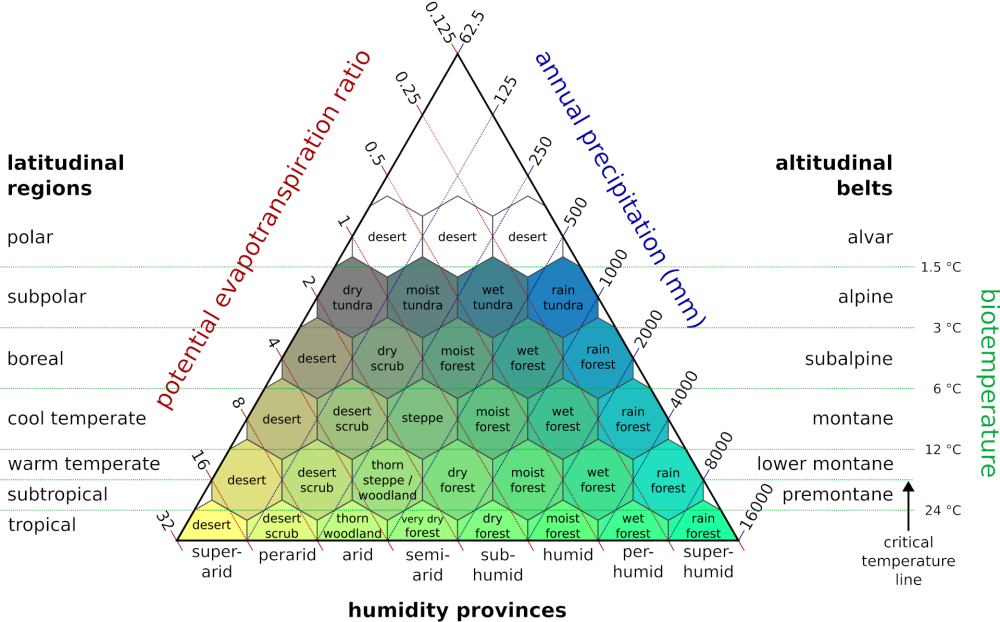
A fair point. I would agree. Good to know. TOPS looks like it's a map of someone's long-standing server? That's nice-looking. I had found a different VS map utility, which looks terrible but it does let you generate any seed that you like. I did mention all of that, unless I was editing while you were posting. But nonetheless, the 15 to 35 degree trend stands. A lot of what you are referring to is smaller-scale. I did mention Nile-like floodplains and sky islands, right? Love those. A large desert would still be varied- areas of stone, areas of dune, mountain ranges (some with sky islands), rivers (some day), differing vegetation depending upon just how arid it is, etc. Yes, I'm familiar. As I mentioned, I went through climate-pedant worldbuilding phase a while ago. I got far too obsessive about it. I tend to prefer Holdridge life zone classifications rather than Koppen. It gives you more of a "ground reality" than the mere temp/rainfall of Koppen- it tells you what sort of land you are notionally walking through. But a lot of software tools still rely upon Koppen, unfortunately. That even looks good as a color scheme for a map! I would definitely contest that. You say: But the very problem is that Minecraft sets those "climactic conditions" in a wholely arbitrary fashion. The way that VS has climate bands north-to-south is still simplistic but nonetheless MUCH better than what Minecraft does.
-
They are beautiful, I'll give them that.
-
The way that bears and wolves behave in the game is already unfair to bears and wolves. What's the difference? The game just needs an oceanic threat, and sharks are the obvious possibility. A huge Humboldt squid would be pretty awesome, too, though. But I agree that players should be very safe in the sailboat. Just not swimming (or rafting?) huge stretches of open water. Rafts should generally be coastal craft, for instance. The water-creature threat should increase with water depth, and again the sailboat should be impervious. We should also be able to make a raft out of reeds (thule or papyrus), not just logs. And I'll plug my own old proposal for an intermediate craft bewteen raft and sailboat:
-
FYI- "Grains are seeds" is a well-known and often-discussed issue. The devs have commented. It's on the list of things to address, but not a high priority. Some day.
-
OK, where do I get the song?!? I must have it!
-
You mean an image editor? GIMP, because fuck Adobe. Those new ArtCraft clones give me a chuckle, too, but I'm not as familiar with them.
-
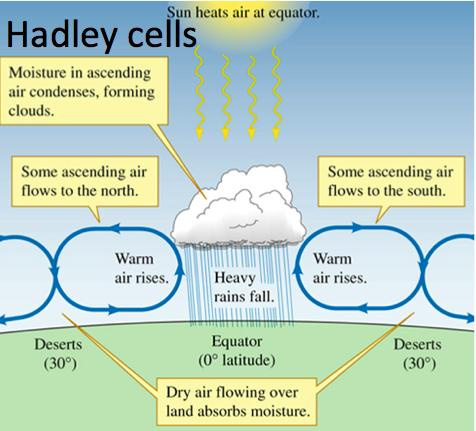
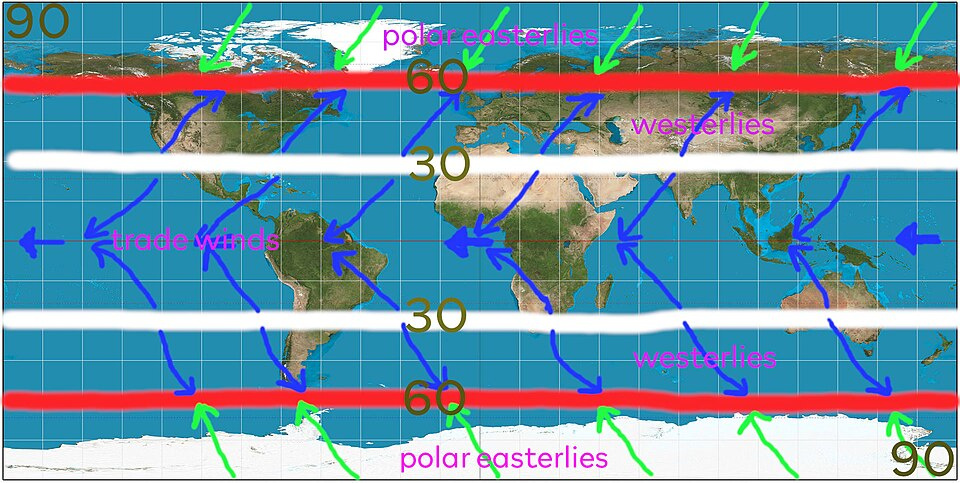
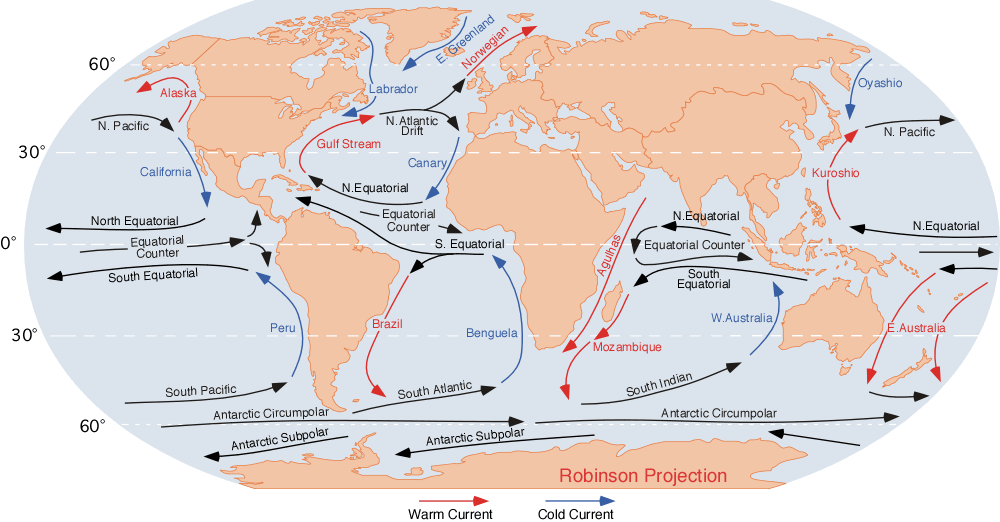
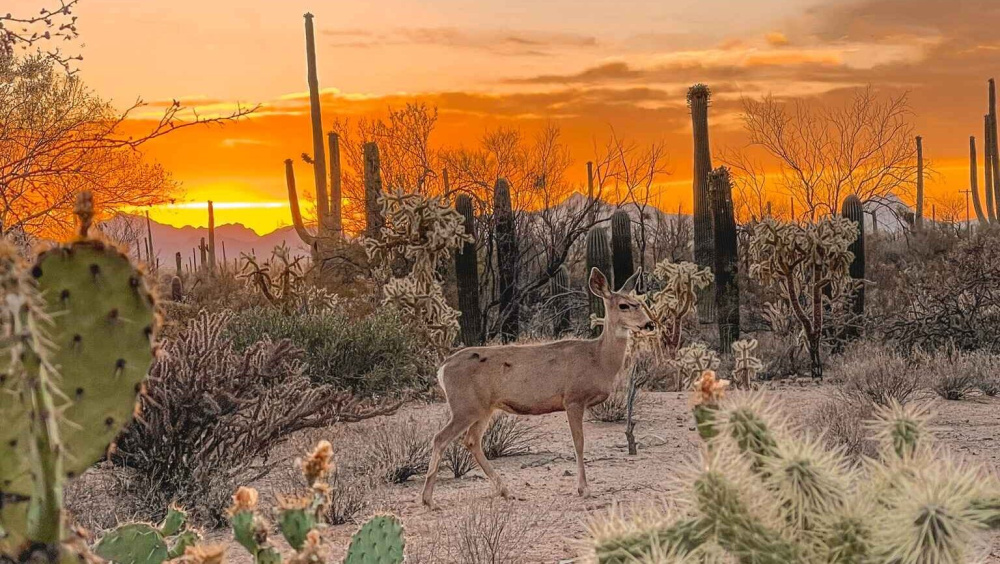
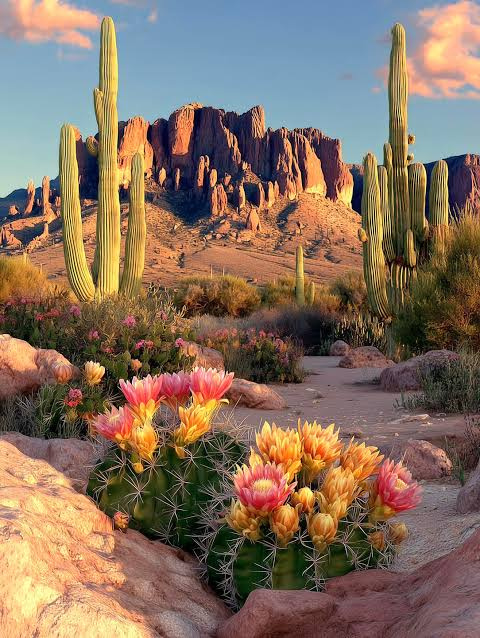
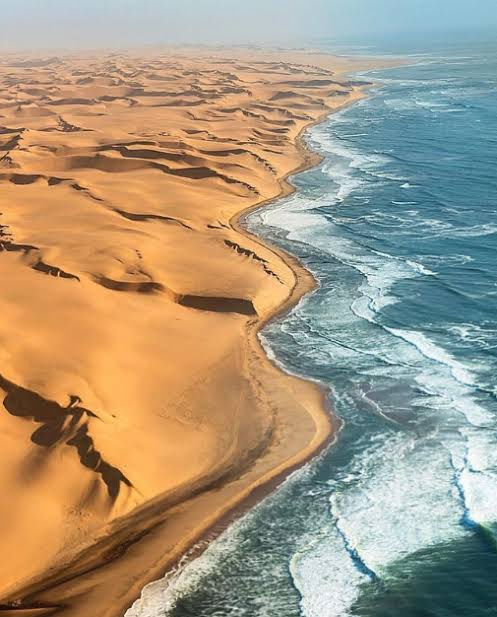
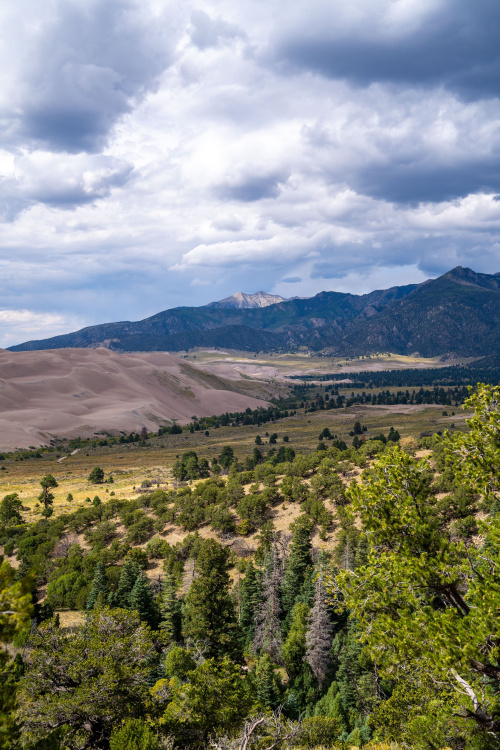
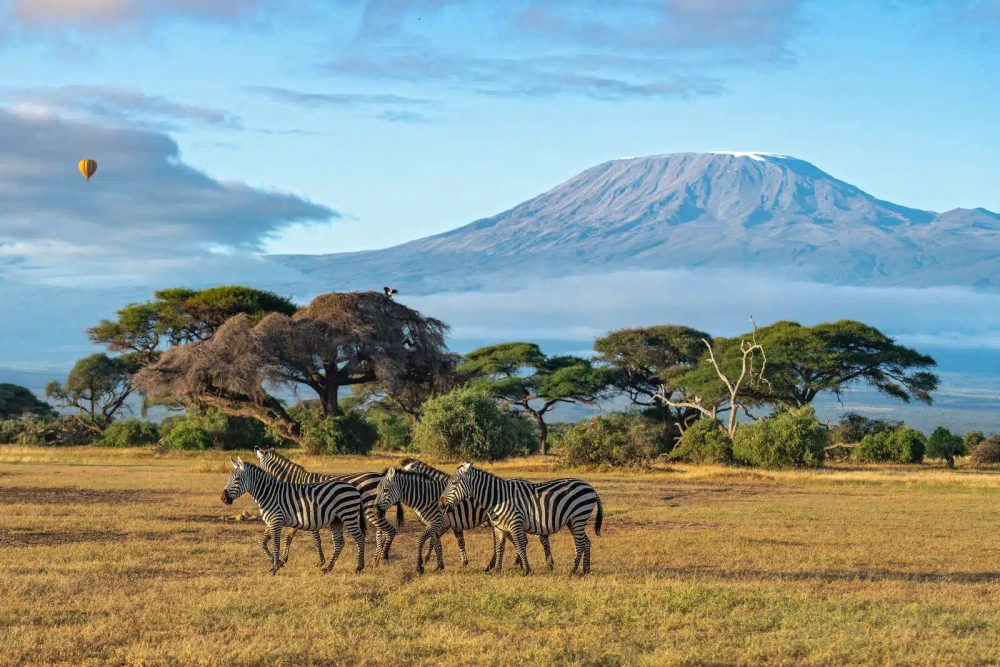
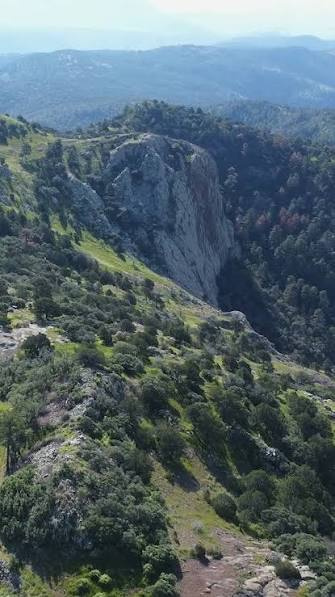
Sonoran Desert: Size, and thus challenge. It would be nice if deserts were large, and thus real obstacles to contend with- you would have to go through or around them (probably by sea). Think of the Sahara. And for a real challenge, start in one. It would be nice if rivers- when those get implemented- might have lush floodplains in deserts, and there were occasional oases, and sky islands, etc. And detailed desert flora and fauna. I absolutely love sky islands- the real ones, I don't just mean floating blocks. (And Minecraft does have the real ones, nowadays...) Davis Mountain, a sky island in Texas: Again, I have only played in temperate zones and am just now getting around to wide exploring, so if I'm wrong let me know. But the current small patches of sand or gravel seem more like the very unrealistic Minecraft biome system. But VS seems to at least make motions towards a bit of realism. The map is 1000x1000 km, with four climate bands: arctic, temperate, warm, and tropical. (Right?) Mind you, we could still have those gravel and sand patches- many of the gravel ones are covered in pine trees, similar to real environments in temperate areas, and things like the Great Sand Dunes in Colorado do exist. But the real deserst should be a band between 15 to 35 degrees, and those huge dunes in other areas should be relatively uncommon. Great Sand Dunes National Park: GSDNP is one of my favorites. I used to live nearby, and it and the San Luis Valley and Sangre de Crusto mountain range were sort of my stomping grounds. Ineed, and if you look at a globe you will see IRL that those areas of low annual rainfall tend to happen from 15 to 35 degrees (both north and south), usually starting on the west side of continents and spreading eastwards until it either hits a weather-driving mountain range or the eastern shore. (There are also arctic deserts, but that's not what I'm talking about.) This is because of Hadley cells, which are an effect of the Earth's size and rotation: The equator heats the air. Strong sunlight warms the tropical oceans and air. Warm, moisture-laden air rises, creating a belt of low pressure. As it rises, it expands and cools, and water vapor condenses into clouds and heavy rainfall. This is why equatorial regions tend to be wet. The air moves poleward high in the atmosphere. Having lost much of its moisture through rainfall, the air spreads north and south, away from the equator. It cools as it moves, eventually becoming dense enough to descend, typically around 20–35° latitude. The air sinks and warms. Descending air is compressed by increasing atmospheric pressure and warms. Its relative humidity falls, clouds struggle to form, and rainfall is suppressed. This creates the subtropical high-pressure belts in which many of the world's great deserts occur. The air travelling along the surface back towards the equator- skewed a bit by the Ciroiolis efect- is what causes the Trade Winds. And air travelling towards the poles causes the Prevailing Westerlies. (And at about 30 degrees are the Doldrums, with little wind.) That's why deserts tend to form on west coasts- the east coast at least gets a little moisture that the winds have picked up over the oceans, and those east-coast oceans tend to be warm currents, which release more moisture. Contrarily, there tend to be cold ocean currents along west coasts centered around 30 degrees, and cold water releases less moisture, thus deserts form on west coasts. These currents are also an effet of the Earth's rotation (See: Humboldt Current, Benguela Current, California Current, etc.) These effects- wind and currents- reinforce one another to cause these deserts. The Sahara-Arabian Desert, the Desert Southwest of North America, the Atacama of South America, Western Australia, the Namib-Kalahari of southern Africa- they all follow this model. The Sahara-Arabian desert ends at the Himalayas, and the Atacama at the Andes. The others just peter out as they approach the east coast. Namib: There are other factors, of course. The Earth's rotation and prevailing surface winds also affect this, and can nudge the desert band around a bit. And large mountains can also cause deserts- the Gobi and Taklamakan are almost entirely due to the rainshadow effect of the Himalayas, for instance, and the North American interior is at least semi-arid because of the very long span of the Rockies and Sierra Nevada, which also creates a rainshadow. )And Eurasia is just so immensely huge that it's interior gets little moisture.) But the 15 to 35 degree arid band due to currents and Hadley cells is the general trend. Explanation- I got seriously into realistic climate models during a worldmaking phase a couple of decades ago. (Cartographersguild.com has great resources.) It's a rabbithole, and I'm not proposing anything like that for VS. But the devs do seem to like the idea of large climate zones, so a desert could be one of them. I had actually thought of this already, and it may not be as involved as it first seems. As I mentioned, the devs already have large climate zones where temperature and rainfall vary. And this then drives the local flora. The desert band would just have rainfall curtailed, then it would probably generate automagically. And decent desert flora and fauna would be nice. Well, we get to select where we spawn. I would propose five climate bands instead of four, since the desert lattitudes would act as one: Arctic Temperate Warm Desert Tropical I think right now we have four, right? Arctic, temperate, warm, and tropical? I could be mis-remembering- I have never spawned anywhere but temperate. And yes, the challenge is one feature that I already mentioned above. If you want a real challenge then spawn in the desert climate band! Everyone likes messing about in deserts- they seem "exotic". Unless you live in one, of course, as I do... And if you do want to go down the climate rabbithole then the desert band should have a narrow band of savannah around it- north, south, and east. The Maasai Mara, a savannah: No, not unless I am misunderstanding the VS map. I think it only covers the northern hemisphere, right? With arctic at the northern end (pole) and tropical at the southern end (equator)? So we would only see the 15 to 35 degree north desert band, between the Warm and Tropical climate bands. Am I wrong? Does the VS map go to both poles? I could easily be wrong- as I said, I am just now starting serious exploring.
-
I find that the deserts in VS aren't really deserts. They are too much like a random biome from that other game, just "an area with sand" or "an area with gravel". Maybe I just haven't traveled far enough? If so, let me know. Anyway, since VS has such huge maps I think it would be interesting (and preferable) to instead have HUGE deserts across the desert latitudes, approximately 15-35 degrees. They would be actual obstacles, creating challenges to cross.
-
Post the entire recipe that you are trying.
-
How do you setup traps for larger game (pigs, bears)?
DeanF replied to grinning_serpent's topic in Discussion
Dig a one-block wide stair down to the bottom of the pit. Bears and wolves are >1 block wide, so you can sit outide their reach and stab them with a spear. -
What is your favorite material to make lanterns out of?
DeanF replied to SnapJelly's topic in Discussion
Molybdochalkos is the way to go in the very early game, when you may not have tons of copper sitting around. You at least get to save a little, and lead is common. In the later game I tend to like brass, because by then I have lots of copper and I tend to also have a lot of zinc laying around once I get iron. So why not use the two things that I have in abundance- copper and zinc? Tin for tin bronze is often (appropriately) hard to find, and bismuth bronze takes fair effort since it has more ingredients to be hunted down. -
Because it is lighter, titanium works horribly for some uses that require mass. Like hammers, axes, or swung swords. Even a titanium knife just doesn't feel right. (Titanium knives are used when corrosion resistance or non-sparking characteristics are desirable, such as for diving or EOD.)
-
Not completely. For some resources a heat map is generated from the seed, and that heat map is the same any time that you use that seed. The probability of whether a chunck actually has that resource in it is set by the heat map. Then all of the probabilities for those chunks get rolled randomly. Roughly. But that's why you can use the same seed over and over and not have cassiterite lodes in exactly the same place, especially if you found one in a "dim" area of the heat map where the probability was low. But in a "bright" area of the heatmap you should at least find some nearby. Here is a VS map viewer that you can play with that will make it all clear: https://vintagestory-map.com/?s=AQAAAABgbwy08R5IfA It has some issues- for instance it clearly doesn't display sea level or areas with many small lakes correctly, but it will teach you what I am talking about. Similarly, you will find traders in the same spot, but the type of trader gets randomly rolled, so they will usually be different even with the same seed. Ruins seem to work differently. I have found that that there can be no ruins whatsoever in a spot that had ruins in a prior playthrough of the same seed. Dungeons are the same. Yet ruins at least are likely to be in the same spot- just not always. (This last paragraph is experiential on my part- I'm not entirely sure how the mechanism works.)
-
I have reached the point where any time something happens in Linux that I don't understand, I just ask ChatGPT. Sadly. The big advantage is that you can then demand that it explain everything, instead of just reproducing the "magic words" that some smug ass gives you on a forum. Assuming that the smug ass even knows what they are talking about in the first place.
-
Only if by "close ranges" you mean 100m.
-
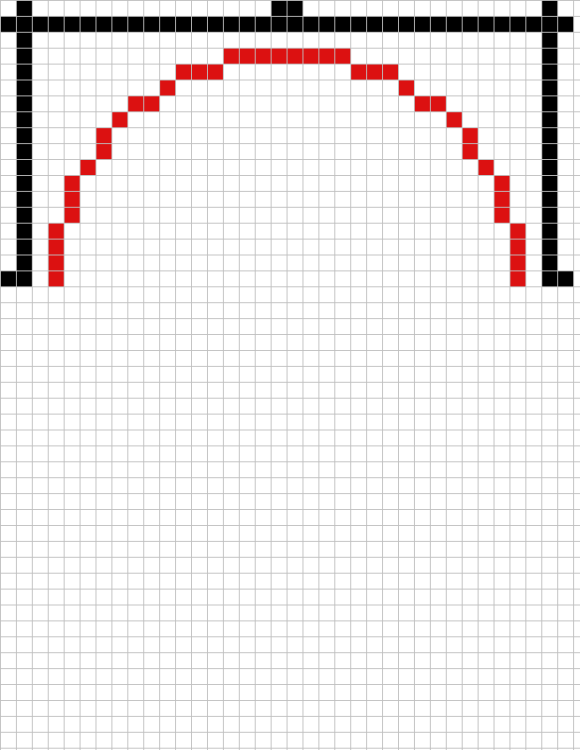
I have seen a lot of questions about making arches, so I thought I'd throw out the 2-block arch guide that I made for myself. It should print on an 8.5"x11.0" sheet. (Sorry, I'm American.) Remove the red and everything inside them. One of my goals was to leave at least one pixel on the outside of the arch. This is so that if there is a block of dissimilar material next to the arch, the different material will be covered. I did this because I often make an arched fireplace and put an oven next to it, and I didn't like to have the brown oven wall showing. This does mean that this is a 30-voxel circle instead of a 32-voxel circle, but if the two blocks under the arch are air it looks right. Edited because I'm an idiot and got it wrong the first time.
-
- 8
-

-

-
I will accept all of that... when wind actually affects arrow flight.
-
I have requested the same in the past.
-
Sifting different kinds of Sand for different resources
DeanF replied to CyberCat05's topic in Suggestions
Fineness. One "official" definition of sand has particles between 0.074 mm and 4.75 mm. By another it's 0.0012 cubic mm to 4.2 cubic mm. But (I assume) for lime to actually dissolve in water it would have to be more fine than that. And not unsurprisingly, almost every source defines dust as "anything more fine than sand". If I'm being really persnickety we should have to burn it in a lime kiln, too, not just grind limestone or chalk. But I guess the game reserves burning for quicklime. I do like the idea of claystone having higher drops for clay. That seems both handy and thematically appropriate. Not sure about shale/blue clay- I just don't know how that relationship works. Your Pulverizer materials ideas sound logical, but as you said there may be game balance reasons not to do that. It does seem silly that we cannot somehow make glass from silica sand. That actually surprised me.- 4 replies
-
- 1
-
-
- materials
- processing
- (and 1 more)
-
To be fair, almost everything that you are shooting at has larger hitboxes than in real life. A wolf, for example, is >1m wide. I'm not sure if that all evens out, though. Oh, define your terms, Brother. What do you mean by "accuracy"? If you mean reliably hitting an individual human at 100m, the answer is no- that's not realistic. You'd need to aim 15-20 degrees up to hit at that range with a 100-lb longbow, so you're aiming above the target's head. Without sights. And while accounting for the Archer's Paradox. Not a recipe for accuracy. Later (1800s) archery experimenters recorded approximately 50% longbow hit probabilities at 100 yards but that was against 4-foot wide targets, so they were much larger than a human torso. There are no records describing hit probabilities at range from medieval times, unfortunately. The ones that do usually just mention the ranges at which archers trained, and that may be where you found those long ranges, but that was training to hit a formation not an individual. One such record mentions training at 600-foot butts, for what that is worth. Probably. Archery in movies and RPGs are usually shown as being far more accurate than IRL. Massed archery was artillery. As I mentioned above, it was fired at formations, not individuals. Not so much modern archery, though. On a still day I can put shafts into a area the size of a dessert plate at 40m all day with my compound bow... which admittedly has sights, unlike a longbow. But I have shot primitive bows... and honestly I had a hard time even finding the target, let alone grouping well. At 10 yards. The Archer's Paradox sucks. (And my compound bow does not suffer from that, either.) And bear in mind that Olympic archers routinely stack shots into a 12.2cm bullseye at 70m. (!) Sonofacrap, that's impressive. But, that is using modern bows with modern stabilizers and sights.
-
I had started another thread where I proposed adding quiche to the game, as a sort of an egg-based pie: And during that discussion I also thought of mince pies, so I thought I'd make a new post. It has always seemed odd to me that meat pies could not be made with fruit, since meat pies are commonly made with fruit IRL. In particular, what was called "mince pie" in Medieval times was almost nothing like what we call mince pie today (at least in the U.S., Europe may be different). The Medieval mince pie had meat in it- hence the term "minced meat"- whereas modern U.S. mince pie is all apple, raisin, dates, etc., and a bunch of spices, with no meat at all. But other combinations of meat and fruit were also common- pork and apples, mutton and prunes or figs, or venison and berries. So I propose that in the game a Mince Pie should be a pie made with any combination of meat and fruit. The model would be pot pies, which in the game now are any combination of meat and vegetables. If we add both quiche and mince pies to the game that will be seven kinds of pie, to placate the pie fanbois. Of course, if the devs implement spices as they are rumored to want to do, then the entire cooking system will need a revamp, anyway.
- 1 reply
-
- 5
-
-
Yes. If you put in eggs, it's a quiche. That's my point. You claimed that from what I described you could put eight veggies in a pie call it a quiche. And that was false, since my entire premise was that to be called a quiche a pie needed eggs. I still have no idea where you came up with that. But I think that I have finally figured out what you are hung up about. Yes, among other issues, you're getting hung up on semantics. A pie does use ingredient slots. They just aren't displayed the way that a pot recipe is, and you can't really take an ingredient back once you put it in. To make a pie you must make a crust and then add four ingredients of 2 each, and the game will only let you add another ingredient that is valid. Well, that is four slots. 4x2. What you seem to be twisted about is that you seem to think that pie recipes are fundamentally different in some way, but they really aren't, which is shown by how pot pies work. Most pies are absolute, with only one category of ingredient in all four slots: all veggies = vegetable pie, all meat = meat pie, all cheese = cheese pie, all fruit = fruit pie. But pot pies are a bit different, in that any combination of meat and vegetables makes a pot pie. So, here is the thing that's going to blow your mind: There is no reason that a quiche cannot require four eggs minimum. So we are saying the same thing, here, except that for some reason you seem to think that it would be impossible to code a 4 egg minimum requirement. What happens if you make a pie and put in 2 meat, 2 more meat, 2 veggies, and then try to put in 2 fruit? The game won't let you put the fruit in, right? Well, the same thing could be so for quiche. For instance if you try to make a recipe with 2 eggs, 0.4L milk, 2 veggie, and then try to add 2 cheese it won't be a valid recipe. The system wouldn't let you add the cheese, because the only valid remaining ingredient is eggs. That being said, I don't know if a quiche actually needs to require 4 eggs. That's why I asked if others thought it should be different. Maybe they only should require 2, if only because it would be nice to have multiple ingredients. Consider Quiche Lorraine- it has both bacon and cheese, and if a VS quiche required 4 eggs and milk then having both meat and cheese in a quiche wouldn't be possible. So maybe it could just be what you said- any pie with 2 eggs and 0.2L milk plus any other ingredients would be a quiche. I had only proposed four eggs because to me most quiche seem to be mostly egg. But if I'm wrong on that, then I'm wrong. That's why I asked. But even in that case, the game would have to be more discerning than it is for a pot pie. It has to check for the presence of eggs and milk plus two of anything else. For instance, what should happen if you put in 2 eggs, 2 meat, 2 fruit, and then try to put in 2 cheese? Well, the game shouldn't let you- the only valid ingredient that you could put in would be milk. But we could make it even easier- leave out the milk, and say that a quiche is any pie that has eggs plus any three other ingredients. Maybe it's just easiest to say that the "any other ingredient" could be milk? And while we are on the subject, meat pies should allow one slot of fruit. Including things like dates, raisins, currants, or apples in meat pies seems to be common IRL, such as in the original Medieval version of mince pie (modern mince pie is all fruit). Or do we need a separate "mince pie" for any combination of meat and fruit? That would be seven different kinds of pie!
-
Not once you have beeswax for sealing crocks. Then it's a bit redundant. Even more so once you are making leather. Actually, I have never done an oil press- can you use vegetable oil in place of fat to make furs?
-
I'll allow it.
-
There is already a mechanic to salt meat- that probably cover's grandma's bacon. But I agree that jerky would be a welcome addition. I share the frustration that bushmeat is arbitrarily made inferior to red meat in so many ways. (I understand that this is done to encourage agriculture and pastoralism, instead of just remaining a hunter-gatherer. But why can't someone be a hunter-gatherer if they want?) After the first couple of months bushmeat is basically only good for stinkbait. So yes, we should be able to make jerky from any meat, including bushmeat. For balance, it should probably lose a little nutritional value in exchange for the longer shelf-life. Or maybe it needs to be made in a smoker instead of just dried, as I discuss here: If that isn't considered enough, then require cooking it in a pot with some water before it can actually be eaten. Hmm, something like hard-tack (or pilot bread) might work the same way... Pemmican would be awesome, too. Powdered dried meat, fat, and berries. You should at least need a pot to make it, with very little fuel needed. The recipe would probably be 2 dried meat, one fat, and one berries for one pemmican. So there would be a hierarchy of shelf-lives. Raw meat spoils quickly, cooked meat a little slower, jerky and pemmican much slower, and salted meat the slowest. But I suspect that the devs might object to pemmican on the grounds that since it has such a great shelf-life and can be made so easily in the early game, why would anyone make anything else? So jerky and pemmican should actually have about the same shelf-life, with pemmican having an advantage in being more nutritious (since it has berries) and is more compact in your inventory. Sort of like how one pie slice takes up the same inventory space as one cooked meat, but it much more nutritious..