cjameshuff
-
Posts
122 -
Joined
-
Last visited
Content Type
Profiles
Forums
Blogs
News
Store
Everything posted by cjameshuff
-
Mechanical Refrigeration System Using Aqua Vitae
cjameshuff replied to Aarón Rodríguez Hernández's topic in Suggestions
An efficient mechanical compressor will require high-precision machine tools and doesn't seem terribly consistent with the setting. It may be more plausible to implement an "icyball" style gas absorption refrigerator that doesn't require moving parts but needs to be manually recharged, but a more consistent approach would be an actual insulated ice house that you fill with ice made during the winter, or perhaps an evaporative cooling system. -
Increase Room Size Maximum Dimensions, While Retaining Maximum Volume.
cjameshuff replied to KoviBat's topic in Suggestions
A couple thoughts about dealing with the performance: Require some special object to "bless" a space as a room. Maybe only do the check around firepits: every room (or every large room, the existing rules being used for small ones) requires a firepit to keep it warm. If the volume is limited to something less than the entire possible volume of the enclosing cube, if you have a starting point within the room, you can scan to the potential boundaries and stop processing if you reach that limit, without even having to do more complex processing to ensure chiseled blocks are valid boundary blocks. If the volume is within limits, the number of boundary blocks to check doesn't scale anywhere near as badly, especially since most rooms will have fairly simple shapes with reasonably low surface area for their volume. -
Is bauxite that hard to find or am i just unlucky?!
cjameshuff replied to omeko88's topic in Questions
In my 1.21 world, the first story location was far to the south. In my 1.22 world, it's to the southeast, and the second and third locations are directly to the east. My assumption has been that they're randomized, probably with limits on how close they can be to each other or to spawn. -
I would love to see a space age mod or someting
cjameshuff replied to LiLbaconboss's topic in Discussion
Look at Factorio. Building your first rocket involves creating an entire industrial base, often with multiple generations of factories to build the things you need to build the things you need to build your rocket, with automated systems mining distant ore deposits, pumping and processing oil, and transporting materials and intermediate components around. The Seraph does all that alone and none of the humans take note? VS isn't exactly medieval, it looks like things were in something like our Renaissance and the early stages of an industrial revolution, but they were just starting to experiment with unpowered flight. However, alongside their clockpunk/steampunk machinery, they also had technologies like teleportation, and might have taken a completely different approach that could get there much sooner if things hadn't been interrupted. -
Mortar production 50% nerf was unnecessary and awful
cjameshuff replied to InternetDragon's topic in Discussion
Glass being made in a bloomery is weird too. Bloomeries being used for both calcining flint and making glass by fusing quartz is even weirder, since flint is quartz, and has actually been used as a high purity source for making glass. -
Mortar production 50% nerf was unnecessary and awful
cjameshuff replied to InternetDragon's topic in Discussion
In a bloomery. Which works, and is very welcome as a more efficient way of calcining flint, but feels odd considering that bloomeries are specialized furnaces for producing iron, and we can heat crucibles to copper-smelting temperatures in a normal fire. Maybe we could have a furnace that's more durable than a bloomery, more efficient than a fire pit, with one or more crucible slots? -
Mortar production 50% nerf was unnecessary and awful
cjameshuff replied to InternetDragon's topic in Discussion
I don't see the grinding as a problem (I need a lot more flour, salt, powdered charcoal, etc), but I really would like a more efficient way for calcining it. It's a bit strange to be cooking it on a campfire when we can smelt substantial amounts of copper alloys in crucibles. -
Is bauxite that hard to find or am i just unlucky?!
cjameshuff replied to omeko88's topic in Questions
In two worlds that I've gotten to steel in, one of them that I've reached the second story location in, I've only found one body of water worth building a boat for, at a distance where it's most practical to access by translocator. It does have bauxite along its shores, but I have numerous easier sources. (Also, I have yet to encounter a story location to the north.) -
Vanilla accessibility option for hearing bees
cjameshuff replied to Toby Watson's topic in Suggestions
The sound is easily drowned out by rain and wind, too. I would suggest making bees that can be found near flowers at a distance. I installed Buzzwords in my first world to figure out if I just wasn't hearing them, and it turned out that the problem was that there simply weren't any near any of the locations I regularly went. While there were several hives in one wooded area not too far away, I didn't normally go through there. If you could find bees near flowers that were arriving and departing in the directions of nearby hives, it would serve as a longer-ranged hint to their presence. -
One way to approach this is just a less efficient recipe. Instead of cutting a log into 12 planks, smooth a piece of split firewood (4 per log), maybe with a stone adze or something. You can work wood with stone tools, it's just slower and less efficient. If good doors need to be dependent on metal, add nails and strips to the recipe, but buckets, barrels, etc would be possible, just expensive.
-
The seeds are an issue too...only walnuts are edible, and you can only harvest them by destroying the tree, which if you've ever had a walnut tree...is not how they work. Acorns, pine nuts, etc should be edible and harvestable in season.
-
It's especially weird in this case, since we're talking about a water soluble mineral that should be softer than anything but talc. Yeah, my previous world had limestone nearby so I could make leather as soon as I could make barrels, which just took copper tools. In my current world, I have to go through a translocator to find any practically accessible limestone but keep tripping over nearby borax deposits, making leather a bronze-tier material. (And there's multiple cassiterite deposits in the caves containing those translocators, so by the time I could reach limestone, I didn't need it.) It seems like it should be one or the other, not something that depends on how convenient it is to mine limestone.
-
My previous world had a limestone-rich area nearby and I only used borax for an iron anvil and a cementation furnace. In my current world, I didn't encounter limestone until I found a translocator that linked to an area with it, and have exclusively used borax for leather. It seems very odd for the metal tier required to make leather changes based on this difference.
-
Borax-cured leather isn't better than limewater-cured leather, and if you have limestone nearby, the requirement just means you use limewater instead. If you don't have limestone nearby, you're just out of luck until you get bronze.
-
I've actually had to dig around borax while looking for near-surface copper and bismuth. It's very strange that you need bronze to mine it, considering that it's a soft mineral (softer than calcite) that is one of only two options for making leather.
-
I think making it alcohol-fueled would be enough, especially if you have to replace inventory containers with fuel storage. You could stockpile enough fuel to make a long trip quickly, at a cost in being able to move large amounts of items, and the cost of producing enough aqua vitae means you wouldn't be able to use it for general travel. For example, I've just returned after locating the second story location and staging some outposts on the path to it, to get some final supplies before I head in. This would be a great time to fly back out, explore the place, and then head back on foot or via any translocators that link close to my existing network.
-
Why not just go without armor? If even copper chain is too much...don't wear it?
-
There's similar issues with blocks underneath them, a barrel that is accessible and visible through the chiseled portion will be dark. This goes for slabs as well.
-
In reality it's used for flavor more than its nutritional content. In game, it's mostly meant for fish bait, not a staple food crop. I did find it useful as foraged food my first year, as there was quite a bit of it growing wild in my area. It's similar to mushrooms or flax that way, there isn't a reason to use it as food once you get established.
-
I actually built a water wheel before finding any rapids. I've had the pieces sitting around for quite a few in-game years. I've been working steel for several years now, have a full set of plate armor, and have only found one location with rapids that might be suitable for building at, near the far end of a translocator link from where I settled. I have an ample stockpile of cassiterite and know several locations where I can get more, in my previous world I similarly had no shortage of it, though in both worlds I also had more bismuth, zinc, and tin than I had copper to alloy them with. I have reasonable amounts of gold and silver, but have only made black bronze for trade. In my first world I was stuck with bronze for a fair amount of time, I had iron nearby but was very unlucky with my first few attempts to locate it.
-
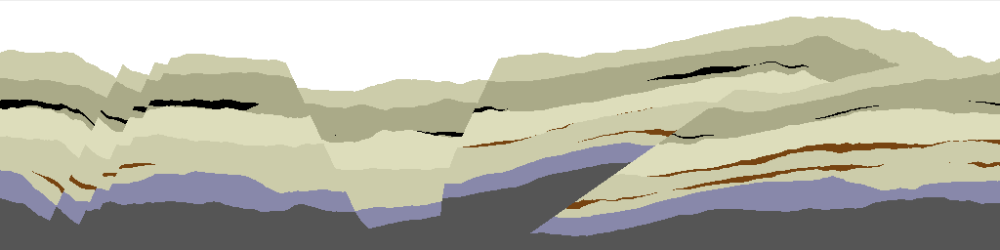
Somewhat related to that...here's some 2D proof of concept stuff I've been tinkering with for more realistic terrain generation. This is based on composing various functions that distort or otherwise modify other terrain functions, starting with a function that simply lays down an uneven deposit of a material...mainly been messing with basic faults, haven't yet gotten around to any erosion effects.
-
Planes; Gameplay, balance and other stuff
cjameshuff replied to Helst_navngivet's topic in Discussion
This is Vintage Story. It would obviously have a very high chance of killing you. -
Silver containers for preserving food/juices/milk
cjameshuff replied to Steppe King's topic in Suggestions
Copper will outright dissolve in hot acidic foods, it can be dissolved in vinegar to make copper acetate, a pigment and fungicide. However, copper pots and kettles have been quite widely used in cooking. Copper is easily worked and has very high heat capacity and conductivity, so it's easy to avoid hot spots and get even heating, and the toxicity is low enough it's usually not a problem. It can also easily be coated with tin to prevent corrosion and allow use with more acidic foods. -
My response would be "the other bear". The one that pops out of the bushes when you move in to engage the first one.
-
And here's me carefully quenching my steel knives strictly for durability. Stone knives don't last long, and replacing them in the field means you have to either interrupt work to forage for sticks and flint or devote inventory to them. I might start quenching for speed instead...didn't know about the entity harvesting bonus.