MKMoose
-
Posts
686 -
Joined
-
Last visited
-
Days Won
2
Content Type
Profiles
Forums
Blogs
News
Store
Everything posted by MKMoose
-
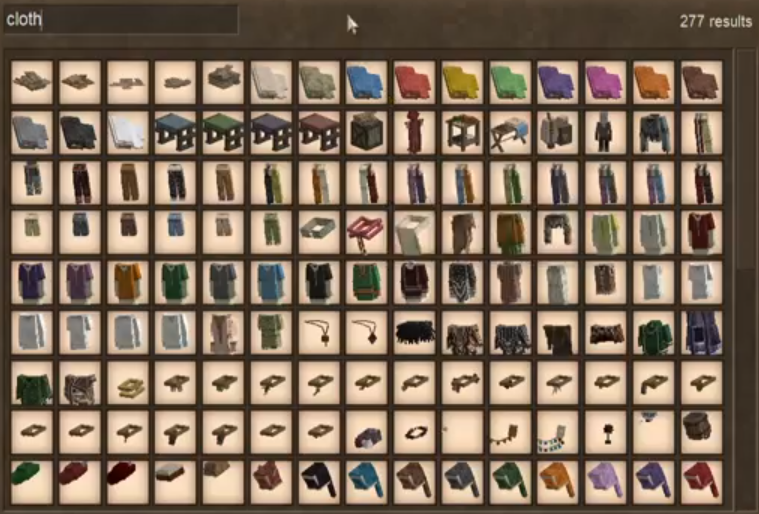
New clothing is already in the game now, in quantity of exactly 177, currently non-craftable and missing all localization. A couple clothing sets are named after specific cultures, regions, as well as a couple slightly eccentric jobs, and the rest are mostly nondescript everyday clothes and accessories. Very cool.
-
I'm getting 854 results when searching for "cloth", and I don't know what I'm doing differently. Also, Elvas seems to be playing 1.22.0-pre.3, though it has some things over the public pre.3. I did find that search, though, and there is indeed a bunch of new stuff, some items closely matching the #devlog teaser, seemingly with no recipes as of now (there's just three extra recipes over the current public pre.3). There's also a bucket.
-
Your vertices. Seemingly used for stress testing. As found in game assets: // Eats all your vertices for breakfast code: "vertexeater", ... shape: { base: "block/stresstest", rotateY: 0 }, ...
-
I wasn't even aware of this. It doesn't seem to be caused by a clear mistake or bug, but it's inconsistent with other wrench-orientable blocks which can only have their actual orientation changed this way, so I kinda don't know what to think about it.
-
Clothing items use "clothes-*" codes, but the creative search also considers things like "Clothing category: Waist" or "Material: Cloth", so both the clothes and some other stuff is gonna show up regardless of whether they have "cloth" as part of the actual name. If it's actually 177 new clothing items, then that would be roughly 50% more than what we have currently not counting the village clothing, or 30% if counting the village. That's pretty impressive.
-
Nope, they don't spawn outside of the story structures (verified by searching for the block code in game assets). Only middle and bottom are obtainable in survival.
-
Okay, I kind of overlooked rushes. It's kind annoying to look for this kind of information sometimes, because the variety of fibrous plants is massive and different plants are slightly more or less suitable for specific purposes. I did make a suggestion of my own a while back to introduce rushes among other plants at one point, so I do quite like that idea. Though keep in mind that the preferred climate of rushes heavily overlaps with cattails (mainly due to just how common both are), and only a couple rushes could feasibly go somewhat colder than cattails. Some features like dog wool kind of feel like they go into the realm of niche and gimmicky to me. Wolves are also arguably a bit of a poor choice in the current balance, because they're supposed to be a threat and not a target (I would personally want them to be neither for the most part, to keep it more realistic, but that's another matter). It's not necessarily a bad idea, but I would probably be more interested in it if some goats as well as muskox weren't a perfectly fine source of wool in cold climates.
-
Addressing these two is pretty difficult, because while there's a whole lot of sources of fibers from both plants and animals which could substitute for reeds and flax, most of them similarly don't grow in colder climates. Cold climates just have a much lower variety of flora and fauna, and that's largely reflected in the game. I think the most historically significant alternatives for cold climates would lie in and hemp and maybe stinging nettle, as far as I can find. Some trees like willow, spruce and birch could maybe be used for a similar purposes, though I'd have to look into it more to be sure. It seems that the devs are looking into some fats and oils in 1.22, so I'd hope for this as well. It is easy enough to get a couple candles by panning bony soil in my experience, but using tallow instead would make a lot of sense as well (especially for Homo Sapiens where there's no bony soil). One thing I'm just not certain about is the relative balance with oil lamps, which are currently not that useful compared to candles but much more accessible. For jam specifically, I think it's fine that honey retains most of its uniqueness, because introducing an excess of alternatives to things could easily render bees obsolete. That said, there are options for some sort of syrups as an alternative to honey (presumably more accessible but more labor-intensive to obtain), as well as sugarcane for hotter climates. My guess is that a bunch will change in this area whenever herbalism and status effects are introduced, but it's very difficult to predict how far the devs will take it. This is probably the most intentional part of the balance of cold climates, but I feel like it also has the most potential to improve. Realistically, the most important sources of food in very cold regions include: land mammals like reindeer or beavers - animal variety and the hunting process itself could use a lot of improvements, but it's there and it's functional, marine mammals like seals or whales - not in the game, fishing - finally in the game in 1.22, we'll see if it's satisfactory, bird eggs - not in the game yet, besides chickens, though at least birds are on the roadmap, berries, seasonally (mostly wild berries, agriculture is very limited in those regions) - hopefully the 1.22 rework will do a lot of good here, various tubers, roots, grasses, herbs and algae (also mostly wild ones) - not really in the game yet, maybe herbalism will provide something here. This is a rather unimpressive 3/6. The biggest missing piece is arguably the most unique and maybe most important, that is marine mammals.
-

I don't really understand how windmills work... How can I improve it?
MKMoose replied to vinnland's topic in Discussion
Because I don't want my helve to be hideously ugly. I don't play the game for pure efficiency, and neither do most people. Most players don't need to process a thousand iron ingots as fast as possible. It may also be worth mentioning that the helve hammer's resistance increases with speed, so it's generally not worth it to upgear a helve either way (especially if you're willing to use multiple hammers on a single anvil), because it takes more than five times the number of sails to achieve a processing rate equivalent to a couple base-speed helves, and also produces very inconsistent speed. As far as I remember, the recommended ratio to achieve high uptime without wasting too much power in high wind is about three full small rotors per helve, maybe less depending on where you place them, and increasing the output is often better done by just adding another helve or two. This also allows to enable and disable some of the helves using clutches to match the current wind speed better, which also reduces the effective optimal number of windmills per helve. Especially when running two helves at a time, I tend to only hit each bloom ~3-7 times to clear the biggest clusters of slag from the corners at a rate of ~5 per hit, and doing it on the same anvil as the helve is working. If you still care about efficiency, then spending less time on the blooms allows to easily squeeze in a toolhead or two or at least make chain out of plates with barely any reheating to process the output of a single bloomery. Granted, it's gonna be much more difficult if not impossible to do it without reheating in 1.22. You can move seven voxels each with the first two hits, and then it's diminishing returns. Same as for blooms - let the helve do what it can do for free, maybe help it a bit where it matters most, even on the same anvil. Sometimes productivity is about figuring out how to make the work more enjoyable and not strictly faster. -
Kinda depends. Modern compound bows differ in much more than just ability to store energy, and the simplest advantage is higher efficiency. They typically use lighter arrows, which allows them to reach much greater velocity, and alongside let-off, stabilizers, sights as well as a couple other improvements it increases their accuracy, ease of use, and can more than double their effective range. Kinetic energy tends to be higher than traditional bows, though lower projectile mass can mean that the penetration ability isn't significantly improved. It may also be worth keeping in mind that hunting bows were generally lighter (~40-80 lb or so, modern ones still fall within this range) than those used in war or whatnot (typically ~100+ lb, sometimes upwards of ~150 lb). I'd be personally interested to eventually see in-game distinction between different draw weights, for a longbow at least. It could even be a nice way to differentiate classes in a more interesting way than blanket ranged changes. As far as I know, even after a hit through the heart, the animal typically still has enough strength for short flight, at least enough to cover some 10-20 m. That should apply to deer at least - other, especially smaller animals may be incapacitated on the spot more easily. As for aiming for the head or spine, that's typically not done simply due to how unreliable it tends to be, from what I've read, even though it can be very effective if it happens. It makes sense that they would just be much more difficult to hit than the heart or lungs, especially with an arrow and not a bullet.
-
Just some questions about what comes beyond steel
MKMoose replied to DitaDataDita's topic in Discussion
Is cementation being interruptible even unrealistic, though? It would be certainly undesirable due to wasted fuel on subsequent reheating, but it's a long-term diffusion process, so I think that cooling and reheating wouldn't be significantly harmful to steel quality. Extensive information on the topic seems relatively scarce, though, on a quick search at least, possibly just because the process is now obsolete. For a blast furnace, I think a suitable compromise between realistic risks, intuitive implementation and multiplayer-friendly lenience would mainly involve two factors: make the furnace a bit unrealistically fast and make sure to leave enough leeway to avoid the need to respect strict timing - the main problem lies in that it should ideally be fast enough to match the output of multiple bloomeries smelting continuously, but not too fast, so as to leave enough time to pick up the casts once they cool and prepare new molds, while also keeping the amount of material in a single cast reasonably small to avoid the problem of having to make dozens of ingots when the player runs a couple short, create an intermediate between a batch and continuous process by adding some initial fuel cost to heat up the furnace before smelting and then some additional fuel cost to minimize damage during shutdown (and otherwise make the process batch-like) - this would incentivize but not require to cast multiple times in a row, instead of in individual batches. An electric arc furnace is a 19th-century invention favored mostly for its versatility, not scale. Early blast furnaces are medieval tech in Europe, earlier in China.While something like an EAF could be cool as an endgame Jonas tech gimmick, potentially for quick on-demand small-scale production or for lore and story purposes, I don't think there's much purpose to introducing it as a significant component of the mainline tech progression. Blast furnaces have been the ironmaking tech pretty much since they were invented, and to this day ever larger blast furnaces supply the world with the vast majority of cast iron for direct use and are the primary source of intermediate iron in steelmaking. -
The pulverizer being locked away behind automation is arguably a perfectly fine limitation, so I'm not sure what the point of a manual pulverizer would be besides short-circuiting mechanical progression and rendering the mechanized pulverizer borderline useless except for easier crushing of large quantities of materials for refractory bricks, unless some other function gets aded to it. Additionally, this proposition includes a number of different components and issues which would cause inconsistency with preexisting features and introduce excess complexity where it's not necessary: Why should the rope be replaced regularly if there are no similar mechanics in the game? Why should the pulley be oiled regularly if all other mechanical parts in the game only use fat in the crafting process? Eye hook being crafted in the grid at temperatures at which the material [which material?] is workable has been deliberately made impossible in 1.22, because for the vast majority of items it never made much sense that they were usable at those temperatures. If anything, it would arguably be much better to allow to manually provide a small amount of power to mechanical components, presumably with the use of something like a treadwheel (doubly useful if it can be powered by both players and animals). Or if not that, then at the very least make the manual pulverizer just utilize the existing pulverizer frame instead of a completely separate construction. Alternatively, especially with herbalism on the horizon, I would expect to see something like mortar and pestle to allow grinding up some things in small quantities that don't make much sense in neither the comically large quern that we have in the game, nor in a large pulverizer (including sulfur, charcoal, potentially dyes like lapis lazuli). A large enough mortar could technically be used for butter churning as well, though doing it in a barrel would likely make more sense. An edge mill could also be a neat addition for making black powder, extracting oil from oil-bearing seeds (e.g. linseed oil from flax) and maybe some other stuff.
-
Just some questions about what comes beyond steel
MKMoose replied to DitaDataDita's topic in Discussion
A bit of a mental shortcut, that's on me, I guess. Technically, it would be a multi-step process - the blast furnace unlocking cast iron and pig iron, then the finery forge allowing pig iron refinement and by extension actually forging the better tools. Although it might be acceptable for simplicty to allow processing pig iron directly on a regular forge and anvil, at least in initial implementation, which would mean that the blast furnace could actually be considered as the way to unlock improved iron in the same way that the bloomery unlocks iron even though it outputs blooms that have to be further processed. The blast furnace is a bit of a rabbit hole for me. I have some ideas on how deep I would want it to go in-game, but frankly I have no clue how deep most people would want it to go. The main quirk of it that seemingly very few people know is that a blast furnace is operated continuously, not in batches, and operating it is a whole skill and job in itself. A late-medieval blast furnace would run continuously for months, operated by a whole crew of people, casting something like 150-500 kg of iron at a time in ~8 hr intervals, requiring regularly adding new charge, draining slag, monitoring hearth temperature, adjusting the position of tuyeres that provide constant air input from water-powered bellows, rebuilding the sand bed between each cast. When something goes wrong, the whole hearth can solidify, rendering the furnace completely unusable, and that's just one of the possible failure modes. Furnace startup and shutdown are very delicate multi-step processes as well. Also, small note: I'm kinda inconsistent in my use of tenses, but blast furnaces have been improving ever since they were first introduced to Europe, so modern blast furnaces work on the same general principle to the medieval ones but are kind of unrecognizable in the specifics. Naturally, settling for something small and relatively safe would be preferable, which is mostly why I was very critical of the 12 m blast furnace idea, which was similar in size to those used at the beginning of the Industrial Revolution, if I recall correctly. It is, of course, entirely possible to implement a simplified design that retains some parts of the realistic complexity while being more approachable and convenient, and a lot just depends on how far the devs would want to take it. Your notes on the bloomery do make me think of some potential improvements to a design I've had in my mind. -
How do you intend to prepare your long-term worlds for version 1.22?
MKMoose replied to Vratislav's topic in Discussion
Not possible as far as I know. A much more useful command for that purpose is often /db prune, though I'm not certain about the details of its usage. The command handbook (accessible from the pause menu in creative mode) may be of use, if you're ever wondering about what a command does and what arguments it takes. Strongly recommend to make a backup before you try it and carefully check whether you're satisfied with the results afterwards. -
Death is probably the most difficult compenent of the system to balance appropriately. Dying can already be beneficial in certain contexts, at least in the early game. At the same time, applying penalties after death would not be met with applause. Some games like Project Zomboid fix it by giving the player a single life, and only allowing to respawn in the same world as a completely fresh character with no accumulated skills (or at least with partial skill loss), but that is completely inapplicable to VS with the current mechanics and lore.
-
Just some questions about what comes beyond steel
MKMoose replied to DitaDataDita's topic in Discussion
If we were to make it really realistic, then quenching bloomery iron should indeed be less effective, and ideally it should actually be completely ineffective until the wrought iron is case-hardened first (which effectively transforms the surface layer of the workpiece into steel). Quenching requires high enough carbon content, which wrought iron normally doesn't have. This also applies to wrought iron produced from pig iron, though pig iron may allow it to retain slightly more carbon or be directly forged into steel without the cementation process. I'm not sure if that's what you're talking about, but there's a kind of alloy referred to as gunmetal or red brass, which is slightly different from typical tin bronze mainly due to the addition of zinc, though is generally still considered a type of bronze. I suppose I don't need to explain what the primary use of gunmetal was. Leaded bronze and phosphor bronze (both including tin) have also seen notable use into the Middle Ages and beyond, mainly due to relatively high corrosion and wear resistance, in-game potentially useful in some mechanical parts. Leaded bronze is also much more castable, but mostly unusable for typical tools. Also, bell bronze could be cool for musical instruments. The most notable takeaway here, to me, is that once iron smelting took off, bronze was mainly used for specific applications where it had other strengths over iron, and I think that this is a useful direction to consider. Instead of focusing too much on power and durability, let bronze be similar to early bloomery iron or just weaker than generalized iron, but provide additional uses for which it is deliberately better than iron or outright the only viable metal. In this way, bronze could become highly useful all the way into the endgame, yet without messing too much with the mainline tool material progression. This is pretty much exactly correct and would closely reflect the historical benefits of introducing blast furnaces. One potential issue that I would point to is that the bloomery process is already quite efficient in VS and there is very little need for bulk iron in the current state of the game. I guess minecarts and steam engines could increase the demand quite a bit, but I still feel like the blast furnace could easily end up less efficient unless drastically simplified. At that point, I would prefer the bloomery process to be made less efficient than it is now, while making the blast furnace into the massive chemical reactor that it really is, with all the risks and all the benefits. While as a general rule I absolutely agree with what you're saying (maybe with a couple small caveats), I don't really see how making iron slightly weaker or more difficult to produce in the bloomery process would cause any significant issues in that category. Not even counting quenching, just reducing damage and speed of early iron tools to be more similar to bronze would still make them better than bronze due to increased durability, whereas making early iron more difficult to process would let it retain the power advantage but be less worthwhile for anything besides a couple of the main tools. Still a quite meaningful milestone, especially if you count all the things that are gated behind iron, more of which are likely to come as the late game becomes more fleshed out. It doesn't seem to me like there's a lot of added complexity and confusion, because the relationship is simple - bloomery iron is relatively weak, wrought iron from pig iron is better. You still have clear progreassion tiers, and one of the tiers just isn't as significant as adjacent tiers in terms of tool power gains. I don't want to paint early iron being similar to bronze as any sort of necessity, because the game would be quite fine without it, under the condition that bloomeries are fully superseded by the blast furnace for the purposes of ironmaking - I think the player shouldn't be incentivized to use the more crude and inefficient process for any reason. I think the best solution could be to add work hardening and annealing to bronze (basically improved power at the cost of some durability), and making iron equivalent in terms of power to probably black bronze (maybe even tin bronze), and leaving durability untouched. As long as quenching and tempering provide a greater power boost to iron than work hardening and annealing does to bronze, iron would be better once the player learns to process it well, but at the same time unquenched iron wouldn't be a strict power downgrade. I'm quite confident I'm not making any mistakes here, because I researched this topic quite extensively whenever I was lambasting the dude who was suggesting a 12 m tall blast furnace. Admittedly, some of that was undeserved, but either way. Cast iron is for most purposes a completely separate kind of iron, which I'm not really considering in the argument about bronze and early iron, because it inherently cannot function as a "next tier" in progression. That said, it could be introduced as a way to craft some specific tools in high quantities. It's unsuitable for weapons and armor, but very useful for some common tools as well as other stuff like cookware or stoves which could be important progression rewards. It can also be heat treated to improve its properties, though steel or at least wrought iron will naturally always be preferred wherever brittleness is really undesirable. Pig iron is practically the same as cast iron, but can be cast more quickly and allows more impurities because it's always forged into wrought iron or steel anyways (or technically not always, but either way it's not used directly for any usable items). Its carbon content is deliberately reduced down to the desired level depending on use case as part of the finery forge process. Even when it technically produces wrought iron, the same kind of iron that bloomeries make when considering carbon content, refining pig iron allows better control over the carbon content and more effective removal of impurities, as well as produces more uniform carbon distribution and grain structure, overall resulting in a higher-quality end product in practically all important metrics (which also means that it's better for cementation). Note that steel from the cementation process was also often better than steel obtained directly from the finery forge process due to even further improved control over carbon content. I'm naturally willing to simplify a lot of details for the sake of making things more straightforward in gameplay, because having some four types of iron and four types of steel is admittedly a bit much, and I'm mostly just roughly describing the most important distinctions that can be easily translated into in-game differences. I think cast iron is kind of nonnegotiable (whether it could be cast directly into tools or have to be wrought is more debatable), but otherwise the rest of the types of iron are not too important. It would be absolutely acceptable in my eyes to keep just one generalized type of wrought iron as long as the blast furnace is significantly better than the bloomery to the point of fully superseding it on the grounds of scale and efficiency alone for the purposes of ironmaking. A blast furnace is exactly how you smelt iron for casting. At least for most purposes, but I don't think any alternatives are significant enough to ever make it into the game, unless it's just crucible steel, though that's unrelated. It also typically uses sand molds as far as I remember, and either way requires a lot new molds for stuff like fences, cooking pots, maybe rail tracks or minecart/train parts and stuff, so I'm not sure that it would keep the old clay molds useful. I guess it could be acceptable for simplicity's sake, but I think I would personally much prefer a proper pig bed and two-part sand molds for maximum complexity in the endgame. -
Maximum FPS can be set using Settings > Graphics > Max FPS (hidden by default until you press the "show all available settings" button). An FPS counter, as far as I know, is only possible using Alt + F3, though it also adds a graph which may be too disruptive during regular gameplay. You can probably also use some third-party software, though the only option I know here is launching the game through Steam and enabling an FPS counter there.
-
Just some questions about what comes beyond steel
MKMoose replied to DitaDataDita's topic in Discussion
Why should iron be a clear and immediate advancement over bronze, though? In-game it's especially drastic now with quenching in the picture, which makes the jump in effectiveness actually quite massive and very desirable in spite of the increased cost over bronze. While simplifying progression to a neat staircase can be beneficial in certain cases, especially in the early game, it is by no means necessary. There's practically no game which doesn't utilize some manner of nonlinearity and nuance within their progression with various alternatives, specializations, tradeoffs and sidegrades, and I think that this is a case where VS could very feasibly implement a distinction between wrought iron made from the bloomery process and made from pig iron. I don't really get the argument regarding the tech tree being "forced to expand", both because I don't see a reason why it would be forced to expand, and because even it it's forced to expand then it doesn't seem to me that it's necessarily undesirable. Bloomery iron, even if weakened enough to be only a sidegrade to bronze (which could be done and to a large extent is already done through more difficult processing), would still serve as a progression gate for all the things that require iron, while the creation of the blast furnace could take place of the primary progression jump in terms of tool quality. A blast furnace could, of course, be a progression milestone even without any added changes to wrought iron, but then it could end up being difficult to make it worthwhile for anything besides cast iron, and endgame progression could end up even more compressed than it is now. -
I don't personally think that's an issue. Everything depends on exact implementation, of course, so it could end up being an issue, but the main way to make hunting more difficult and satisfying is not to make animals less common, but to make them better at evading and escaping the player. Making animals less common could actually make hunting less satisfying, because too much focus would be placed on searching and not enough on actually hunting, making the whole process more tedious and boring as well as forcing the hunting itself to be easier. If animals had increased awareness to make them bolt from upwards of 50 m away when they hear the seraph, as well as improved pathfinding if only to avoid jumping into pits, then an unskilled hunter would struggle to kill anything even if the world was absolutely filled with animals. In this case, even a skilled hunter would need to go through the process of finding an animal, approaching it quietly, hitting it, and then following the blood trail - a much more time-consuming process than we have now, serving to balance hunting independently of animal frequency, and also creating plenty of incentive for livestock which can provide more continuous products (milk and eggs), or be killed quickly and easily on the spot for meat. I personally take that as a given whenever a status effect system gets implemented, and it seems to have been mentioned by the OP, though I cannot guess how the devs will go about it. Bleeding and injuries are a very intuitive way to increase lethality of combat both ways without an excess of annoying, unsalvageable one-taps. Moment-to-moment combat would still lilkely end up easier, but having a supply of bandages and other healing items would be much more critical for survival than it is now.
-
Some of this is being being adjusted in 1.22 (but more changes are likely to come before it hits stable): spear damage when thrown has been reduced quite significantly, spear windup time has been increased twice, and the time to achieve full accuracy increased thrice, ferrous spears have been adde added, the health of several small animals has been reduced (foxes and raccoons from 6 to 5, rabbits from 5 to 3, chickens from 3 to 2.5), quenching is being added, but arrowheads currently can't be quenched and so don't get free buffs - whether that's an oversight or a deliberate choice remains to be seen. These are the changes to spear damage, to be specific: damageByType: { "*-granite": 2.5 (4 on the current stable), // only one-taps chickens and small fish "*-flint": 3.25 (5), // one-taps hares "*-copper": 4.25 (5.75), // one-taps some medium fish "*-tinbronze": 5.25 (7.5), // one-taps foxes and raccoons, 3-taps pigs and wolves "*-iron": 6 (8.25), // one-taps pudu deer and some medium-large fish "*-meteoriciron": 6.1, // two-taps T0 drifters "*-steel": 6.2 // no notable breakpoints }, Do keep in mind that modern compound bows are leagues ahead of anything that we have available in the game. It is extremely unlikely that a deer will just "fall down" after getting hit. One-tapping a deer is something I would like to see as well, but if that's the case, then I expect to also have to (in most cases) follow the blood trail from the hit location to the body, in many cases 50+ m away. And that's primarily for arrows that hit the heart or lungs. Instant collapse is technically possible, especially on a hit to the brain or spinal cord, but it's rare in practice. Overall, hunting broadly encompasses a bunch of older, low-level mechanics in the game, which have seen a lot of improvement over the years, but regardles I think they seem to be in the recent months receiving increasing attention as deserving of an overhaul. I'm not sure whether there are any good consolidated threads on any of it, and everything is kind of scattered all over. Hunting itself basically just gets a range of the same ideas thrown at it semi-regularly : improved hitboxes, ideally with localized hit detection for vital organs, improved awareness mechanics for animals (line of sight, hearing, potentially smell), improved animal pathfinding and behavior, bleeding and various kinds of injuries (presumably implemented through a status effect system; the Blood Trail mod is frequently brought up at this point) - the primary way to increase lethality across the board without an excess of immediate one-tap kills, under which your suggestion would fall in quite neatly; this is also probably the most likely to get implemented in the relatively short term, deeper, more mechanically involved aiming system. To avoid excessive reiterating of the same topics and to avoid making this into a whole essay, I'm gonna just point to another thread where similar issues have been discussed (there's also this, you've probably read a couple of them), as well as plug my own suggestions to implement butchering (this could also serve as a balance lever for livestock against hunting) and improve ranged weapons (mainly focusing on aiming) which I feel would be greatly beneficial for the game. Unfortunately, most of those don't seem to be a significant priority and it's very unlikely that anything in this category beyond the spear rebalance will be squeezed into 1.22.
-
That kind of how the system works, though. An area with high readings indicates an area with high deposit frequency. It can go somewhat out of whack for iron which has a very low number of deposits per chunk, but it's still generally true on average. While I'm not confident that I like your exact suggestion, I would love to see deposit generation even more geologically accurate than it is now (which already is much better than similar games, frankly). Ore genesis is a whole topic of its own, but in-game it only really translates to a couple fairly simple generation parameters and allowed host rock types. Realistically, even some "small" veins can be hundreds of meters across, and there's some stuff like banded iron formations which can span dozens or even hundreds of kilometers. At least for certain ores this would have very similar effects to your idea here. While I wouldn't want to neglect practicality in gameplay, I think it would generally be quite fun if ore was relatively easy to find in very large deposits, but more difficult and dangerous to actually mine (probably with more developed instability mechanics), to create proper incentive for long-term mining operations and by extension minecarts.
-
Just some questions about what comes beyond steel
MKMoose replied to DitaDataDita's topic in Discussion
While others have replied to this already, I want to mention that, purely in terms of generation parameters pulled from game assets, bronze is significantly more common than iron, even when controlling for durability. Granted, it can be more annoying to obtain due to smaller deposit size and extremely high deposit frequency in righ areas. To some extent, this is already the case, though admittedly it seems like an accidental consequence of the system more than a clear design choice. Bronze finds its use primarily in cases where durability is the only parameter that matters. Tongs, hammer, crowbar, chisel, wrench, as well as anything that is intented to be used for crafting. It's doubly useful for the tools that don't have to be forged, because casting in quantity is easier, faster and cheaper. Personally, I'm not opposed to the idea of bronze being better in some capacity than iron (I've suggested it elsewhere myself), though I think it might be better to achieve a similar effect by adding work hardening and annealing for bronze (and potentially low-carbon wrought iron as well), to provide effects similar to quenching and tempering (but weaker and/or at the cost of some durability), smoothing out the sudden transition to iron. If aiming to separate the Iron Age into two parts, I would personally look into splitting it clearly into "Bloomery Iron Age" and "Cast Iron Age" (not real terms, but illustrative enough). Iron obtained from the bloomery process and wrought by hand would contain uneven grain and more slag inclusions, so generally produce much lower quality results, and realistically it wouldn't be quenchable. Iron produced in a much more complex process using a blast furnace (and ideally processed using a powerful helve in a finery forge) would be a much better product in a whole range of metrics, reflecting the actual way iron quality has progressed from being at best a sidegrade to bronze to eventually well superseding it - through gradually advancing metallurgical knowledge as well as improved smelting and forging processes. And that's not even mentioning the benefit of the blast furnace that lies in cast iron. -
tempering Quenching-Tempering: Finding the best combination
MKMoose replied to Diregoldleaf's topic in Discussion
Earlier, unrelated post from a whole different thread. I'm talking purely quenching here, so while I like the ideas for bronze, I might reference them in more detail in that other thread. -
Once you take a look through the handbook, assets and code, you can find a lot of interesting things. The model for a potato has been in the game for a good while now, though who knows when it may get actually added as a plant. There is a whole bunch of stuff for as of yet incomplete mechanical parts, some barebones code for a blast furnace, and a whole lot of other small breadcrumbs that the devs are working on or have paused work on temporarily or indefinitely. There are textures for a bunch of herbs (including names) already in the game files since at least 1.21. A bunch of code for the berry bushes is already on GitHub since pre.3 released, and you can even place them in creative and see them grow, though I haven't tested whether they can actually produce fruit and generally whether they are mechanically complete. It's worth noting that they use a health/nutrient system of some sort, though I haven't checked whether it's similar to crops.
-
tempering Quenching-Tempering: Finding the best combination
MKMoose replied to Diregoldleaf's topic in Discussion
The current implementation gives the first couple quenchings for nearly free, but then basically gets the player to figure out how much they are willing to slog through for diminishing returns. Choosing whether to temper or not mostly boils down to optimization and not any sort of strategic choice. Whatever you do, you can go further, at the risk of having to do it all over again. I don't personally find much fun in that, and I think that it just doesn't work well even before you start getting into the extremes. You can now make weapons that are by all reasonable metrics outright overpowered (relative to the 1.21 balance, and relative to weapons that can't be quenched), only at the additional expense of a bunch of resources. This also creates a massive jump over bronze and other early-game options - it's easy and still pretty cheap to get an iron spear or falx with some 50% higher damage than a bronze equivalent. I'd argue that adding a stricter ceiling, if done well, would allow to introduce more significant decision-making and more satisfying skill-based mechanics into the process. A highly simplified realistic purpose of quenching and tempering is that ferrous alloys generally start from a soft and often uneven structure, so quenching is done to increase the hardness of the metal as much as possible, which also makes it much more brittle, while tempering is done afterwards (or on its own) to reduce hardness at a benefit to ductility and toughness, which partially reverses the effects of quenching but the benefit is generally much greater than the lost hardness. Right now, quenching has almost no skill expression, odd choice of risks, and only one real benefit. There are a couple quirks of the current implementation I would personally love to see changed: Reduce the repetition. It's tedious and unrealistic. Make the effects of quenching less one-dimensional. Durability buffs and shatter chance go against each other - if the shatter chance is higher than the relative durability increase, then increasing durability is practically worthless, and that threshold currently ends up being crossed very quickly. Consequently, power is the only real use of quenching past a certain point. The easiest way to do amend this would be to just make tempering more realistic by giving it an increase to durability at the cost of power, and throwing the idea of quenching for durability into the trash (quenching an item covered in clay is usually done while only covering part of it, especially the spine of blades, to harden the exposed edge while protecting the spine from becoming brittle, which has almost identical effect on the edge but reduces risk of cracking during quenching as well as preserves durability and flexibility of the spine). Make the risk of shattering during quenching dependent on player skill, knowledge and preparation, and potentially extend that to the beneficial effects of quenching as well. Historically, it was critical to know how to quench while maximizing benefits and minimizing risk of cracking (not outright shattering, though still in many cases rendering the workpiece largely unusable). This incuded normalizing the temperature of the workpiece before final quenching (bringing it up to ~750 C and then cooling in still air), interrupted quenching or appropriate choice of quenching medium (mainly for high-carbon steels), and a couple other things. An additional mechanic could lie in variable effects depending on closeness to "ideal" quenching, which could serve as a way to add a level of uncertainty beyond pure randomness and space for skill expression and mastery of the exact parameters required to achieve the maximum benefits. Whatever is easy enough to implement and fits the game, as long as there are ways to control the effects in some capacity, ideally in a dynamic and engaging way and not just through more complex setup. Tempering doesn't count, at least not in its current implementation, because when power is the only real benefit of quenching then tempering becomes almost exclusively a matter of optimization. Penalize leaving a quenched tool untempered. This is practically never done in real life, because it's where shattering actually happens most easily. Metal which has been quenched but not tempered is brittle and will easily break on strong impact. This could be implemented by adding a shatter chance during usage or just a durability penalty after quenching, which would be removed or heavily reduced with tempering. Make temperature control less forgiving, and especially add a penalty to overheating the workpiece. Heating up the metal up to certain thresholds after quenching or tempering reverses most if not all prior work, and overheating can promote warping as well as increase risk of cracking. While heating above certain temperatures could should only reduce or remove certain effects, heating unnecessarily high could also increase risks during quenching. An extra change which I would love to see would be to remove the exact temperature readouts in the tooltips and require the player to judge the temperature of the workpiece by color, though that would be optional and probably easily circumvented with commands. Try telling me that you wouldn't prefer something in this direction over repetition of the same simplistic process to maximize a single stat against your tolerance for tedium and randomness. Now that I look at it, it's a whole suggestion in itself, so I might end up refining it and posting in a new thread at some point.