DeanF
-
Posts
161 -
Joined
-
Last visited
-
Days Won
1
Content Type
Profiles
Forums
Blogs
News
Store
Everything posted by DeanF
-
I have no idea where you are getting this from. Where did you parse eggs, cheese, or veggie in any slot??? I had thought that my example was clear- a quiche would need at a minimum 4 eggs. As you quoted, slot #1 and #2 both say "2 eggs" FULL STOP, nothing else. Where is the veggie in that? Only slots #3 and #4 can have something other than eggs. So how on Earth did you think that I meant that 8 veggies was a quiche? My mind is boggled, frankly. This has to be some sort of interwebs miscommunication. Also, just FYI, I later changed the recipe once I found out that quiche is a custard and thus requires milk. (It would be nice to have another use for milk...)
-
Ah, so the issue is that the Handbook is wrong. I would have beaten my head against this problem forever. Thanks, All. Everyone was very helpful. I guess that now I need to source andesite gravel...
-
That entire description "kinda" agrees with me, so I'm not sure what you are trying to dispute. You add ingredients four times, and each time uses two of a given ingredient. If you are getting hung up on semantics like the word "slot", or that I dared to number them to make my point, well, that's your neurosis not mine. I had to describe what I mean somehow. Either we are agreeing, someone is being annoyingly persnickety, one of us is having a parsing issue, or something is simply not communicating well in text. Any of which is quite unsurprising on an interwebs forum.
-
I am all for any mechanic that adds depth.
-
Can I (Linux) Join My Friend (Windows) or vice versa
DeanF replied to YourWaterDispenser-UwU's topic in Questions
Sometimes ad-hoc simply won't work, depending upon your router settings. And from what I have read, the fix is very obscure, and highly variable depending upon the router and it's firmware. Like, to the point that what I have read recommended not even trying, and just setting up your own server. -
Certainly, if you haven't already tried it, updating your graphics driver should be the first step. Since you seem to only use your Win box for a couple of games that you can't get to run on your preferred Mac, I assume that you probably don't maintain it as meticulously. I know that I don't.
-
Linux is incredibly sensitive to graphics driver versions, in general. So the first thing I'd try is an update. Also, most Linux distros struggle more with NVIDIA than with AMD. (Ask me how I know...)
-
Yes, on cold days you will see that the shelf-life listed is longer than on hot days. It's giving you the estimated shelf-life if the outside temperature doesn't change. Because what cellars do is reduce the effective temperature- that's how they give longer shelf-lives.
-
LadyWYT answered everything, but I just want to add regarding: Two words: Bear Pits Get the bear to chase you, and jump over the pit- the bear will usually fall in. Sometimes it takes a few tries, though. A bear needs at least a 3x3x3 pit so that the bear can fit yet not be able to climb out and maul you. Both bears and wolves are >1 block wide, so you can dig a stairs down into the pit on one side that's only 1 block wide and be safe, as long as you don't get too close. Since I showed her this, my daughter now makes a game of killing bears to get the Bear Hide Armor, because she thinks that it looks cool. Remember that there is a special rule for cellars, in addition to the 7x7x7 option. A 7 tall cellar is really just a waste of space because of how hard it can be to reach very high shelves. So a cellar can also be up to 9 blocks long, so long as it total volume is not >150 blocks, and no other dimension is more than 7. So a 3x5x9 cellar is pretty nearly optimal- so that's 36 shelves (144 crocks) with 18 storage vessels underneath, just on the two 9-long walls alone. And the total volume is only 135, so you can even squeeze in a few alcoves. And as LadyWYT said, yes, the materials in the walls matters. For instance, if you put a cellar in under your house but the ceiling is the wood floor from above, it won't work as well as if the ceiling were cobblestone. Wood is "warmer" than stone. Also, limit the number of doors- every block of doors reduces your number of "cooling blocks" by 3. So a normal door negates 6 of your cooling blocks. And you also have to be careful what side of the block you put a door on. Because if it is on the wrong side, then the door's block might count for calculating one of the dimensions, and make the room too large to be a cellar. The wiki covers all of this: https://wiki.vintagestory.at/Room#Cellar
-
I can't seem to make fanned cobblestone. I have blocks of sand, blocks of gravel, and everything else on the grid is stones. Not working. Is it just me?
-
Yes it is. Other than the dough, a pie is four slots with each slot holding two items. So... 2 eggs. 2 eggs. 2 vegetables or 2 more eggs. 2 cheese, or 2 vegetables, or 2 more eggs. Was that unclear in my OP? It's like a pot pie that uses eggs as the protein source instead of meat, except that you can also add cheese. But my culinary fu is weak- can you call it a quiche if it only has eggs? Or does it need some other ingredient as well? Should the cheese be mandatory, for example? (And while we are on the subject, I sort of feel like a meat pie should allow one slot of fruit.) EDIT- So Wikipedia says that a quiche is a custard, so it must have both eggs and milk. And they can have meat, though beyond eggs and milk everything is optional Well, I guess that would be another use for milk, other than cheese-making, right? So I guess that instead it should look like this?: 2 eggs 2 eggs 0.4L milk 2 of almost anything- vegetables, cheese, meat, poultry, seafood, fruit, or more eggs. I feel like you should be able to mix cheese with something else, but there aren't enough ingredient slots. Does anyone think that some other schema would be better? I can't really conceive of making a pie-sized quiche with only 2 eggs.
-
There is no clay bug- you just haven't learned to recognize it. I had the same issue, and many others will tell you likewise. You need to play a while to train your eye to spot it. Once you see it a few times it will start to jump out at you. It's easiest looking for it at first in hillsides. When you are looking down at it on a level surface it can just look like low quality soil or forest floor. But eventually you get to the point where you can pick it out even in level ground. And as I said above, this game really rewards a little investment in it. I hope that you don't quit it- you'd be missing out.
-
Bear Hide Armor repair with bones instead of bear hides
DeanF replied to DeanF's topic in Suggestions
Yes, I think of bear hide armor as being the same tier as wood lamellar armor, and that is why I think it should be as easy to repair. Thus my proposition for using bones. Making the bear hide armor takes a lot of bones, so it's armor value is probably more from being a sort of a bone splint armor than from the hide. And I am also very much looking forward to the armor rework. -
From perusing the wiki, it doesn't appear that we can make pies with eggs- eggs are not listed as a valid protein for meat pies or pot pies, frex- though I admit that I haven't had an opportunity to try. If not, we should. A quiche might be at least 2 slots of eggs, plus 1 slot of vegetable or eggs, and 1 slot of vegetables or cheese or eggs. This would expand the utility of eggs greatly.
-
Any way to stop animals from spawning within a base or fenced area
DeanF replied to Javex's topic in Suggestions
Place some sort of surface that isn't a full-height block. For instance, hoe/till all of the farmland. (Farmland is one voxel short of a full block, I think.) Then critters won't spawn on it. Even when grass grows on it rabbits shouldn't spawn on it, but they will spawn on grass on full-height dirt blocks. I think that cobblestone paths prevent spawning, too, but I've never personally tried that. And Packed Dirt doesn't grow grass, so that's safe, too. But all of my "eaten by wild animals" issue with farmland stopped once I put in fencing and tilled all of the blocks. The wiki says that you can also place rocks on soil blocks to that grass won't grow. (Rabbits only spawn on tall grass on untilled soil blocks.) -
The problem in your photo is probably that the carcass that you are trying to harvest is in tall grass. You end up targeting the grass instead; it's admittedly tricky. Remove the grass- including the shorter grass that is left behind after the first pass- then you should be able to target the carcass easier. And yes, be sure that the prompts for block interaction are enabled (I don't see the prompt in your screenshot). That makes the exact thing that you are interacting with a bit more transparent, and tells you exactly which of the many button presses/holds that are possible are functional for that item. But... as some others have said, if you have a very low frustration threshold then you might want to go back to Minecraft. This game has some very complex crafting mechanics... and the devs have indicated it's going to get more so. For instance, they have said that they want to do away with the crafting grid and make all crafting have some sort of mini-game the way that flint knapping and pottery making do now. And yes, it's still an alpha, and the handbook is good but not comprehensive. I find the wiki to be very useful at times. That being said, Dude, this game really rewards a little investment. I would not hesitate to call it the best game that I have ever played, though that probably reveals my biases towards survival games and complexity. I have played almost nothing else since I learned about it three months ago. I popped back in for one session of Star Citizen to see how that was progressing. That's it. In three months.
-
Is it just me, or is the Bear Hide Armor too costly to repair? It may just be me... But the Bear Hide Armor is very low-tier, with little protection. Yes, it's meant to be a daily armor that doesn't slow you down or break healing too much. But in truth it is practically cosmetic. My daughter likes how it looks but it's just too much of a pain to repair- a bear hide requires quite a bit of effort. And that's fun the first time, but not over and over. The Wooden Lamellar Armor is better and only requires firewood to repair. It seems like the Bear Hide Armor should be repairable with bones instead; especially since that's really where it's protection comes from anyway. And these low-tier armors should be easy to repair. Just my $0.02, FWIW.
-
I have no strong opinions on all of the possible logos that are based upon the old tree-with-clock one. They all look acceptable, and I am sure that Anego will choose something appropriate. I care more about the mini-icon on the taskbar. Here is my taskbar: That VS icon is just a brown/green blob. You cannot see any detail, so why obsess about it. I would instead argue that we need a different icon for this use. I actually like the design by Nicodemus on the first page of this thread for this use. (And no, I do not think that it looks too much like Factorio.) So for reference, here is Nicodemus's icon: Or perhaps a glowing teal version? If Anego plans to use some version of Phobiak's logo, then glowing teal might be especially apropos. But something based upon a simple figure like a gear. On my Taskbar the Gimp icon is almost too detailed. The Firefox one as well. They skirt the line.



-
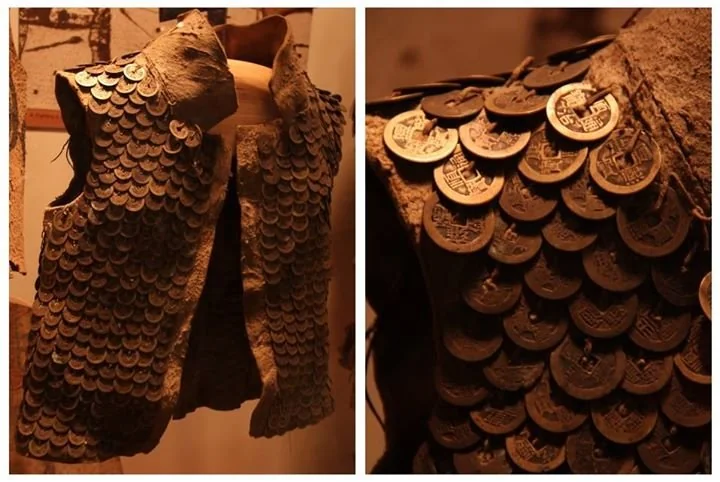
Coin armor. But made with gears.
-
I was pretty opposed to firearms in the game. But then I watched some videos where players used the firearms mod that basically added smoothbore muzzle-loaders and I had to admit... it didn't seem discordant. It still seemed primitive. And heck, we have bombs already. So I guess that now I wouldn't object, especially if reload times were appropriately long. Meh, those are all debatable. Early muskets were practically small cannons- .75 caliber was typical, and modern terminology defines a cannon as 20mm or greater, so that's pretty close. And no, muzzle velocity wasn't particularly high compared to a modern rifle, but it was still supersonic and that's a big chunk of lead. You're thinking of things like the little .36 pocket pistols that ladies carried in their muffs when you say underpowered. But muskets ended the age of the plate-armored knight, for heaven's sake! Yes you could make musket-proof plate, but that was so heavy that they eventually only made them as cuirass rather than full suits. And early firearms like matchlocks were certainly cheaper than swords- by a huge margin, actually. But not cheaper than common soldiers' weapons like pikes or other polearms. So that's a bit relative. Accuracy, again, is relative. No, smoothbores are not accurate by modern rifle standards, but nonetheless more accurate than most people think, especially when carefully loaded. That's why commanders tended to save the first volley- "Don't fire until you can see the whites of their eyes!", and so on. I won't get into it, but they lose accuracy mostly during rapid fire. Which is what militaries cared about, so their bullet tolerances were loose so that they could be reloaded faster, for instance. But a tightly-fitted smoothbore ball could be pretty accurate. At least as much so as a bow or crossbow. Here are videos of someone shooting a smoothbore and ringing the target like a bell, center of mass hits every time: Seriously- when you see the target later in the video he had three shots stacked on top of each other. If you are unfamiliar with Karl Kasarda, he's one of the more academic GunTubers. (As opposed to the hairy-chested GunTubers.) He is one of very few that I'm willing to watch any more, along with his old partner Ian McCollum. And here is a relative firearms novice (see his awkward stance) doing the same: You got the big advantage right, though- it was a hell of a lot easier to train a musketeer than an archer. Especially at long ranges their trajectory is much more flat. "To train an archer, begin by training his grandfather." But firearms are better in many ways. There is a reason that every culture that was ever introduced to them came to prefer them over their other historical weapons. Yes, even the Japanese. So I guess that if I could smear a Tainted Shiver across the landscape in one shot, I really wouldn't complain- that's 25 damage. Especially if it then took 30 seconds to reload. There's even a possible tech advancement path, with paper cartridges dropping reload time to 20 seconds or something. There definitely should be a way to break out of the reload animation, though, in case an enemy closes with you. And bayonets would also be awesome. It should be impossible to reload a musket except in a standing position- so not mounted or seated. But it should be possible to reload a pistol while mounted, sitting, etc.
-
Yes, this is true. The folks at cartographersguild.com, where they make fictional maps, are quite dedicated about criticizing this mistake. They call them the River Police. With extremely rare exception, rivers combine, they don't fork. Another thing that trips up amateur cartographers for some inexplicable reason is the fact that water flows downhill. I still get boggled when I see that one violated. Given the way that VS worldgen proceeds in chunks, I can see a lot of difficulties with generating rivers. They sort of have to flow downhill, and how can that be predicted for a downstream chunk that hasn't generated yet? You might have to recreate the whole worldgen process to include an erosion mechanic. Steal it from a program like Wilbur?. (Wilbur works by moving voxels downhill scaled for slope and rainfall.) I suspect that is why all of the mods that add "rivers" result in some pretty odd geography, like holes punched through mountains. That's just a problem with any game that descends from that other voxel game, y'know? The basic worldgen that got inherited is problematic. It really should be erosion-based instead, but crap that's practically starting development over again completely. The little streams and rivulets that we have now are a lot easier- they just need to end in ponds in low areas instead of magically dissipating.
-
I like it. The clamming might be easier to implement. Put "shows" like breathing holes and squirts in sand that has clams. But oyster shoals in shallow saltwater would be pretty nice, too- those could work sort of like berry bushes or picking up stones. An while we are at it, where are the crawfish and crabs?
-
A very interesting video. But the programming isn't really insurmountable- it's been done before, at least as early as the 1990s. The problem is players... Players generally decimate ecosystems in games. See Ultima Online for an example: Or at least that's the example that I remember. Have complex ecologies actually worked in a game at some point? Also, the idea might actually work in a solo game. If you decimate the local wildlife, then there are no animals left to hunt and it's your own fault. But in a multiplayer game the Tragedy of the Commons always manifests.
-
Hmm, I just learned that animal spawn areas persist. For instance, even if you deforest an area, the wolf spawn locations there will still spawn wolves. So maybe we do need animal markers? For marking hunting grounds, per se... A wolf and bear to mark danger zones, or maybe their paw prints or something, and then prey animals: a pig, a sheep/goat, a deer, etc. A fish symbol, for sure.
-
You can already preserve meat in salt; I think that fills the sausage niche. But a smoker for making jerky would be nice, though for gameplay reasons the smoked meat should not last as long as the salted meat- it is harder to find the salt, so it should have a benefit. You should also have to make it in batches- sort of like charcoal- to keep it from being ubiquitous in the early game. For example you might have to make a firepit in a hole, build a tipi smoker over it with sticks and some raw hides, load it with meat (and I think that bushmeat should work as well as red meat), and wait 20 hours or so before breaking it like a skep. These smokers could be different sizes and capacities, depending upon whether you use two small, medium, or large hides (and more sticks). The sticks and hide should be partly recoverable- when you break the tipi you get one hide and half the sticks back. These could be raw hides- they shouldn't need to be preserved, though preserved ones or even leather should work fine in a pinch. I envision each smoker having four input slots, like making a meal. Red meat, bushmeat, poultry, and fish filets should all be smokable, and lose a slight bit of nutritional value when smoked, again for gameplay reasons. The small smoker only accepts one item per slot (total 4), but the medium one accepts two (total 8 ) and the large one accepts four (total 16). But meat, fat, and berries is a pretty simple recipe, so pemmican gets my vote. Even better if you have to use the smoked meat above as the meat to make the pemmican, since after all pemmican is supposed to be made with ground dried meat, and then the benefit of all of that effort is that pemmican should last as long as salted meat. And it probably shouldn't be possible with fish... maybe? (Was there ever an example of fish pemmican?) You definitely should still have to make pemmican in a pot, though the cook time would be very fast. Production chains in survival games are always a good thing. So long as animal fat and the vegetable oils from sunflowers and olive are discrete, the vegetable oils should not work for making pemmican- only animal fat. Yet again for gameplay reasons, it might be best if pemmican were treated like other meals, meaning that you need a bowl, and crocks. Two smoked meat, a fat, and a berries makes one meal of pemmican. With all of these mechanics, you can definitely make salted meat more easily in much larger batches... once you have the salt. That's it's big advantage over pemmican. Pemmican should be a small-batch stone age technology. Hardtack or pilot bread might work, so long as you had to make soup out of it to actually eat it- the resulting meal could be called "mush". Otherwise hardtack should be inedible. But it should have some sort of shelf life, even if it's a very long one, like grain.