MKMoose
-
Posts
686 -
Joined
-
Last visited
-
Days Won
2
Content Type
Profiles
Forums
Blogs
News
Store
Everything posted by MKMoose
-

tempering Quenching-Tempering: Finding the best combination
MKMoose replied to Diregoldleaf's topic in Discussion
There's still the problem of the shatter chance clearly being 10% after the first quenching (and then reduced to 8% when tempering, for more context). I would say that's caused by the default value of the shatterchance attribute being BreakChancePerQuench, that is 0.05 and not 0.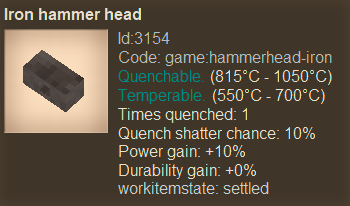
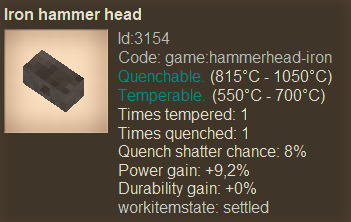
-
Hasn't this always been the case, though? The information about this explicitly included that this is the usual state of things. Searching for "pre.2" in the News section doesn't return any relevant patch notes. At the same time, rc.1 releases seem to include a summary of changes since pre.1.
-
tempering Quenching-Tempering: Finding the best combination
MKMoose replied to Diregoldleaf's topic in Discussion
What I especially like about this approach is that it could create a much more approachable and interesting puzzle out of the system. In this case, there would be a real high-level choice behind tempering (which would then probably have to get heavily buffed): do you prefer to reduce the risk of shattering at the cost of slightly reducing the maximum achievable power of your weapon, or do you take the resource loss for a small chance at a perfect weapon? Kinda unrelated, but my main gripe with suggestions to return bits or damaged toolheads when a tool breaks is that most of these ideas kind of don't serve a purpose. What's the gameplay reason for it? A tool breaking is ultimately a loss of resources - if some of those resources are given back, then that's still the same kind of loss, just a bit smaller, and you end up having to carry the bits or toolheads back home and repurpose them, which will most likely feel like extra obligation or maintenance. Same, at least when that quenching is done correctly, if they decide to make it a bit more skill-based. Though I still need confirmation on whether there actually is any, because I haven't had anything shatter on the first quench yet. -
tempering Quenching-Tempering: Finding the best combination
MKMoose replied to Diregoldleaf's topic in Discussion
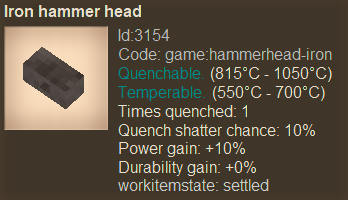
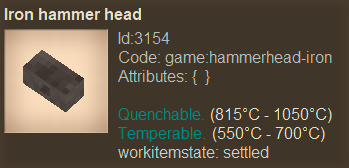
Why does your shatter chance go up with each additional tempering besides the first one? On top of that, I'm not certain about the first quenching done on a brand new item, but the second quenching will start off at 10%. The first quenching is a little odd, but it seems to have no "shatterChance" attribute at that point, so the default value of 5% would be used. By modifying "quenchIteration", I can get it to show up in the tooltip. But after quenching a couple dozen times I haven't gotten it to trigger, so I'm not certain if it can actually shatter on the first time.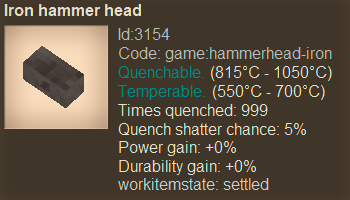
-
tempering Quenching-Tempering: Finding the best combination
MKMoose replied to Diregoldleaf's topic in Discussion
It seems to exactly match the table you titled Q-T22-QUENCH. Tempering 22 times is not exactly practical for most people, and it may get patched out if they end up adjusting the in-game behavior to match the handbook guide, but regardless the graph appears to be correct for that scenario. -
tempering Quenching-Tempering: Finding the best combination
MKMoose replied to Diregoldleaf's topic in Discussion
Disregarding for now whether the math for a single tool is correct or not, this depends entirely on what you're trying to calculate. If you have a 0.55 chance that the tool head doesn't break, then on average you will get one finished tool after processing 1 / 0.55 = 1.82 tool heads. What you're claiming to be more correct is a fundamentally different calculation, because you're effectively saying how many tool heads you'd need to get at least one finished tool with a certain minimum probability. Processing four tool heads to reach 0.95 confidence will on average give you 0.55 * 4 = 2.2 finished tools. Which of those numbers is more important here depends entirely on how many tools the player needs to use. If they're only ever gonna need one, then the probability of getting at least one tool is important. But if they're gonna burn through many tools, then the average return might be worth paying more attention to. I fail to notice any discrepancies between the code I've pointed to and the OP's data (the raw data at least) except the matter of whether the first quenching can shatter the item (it seems to me like it can based on the code, but it's not communicated in the tooltips and the handbook also seems to imply that it can't). Note that most of the OP's numbers appear to be based on items which are only tempered a number of times after the first quenching, which is why it may seem odd. -
tempering Quenching-Tempering: Finding the best combination
MKMoose replied to Diregoldleaf's topic in Discussion
It effectively says that you can temper an item as many times as you wish, at any point, as long as that number doesn't exceed the number of times that you've quenched it. It doesn't match the in-game behavior because there's actually just no check comparing the numbers in the code, but it's not locked into a linear process either. -
I feel like if the Bronze Age is short, then the Copper Age is a mere moment, because many people will only craft the bare minimum set of three copper tools and then beeline for bronze. One thing that is especially difficult to balance here is the contrast between new and experienced players. Some struggle to find their first copper deposits, and some will easily get to steel before the first winter ends. Any way to extend the early game would likely end up in a similar fashion - a large obstacle for the beginner, but at most an inconvenience for the veteran. I don't think it's worth it to delay or extend progression for the sake of it. Iron is already non-critical, because it's possible to do nearly everything in the game with bronze tools with no issues - the durability is unimpressive but absolutely sufficient for the average player not engaging in some massive projects, and there are very few features which are actually gated behind iron. The main problem here is that even if the player were forced to wait for some long processes or slog through a tedious grind to get to iron, it will still almost always be technically optimal to get the better tools before engaging in the activities which aren't critical to progression, even if the improvement isn't too significant in practice. If the goal is to extend the Bronze Age, then the best way to do it might be to just continue adding various features that don't benefit significantly from having better tools (some of which might be only unlocked at bronze, like the helve or the crate trap). Or generally develop the more primitive parts of the game's progression to be more self-sufficient with more unique unlocks that don't have clear endgame upgrades, so that they're not just stepping stones to iron and steel. Sure, most of it would be optional and many players would skip it, but beyond a couple critical unlocks it seems intentional that going through the material progression isn't strictly required for everything else. As for examples of those optional mechanics - herbalism, mushroom farming and improved animal domestication are on the roadmap, and so are woodworking (ideally including wood and bone carving) as well as weaving, which could be pretty big undertakings but would likely serve well to extend the early game without putting pressure onto the player to advance quickly through the progression. It turns out that earlier I was testing on a world with a lower time speed, so I initially though the difference in cooling rate is lower. It's a bit annoying, frankly, to have to switch back and forth, though I don't think it's too bad. The iron blooms also seem to cool down faster than ingots for seemingly no reason. Though I don't think that this has much influence on making bronze armor. In this specific case, making iron armor more annoying to obtain just makes it more annoying to obtain, but bronze armor is still weak and expensive, and gambeson still exists.
-
tempering Quenching-Tempering: Finding the best combination
MKMoose replied to Diregoldleaf's topic in Discussion
It literally doesn't say this, unless it's grossly mistranslated in whatever language you might be using. They can be found based on the code for the Quenchable behavior, most notably the applyTemperedStats() and applyQuenchedStats() functions. Though those are quite likely to still change if the current balance is deemed unsatisfactory. As I see it, the maximum buffs obtainable through quenching are way too high. It's supposed to improve the tool, but the likes of 50% power gains are borderline absurd. I would much rather take a more skill-based mechanic with a lower but more consistent ceiling. -
There is no single clear production method for it, because "Damascus steel" is a marketing term more than an actual type of steel (especially nowadays, but historically to an extent as well). It's generally agreed upon that it is likely named after the city of Damascus, and not necessarily a specific kind of steel. Some blades referred to as Damascene don't have the typical pattern in the steel, and many blades with a similar "watered" pattern aren't Damascene, because similar steelmaking processes have been used in many different places. The majority of Damascus steel was likely wootz steel imported from India, forged into blades by local weaponsmiths. I could see crucible steel or more specifically wootz steel being added to the game, but it wouldn't require any advanced machinery. It would likely be worse than steel from the cementation process for most purposes. Maybe it could be favorable for blades, but it would likely have to be kept broadly weaker and difficult or risky to process, to let the cementation furnace retain most of its incentives. It would likely have to be limited to certain items, and certainly shouldn't have a T5 pickaxe, to avoid short-circuiting endgame progression. I broadly like the idea of crucible steel, but I just don't see a way to implement it in a realistic way without either keeping its use cases extremely limited or taking a wrecking ball to existing endgame progression.
-
It would be pretty easy to implement and would require no significant changes to the existing windmills or wind, and the underlying code might just require the added possibility of a windmill with a vertical axis of rotation. A very basic panemone could potentially even be crafted without the use of linen, as a rudimentary way to power a quern in the early game. The main balancing issue to solve is how to make them less useful than regular windmills, because just making them produce very little torque would still make it possible to power large machinery with a whole array of them at no detriment. I think the best way to do it would be to have them require stronger winds to produce usable power, indicating that they are less efficient and have to overcome more internal friction.
-
Fair enough, it can actually be very useful as it allows to see in places which would otherwise be pitch black. It's also really nice in that it doesn't take an item slot to hold it like a torch or lantern. Can be especially useful when using a torch, because a torch can get extinguished in water. What I meant by "not practical" was more that I would never consider it sufficient to be my only light source, unless I was seriously min-maxing.
-
Just some questions about what comes beyond steel
MKMoose replied to DitaDataDita's topic in Discussion
If you're working with charcoal, the bellows don't really do much at the moment, until you need to go past the default temperature limit for quenching. They slightly increase the rate at which temperature rises and allow you to heat up the item further tobe able to work it for longer before having to put it back in the forge briefly, but both effects are not particularly significant. If you're working with brown or black coal, then the bellows are necessary for ironworking, but still only particularly useful once you need to increase the temperature above the maximum to reach the minimum for ironworking. I tested it recently and wanted to report it, and just as I was about to open my own issue, it was reported in #8365. -
Besides allowing to carry a spare temporal gear, its only purpose is to provide a very dim light. Not enough to really be practical, but in an occasional emergency it may be better than nothing.
-
Something like this has been a known issue for a while now, as seen in #4433 or #7576. Unfortunately, as far as I know the only fix on your side is to spawn the elk back in via creative mode.
-
Just some questions about what comes beyond steel
MKMoose replied to DitaDataDita's topic in Discussion
Fair enough, it would probably have been better for me to say that bronze could be better than iron for certain applications in terms of the ratio of end result to cost, which would still likely end up worse than iron when comparing the stats in isolation. It could also be better in some regards and worse in others, especially in the form of higher speed but lower durability (largely just for the sake of more interesting gameplay balance). To some extent you can see what that could look like with tin bronze and bismuth bronze, of which the latter has higher durability in everything besides armor, which makes it outright better for tools where speed or damage doesn't matter (though it can be more expensive), while tin bronze tends to be more preferable for pickaxes, falxes, spears and the like. In the current balance the differences tend to be small enough to not matter most of the time, but exaggerating a bit for the sake of gameplay variety might not be a bad idea. Saving iron and continuing to use bronze for certain applications is just not something that I've found useful in my own gameplay, because getting fire clay and iron ore is a progression gate more than it is a significant cost for every iron ingot. Once you have all the resources, then even manually working blooms can often be more worthwhile in terms of the reward to effort ratio than using bronze. That at least goes for the tools that can't be cast directly - maybe bronze could be useful for some things like axes or shovels, though personally I haven't found it really worthwhile regardless due to how scarce the alloying elements for bronze can sometimes be and how large the jump to iron is. The durability is usually roughly doubled, and the improvement to mining speed is typically ~20-35% with the only notable exception being the shovel at ~10% (and that's not counting quenching with 1.22, which done once at no risk gives a nearly free buff on top of this, further widening the gap). At that point, I feel like the only real purpose of bronze once you have iron is for tools that you know you're not gonna use past the durability of a single bronze item anyways, but frankly, that's kind of a lame purpose. Either way, the main idea is to make the transition to the Iron Age more gradual with only inefficient, small-scale production at first, and this is just one small component which could additionally contribute but isn't really integral to it. I don't find this to be the case at all, though we'll see if it changes further before stable. In the current balance, a single risk-free quenching with a fairly small up-front investment into bellows (3x nails and 6x leather for the small ones) should allow to increase the power (i.e. damage and mining speed) of most ferrous tools by 10%, or durability by 20% when covered in clay. If you take out the iron out of the bloomery fast enough then you don't even have to use bellows for at least one or two tools, if going for a power increase (even easier with meteoric iron or repurposed bits since you get ingots directly - I feel like that should be changed eventually). To me, this is just further incentive to make the jump to iron as fast as possible. Maybe I'm optimizing a little too much, but either way it's an added buff on top of everything else, while the baseline time and cost of ironmaking are nearly unaffected. -
Just some questions about what comes beyond steel
MKMoose replied to DitaDataDita's topic in Discussion
Doesn't seem to be too many ways to do that, realistically. The simplest solution in cold-working and annealing would probably be a good idea, in line with quenching and tempering for ferrous metals, though it could also end up just being the default for all bronze tools and not a way to extend the Bronze Age. There could be a number of sub-types of bronze alloys (a fourth one made with arsenic may not be a terrible idea, and it may be worth to allow using different ratios), each of which could be better for a different range of applications and potentially similar to iron in certain cases, making it more useful to invest into multiple types of bronze with different alloying elements instead of rushing to iron. It could end up a bit complex, though. As things stand, though, iron unlocks a significant chunk of progression, and developing iron would probably be a more worthwhile idea either way. The argument about the durability and strength of iron is kind of difficult to realize in-game, because almost the entirety of it is reliant on metalworking knowledge and the processing methods used. The only real way to translate that into gameplay would be to introduce a couple types of iron of different quality based on how it's smelted, whether some additional flux is added, and whether it's wrought by hand or using a helve, and I don't know if we want to go that route. It may be a decent idea to introduce bog iron as a source of small quantities of iron for inefficient smelting in bloomeries to reduce the hard gating of progression. At the same time the cost of processing iron blooms into iron could be increased, to drive players to keep using bronze for longer until they progress enough to reduce the workload of iron processing. Also, a significant addition which I would expect to be introduced eventually is cast iron alongside a blast furnace, which would unlock a range of cast iron items, including tools (for certain purposes similar to wrought iron, but very brittle so not useful for many other applications) which could be produced in potentially greater quantity than even bronze, as well as higher-quality wrought iron if that is of interest. It could serve as a second progression milestone related to iron, with a bunch of other unlocks like cast iron stoves and cookware. An extra addition which I would be interested in would be rust, which would degrade power of ferrous tools if not oiled after use and would need to be removed at a cost of durability. Increased need for regular maintenance (though only when putting tools away in this case) could be a neat tradeoff for unrealistically high durability, though admittedly it probably wouldn't be the most popular change. Bronze has much higher Vickers hardness than wrought iron and can be even somewhat higher than some steels, which generally means superior resistance to wear and generally higher durability where the use case favors it (at least over the iron more typical to the Middle Ages - modern iron and steels are much better). I feel like it would be ideal to discard the idea of tiers to some extent, and make bronze outright better than iron for some applications and worse for others. This way, deciding which metal to use would be less about "pick the best tier of metal that you have" and more about "pick the most suitable metal for this specific purpose". Don't wanna make a whole mess of the system, of course, but for example bronze knives and garden tools could be better than iron equivalents (still worse than steel, to be clear). -
To some extent that is already the case, since it's easy to feed domesticated animals until they reach good weight, whereas wild animals will generally be at the weight you find them at, which can be especially low in the winter months (or at least it's supposed to). You'd probably have to set up a trough in the wild to somehow feed them, and most people don't bother as far as I can tell. Some changes with generations would make a lot of sense, though, even if only visual - sheep more wooly, boars less hairy and providing more fat (in part to make them stand out from other animals, over which they don't really anything unique), and so on. I personally think animal husbandry could be reworked to require more regular feeding and generally more effort to achieve proper results, which could counterbalance an increase to animal yields. And that might require changes to farming as well. As it stands, animal husbandry largely functions as a nutrition type conversion of sorts, but the costs beyond the initial setup end up being almost irrelevant in many cases due to the abundance of food once a good farm is set up, and for the most part it only takes a whole bunch of waiting. And in the case of chickens you don't even really have to wait particularly long for anything.
-
Try this command: /giveitem lore-book-aged-orangebrown 1 s[] { category: "jonas" } You can replace "jonas" with "villager", "tobias", "research" and "diaries". Not sure what that is equivalent to in-game. There doesn't seem to be a way to get specific lore, just these five categories.
-
I stupidly didn't verify the one thing that has changed in the new update, that's on me. The same bug that causes handbook crashes seems to cause affected recipes (including most if not all recipes that use pelts) to not resolve, so that specific recipe for the sling isn't functional.
-
Just some questions about what comes beyond steel
MKMoose replied to DitaDataDita's topic in Discussion
If I recall correctly, Tyron has said relatively recently that they don't really have any plans for anything beyond steel, and at most they may add some specialized steels for certain narrow use cases. The problem of sorts with all of these materials (stainless steel, specialized alloy steel, a variety of other stuff), is that most of them only became known and used in the late 19th or 20th century, often due to rising need for advanced materials for new machinery functioning in increasingly demanding conditions. That especialy applies to the more modern materials that you've listed here, which are generally used for very specialized purposes, many of which aren't in the game and almost certainly will never be added, except maybe in very limited capacity as part of some Jonas tech shenanigans. This kind of metallurgy is generally a modern thing driven by modern needs, so implementing something like that while at this point we still have almost no signs of the Industrial Revolution in the game would be frankly quite absurd. Granted, there's already a bunch of somewhat anachronistic features like chromium tanning or the cementation furnace, but they're not that modern. -
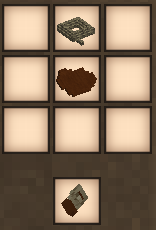
Should be possible to replace the piece of leather with a piece of linen or a small/medium pelt. Tested on 1.22.0-pre.3.
-
Keep in mind that the 25% increase is in just one set of sails, but a single metal windmill rotor can take 10 sets of large sails, making the full rotor's power equivalent to 2.5 small sails (granted, at a flax equivalent of 4 small rotors, as well as 12 iron ingots - a very large cost for unimpressive returns). I would personally want the power from a single set of large sails increased to at least 40 kN up from 25 kN, considering how much space it takes up and the material investment necessary to build it, but for now we're still early into the prerelease and there's a lot of space for adjustments. The large windmill costs more than 4x as much as the small one (including 12 iron ingots, which is also a progression gate), visually has ~4x the effective sail area, and it takes up 8x the volume or 4x the area if you want to avoid wind turbulence. I think it would be quite reasonable to at least give it 4x the power as well instead of the current 2.5x, because what's the point otherwise? With the current balance, you can build a small quad windmill for a lower cost and just 20% lower return in spite of the turbulence, and optionally make it ugly and sprawled-out to avoid turbulence for 60% higher return than a single large windmill. As an additional note: the two windmill sizes currently have the same rotational speed, so I think it would make a lot of sense to make the large windmill rotate slower, but with significantly higher torque (due to a longer lever that the force is applied on), to introduce a more meaningful difference between them. In the current implementation of wind turbulence, a quad windmill needs 10 blocks of separation between the central axle and each rotor to avoid the penalty. Kind of hideous. I feel like the simplest way to improve wind turbulence is to make the minimum distance between windmills greater along the axis of rotation, as well as make the turbulence strength fall off with distance and accumulate with larger numbers of windmills. These changes would further encourage side-by-side windmills while disincentivizing hyperoptimization, and would also make the whole mechanic more approachable.
-
Storing gears (both rusty and temporal) in vanilla or modded.
MKMoose replied to Broccoli Clock's topic in Questions
Purposeful Storage seems to include a pretty neat rack for storing rusty and temporal gears. The new cabinets aren't very space-efficient, but I love that now at least we have a proper way to display items. -
An iron hatch door is what you need in the vanilla game - as much is stated in the in-game handbook. There's a couple things you may want to check: Is the coke oven constructed correctly, with the right materials (fireclay or refractory bricks)? Are you using the right coal for it (brown or black coal)? Anthracite or charcoal won't work, though it doesn't seem to be mentioned explicitly in the handbook. Does the oven work correctly in the vanilla game for you? If it works in vanilla and not modded, then it's likely that one of your mods is causing it to break. If the coke oven is functioning correctly, it should have a bunch of gray smoke particles coming out from the top.