Sunny_Sometimes
-
Posts
5 -
Joined
-
Last visited
Content Type
Profiles
Forums
Blogs
News
Store
Everything posted by Sunny_Sometimes
-
On the topic of items potentially craftable with hand-weaving and related mechanics (some of these might be excessive): Crude cloth: A coarse and weak cloth made from simple string, using a crude loom. Not suitable for many clothing items but might work for a rug or blanket. -- Materials: simple string. Knitted cloth: A flat sheet of knitted material that would come in linen and woolen varieties. Useful for some clothing, like a shawl, or for blankets or rugs. -- Materials: yarn. Rawhide: Created by scraping an untreated hide with a knife and then stretching it on a frame of sticks or boards to dry. Could be used whole or cut into strips for lashing or weaving (would need to be briefly soaked first to make it pliable). Existing "rawhide" recipes would use this instead of fresh hides. A similar process would be needed to convert lime-soaked hides into parchment and would involve additional scraping and burnishing while stretched and wet. -- Materials: hides. Blankets: A sheet of cloth or hide could be added (right-click with the blanket in hand) to any bed for additional warmth and increased maximum sleep duration while using it. It could also be draped around the body while stationary or walking (prevents running). The warmth and sleep duration gain would depend on the material. Might also let a player sleep anywhere for a short time--say, 5 hours--without a bed. Quilts might be made from stitched cloth that's been packed with loose wool. -- Materials: linen, woolen cloth, knitted cloth, large hides and pelts, medium or small hides and pelts (stitched together). Pillows: Could be added to a bed in the same manner as blankets for an increase in the maximum sleep duration (0.3-0.5 hours) and possibly a boost to healing rate while asleep. It might have two variants: a simple version stuffed with hay and a fine version stuffed with feathers. -- Materials: linen, woolen cloth + grass, straw, feathers, stitching materials. Beds: In conjunction with blankets and pillows, beds might have more involved in their construction. A hay bed, as is already in game, would be made simply from hay (grass) or straw. A straw mattress would increase the maximum sleep duration and involve stitching fabric together and then stuffing it with hay or straw. A feather mattress would be similar but stuffed with feathers instead, and offer a larger bonus to sleep duration and possibly a healing buff as well. Both kinds of mattress could be put on a frame for additional sleep duration, which would be constructed with boards and rope. -- Materials: linen, woolen cloth + grass, straw, feathers, stitching materials. Thatch: Since writing previously, I've landed on the idea of making tule grass simply drop straw and then allowing raw straw, reeds, or grass to be lashed together with string, vines, etc. to create thatch, possibly by holding the lashing material in the off-hand and the main thatch material in the main hand and holding right-click (I'm personally a big proponent of moving as much crafting out of the grid as possible--all of it, ideally, but it's a long journey to reach that goal in a manner that's more immersive than it is frustrating). Additionally, thatch that's exposed to the weather might become aged thatch over time, eventually degrading to a point that the roof starts leaking (might happen 0-2 times per year, on average, depending on the climate). Fresh thatch could be added to the roof to repair it. As a side note: it makes no sense to me that tule currently isn't any more efficient than regular grass for thatch (4 pieces each), given the size disparity of the plants and the sheer prevalence of grass--imo grass should make about half as much per plant harvested, or tule twice as much. -- Materials: reeds, papyrus, straw, grass + lashing (string, etc.). Baskets: Aside from the existing hand baskets and chests, perhaps a carrying basket (needs a better name?) could contain a larger amount of a singular item or type of item, e.g. fruits, stones, etc.--similar to the mining bag (maybe 6-8 slots), but the category would be defined by the first item inserted and would reset when the basket is emptied completely. It could either be set on the ground and drawn from/filled or optionally occupy a player's first inventory expansion slot to be transported with its contents (visible when worn a la backpacks). This might possibly be done entirely without an inventory GUI, a la crates, aside from the tool tip and what contents can physically be seen by looking at it. Items would then be pulled out in reverse order from how they were inserted, with the basket needing to be set on the ground first to do so. Picked-up items would be able to enter it while worn, to facilitate crop harvesting, quarrying, etc., but the player couldn't interact with its inventory via their own aside from maybe dragging-and-dropping things into it. It could also be placed on a raft as stowage a la the reed chest. A larger storage basket than the chest would also be nice, maybe comparable in size to the storage vessel but without its food-preserving qualities and requiring more time and materials than the chest. Some smaller, more decorative baskets or bowls would be nice as well and might be able to hold a small, set number of individual items. Due to that restriction, it could be carried directly in the inventory when not placed on the ground, effectively functioning in a tangential manner to MC's bundles. That or it would have a single inventory slot for a stack of items, with an inventory GUI not being needed in either scenario. A specialized "sewing basket" might hold a mix-and-match stack's-worth of string, yarn, or thread. Another use-case idea for small baskets might be to carry water--say, 5L--but only for a short period of time as their contents would gradually leak out. -- Materials: reeds, papyrus, straw, bamboo strips. Covers & lids: Covers for jugs and flowerpots and lids for bowls, barrels, and cooking pots could partially decrease their food spoilage rate when above cellar conditions by keeping the sun off, but lids would need to be removed to interact with the contents (a simple right-click to add/remove). Lids might also keep rain out (rainwater getting into open barrels, buckets, bowls, and pots is something I'm interested in, personally, both for added dynamics to food/item preservation and for players with source block transport disabled). Then again, cooking pots are already shown with a lid in their in-use state, despite it not being represented in the recipe. -- Materials: reeds, papyrus, straw, bamboo strips. Skeps: After weaving the outer structure, clay would need to be held and added to complete it (might be very similar to regular clay-forming but in larger sections to speed the process up). -- Materials: reeds, papyrus, straw, bamboo strips + clay. Mats: Mats would be constructible from many of the pliable, non-cloth materials. They could be used for decoration or in other processes (like felting). Most easily produced with a crude loom. -- Materials: reeds, papyrus, straw, bamboo strips, grass. Shields: Crude shields would be made from mats of reeds or papyrus and a framing material like sticks or bamboo. A wholly-bamboo shield would be stronger than the crude shield and have its own weaving recipe and (more refined) shape. -- Materials: reeds, papyrus, bamboo strips + sticks, bamboo. Rugs: Could be made by stitching a border onto any heavy-enough cloth and could be laid on the floor or hung on a wall. Additional string or yarn would add tassels. Might influence room warmth in some way. -- Materials: linen, woolen cloth, crude cloth + string, yarn, thread. Curtains: Made from stitched cloth or straw mats and hung on a rod above a window. Can be drawn opened or closed with right-click. -- Materials: linen, woolen cloth, crude cloth, straw mat + stitching (thread, etc.). Lace: Could be created by knitting any fine thread into a doily (small and large sizes) or into a strip for embellishing other garments. -- Materials: thread. Flower wreath: Already an item in game, but could use a weaving recipe. -- Materials: flowers. Woven hats: Could be made in a variety of styles, depending on the material; some coming with string chin straps or optional additions like a ribbon of cloth or leather that feathers and flowers could be tucked into (a flower wreath might also take the place of a ribbon). -- Materials: reeds, papyrus, straw, bamboo strips. Felt hats: Could be made in a variety of styles by pressing felt over a wooden mold. -- Materials: felt. Valenki: A warm felt boot, also made by pressing felt over a mold. Might be soled with leather to increase durability. -- Materials: felt + leather. Grass skirts: Not much warmth, but covers things. Beads could potentially be added for decoration. -- Materials: straw, grass + string, beads. Beaded necklaces & bracelets: Beads could be made from wood, bone, metal, shells, etc. or be bought or found. -- Materials: string, yarn + beads. Mino capes: A straw raincoat. Possibly exclusive to straw from rice plants, due to its water-resistant properties, though that might make it too exclusive a recipe. Might also be useful for camouflage in multiplayer. -- Materials: (rice) straw + string. Chairs & tables: Certain varieties could be made entirely by weaving one of the stronger materials (reeds, papyrus, bamboo), sometimes with sticks for support. In other instances, seats, backs, etc. could be woven or stretched onto an existing wooden frame, and could be done with a wider array of materials. -- Materials: reeds, papyrus, straw, bamboo, rawhide, leather, linen, woolen cloth. Rafts: Construction of the existing rafts could be turned into a weaving recipe. -- Materials: logs (possibly quarter logs), bamboo + rope, crude rope. Rawhide boat: A boat with single and double-seat variants that would be made by weaving a frame from sticks and then stretching a large (1-seat) or huge (2-seat) rawhide over it with pitch glue. Alternatively, a pelota boat might be constructed simply with a large or huge rawhide and rope, but would have limited durability. As a side-note: tar could be added to the game as a material for waterproofing and would be obtained from rare tar pits or as a byproduct from coke production or the conversion of certain wood types (pine, larch, birch, etc.) into charcoal, possibly in a special kind of charcoal pit. -- Materials: sticks, rawhide + pitch glue. Bamboo boat: A more shapely boat than the bamboo raft (might have 3 seats/stowage locations) could be made entirely of woven construction but would need to be waterproofed with rendered fat or pitch glue. -- Materials: bamboo strips + rendered fat, pitch glue. Miscellaneous sculptures & other decorations: Were mentioned in the original thread post, so I ought to include them as well. -- Materials: varies. Crude sack: Could be made out of a shirt or blanket for early-game inventory expansion. Might need to be set down to access its contents. -- Materials: various clothing, blankets, etc. Woven sandals: Sandals made entirely by weaving. -- Materials: reeds, papyrus, straw. Soled sandals: Sandals made by adding straps to a sole made from wood or leather. -- Materials: wood, leather + string, yarn, leather strips. Additional ideas I haven't mentioned previously: Woven cloth might come in two primary grades--simple and fine--depending on if it was woven with yarn or thread (thread requiring a proper spinning wheel). Some recipes would require a certain grade; for instance a veil or fine pillow might require fine cloth, while fine cloth might be too lightweight for a rug. Fine cloth might also offer more potential weaving patterns on the loom. Cotton, jute, and silk could be added as additional fiber sources, with jute making heavy burlap and rope and silk requiring a lot of special processing but creating particularly fine and valuable items. Specific "tailored" garments, such as tailored gambesons (or even scale and plate armor, in a tangential mechanic), would, instead of having their own recipes, be created by taking measurements of a player, using a measuring tape made from string, and then applying those measurements to the garment's paper template before adding and cutting the materials. After assembly is complete, the garment would then be "tailored" to the specific player the measurements were taken from, and only they would be able to enjoy its improved attributes when wearing it. For any other player, it would behave like the original unaltered garment (with the associated movement speed debuffs, etc.). The ability to make alterations to an existing garment via measuring, cutting, and sewing would be exclusive to tailor-class players, and such after-the-fact alterations would give a slight additional buff to traits. Aside from the existing hats with rain-repellent properties, clothing in general could be further integrated into the wetness mechanic and its affect on body temperature. Ponchos and raincoats should also keep rain off, with rain being able to reach both the head and upper body, depending on what's being worn (possibly the lower body as well, if there's strong winds). Raincoats might need to be treated with wax or rendered fat when created or mended to maintain their water-repellent properties. Clothes (gambesons included) that are not water-repellent would in turn absorb water (wool and fleece would absorb the most) and would need to be removed for the player's body to dry quickly. The wet clothes would slowly dry on their own (out of the rain), but this could be accelerated by placing them on the ground in the sun or near a fire. Wet clothes might also weigh the player down, slowing walk speed and making swimming difficult (as a tangent: full plate armor should realistically make you sink like a rock lol). This all would encourage players to engage with their clothing more often, give value to making and keeping spare and specialized items, and make jumping into a lake a more consequential decision if they don't remove their heavy garments first. Proper roofs would also become more important, especially if cloth and other items (like unfired pottery) could degrade over time in the elements until they fall apart/rot. To go along with the boats mentioned, dugout canoes and other small craft could be an interesting addition. I personally think something as large as a raft or a boat, especially if it becomes craftable outside of the inventory, ought to take up an inventory expansion slot to be carried (some amount of dragging it with an empty hand would make sense though).
-
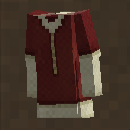
To go more in-depth about my ideas for coloration and clothing construction: My ideal would be to allow for a high degree of customization and creativity while keeping the total number of items restrained. To this end, each clothing/woven "item" would be defined by its shape/structure and base texture, while its coloration and attributes would be derived from attached data about its construction. For example, the various existing kirtle tops would all be folded into a single kirtle top "item". This item would then have two defined "material regions" to describe the inner and outer sections. The red and white areas would be the two material regions, possibly labeled as "plain red linen" and "plain undyed linen" in this example. The particular pieces of cloth/fur/leather used would then determine the coloration/pattern of each of these regions as a texture underlay. Some garments would have additional secondary regions for visible stitching, buttons, cuffs, etc. (buttons could be fun!). The total durability and warmth would come from the materials used. Knitted items and baskets would be divided into predefined sections, which would be worked on in sequence. The choice to change material could be made when starting a new section, but a section would be internally uniform. Cloth patterns would be handled in a similar fashion, with different predefined parts of the texture being colored by the yarn/thread used for them. For readability, these details might be obfuscated once the cloth is part of a garment and be simply referred to as "patterned linen" or similar, possibly with the most-used color associated. The most-used color would be what traders care about when purchasing, for ease of gameplay, though they might specify that they want it patterned and not just plain. It might also be possible to bleach cloth and then mordant and dye it again to make it uniform (maybe whole garments, even?). To make it engaging, I imagine the usage of a loom would be a fairly hands-on process; inputting materials, right-clicking on different parts of the device in sequence to operate it, etc. Think of the fruit-press, but taking longer. A spinning wheel would be much more simple to operate, like a quern. The storage of non-identical bolts of cloth might be facilitated by a hanging rack of some sort, similar to the vertical rack. A bobbin rack could likewise hold yarn, thread, and string. Clothing items don't stack to begin with, though the ability for more types of clothing to be stored in cabinets would be nice (might need to remove the central shelf for boots to fit, though they can go on the ground anyway). When it comes to the actual construction/tailoring of garments, this would generally be done in one of three ways: Knitted garments would be made whole from yarn as a singular work item, which could be worked on while seated with a knitting needle in each hand and freely set down/picked up as mentioned previously. More complex garments would be made with the assistance of a paper template. Some templates could be made by placing paper on the ground and shift+right-clicking with shears or a knife in a process similar to knapping (the tailor class would have more options). Others could only be bought or found, but all templates could be copied with additional paper like the glider schematic. To use a template, it would need to be placed on a large-enough flat surface (a 2x2 or 3x3 area, possibly?). Cloth would then be added and cut in the same knapping-like fashion. This might be the point where the player could choose which cloth/fur/leather would constitute which material region of the piece, possibly by the block of the template its added to (templates would have restrictions on what kinds of materials could occupy which regions). When that process is complete, the template would be destroyed and the cloth would be converted into a work item, which could in turn be sewn together in a process similar to knitting but with a bone/metal needle and thread instead of a pair of knitting needles. Additional components like buttons would be added via the F-key menu from inventory (sort of similar to adding materials to chiseled blocks, but with predefined slots). Alternatively, the mechanic could function by adding thread to a needle, like fishing bait to a pole, and then holding the component to be added in the off-hand. A derivation of this mechanic (either version) could be used for mending. Some very simple garments, such as tunics and wraps, could be made with whole cloth or hides that are held in place with a belt of simple rope or a needle/brooch of some sort. A bone needle and simple string might offer some very rough stitching as well, only suitable for crude garments. Embroidery may be done in a similar way to sewing, by sitting down with a needle and thread in hand (thread color determining embroidery color) and right-clicking on the item. When done on whole cloth, a list of shapes could be chosen from to be repeated across the surface; X's, ropes, flowers, gears, etc., with the tailor class having more options. A piece of cloth could only be embroidered once. Finished garments would have predefined locations where a shape could be added in the same manner. Some extra notes: I like the addition of soaking/retting reeds, straw, etc. in water first to make them pliable. However, locking that behind barrels would heavily interfere with progression. As I mentioned with papyrus-making, this might alternatively be accomplished by stacking the item on the ground underwater for a length of time, similar to curing oiled hides on the ground, or even by leaving it out in the rain (for a longer period of time). Leaving it in the water too long may cause it to rot, though. Pulp makes sense to be confined to a barrel so it doesn't wash away. I've long been disgruntled by the near-lack of skirts/dresses/gowns in the game, much less ones craftable by the player. Hopefully there would be some patterns for those. The crafting station idea, while interesting, does feel overly prescriptive in a way that existing mechanics don't. I fear that could hurt immersion. The mechanics I've described would require a similar amount of inventory/hotbar management to metalworking, I'd estimate. A wooden mallet could be a handy tool in many situations, be cheap and easy to make, and save on metal hammer durability when that kind of hammer isn't really necessary for the task. I mentioned the wooden club as it's the closest equivalent already in game, but a dedicated mallet would be nice. I could also envision other kinds of fence being made in a manner similar to the wattle mechanic I described; carving posts out of logs or boards, driving them into the ground, and then connecting them with additional material.
-
I use a barrel of water for that purpose, personally. That particular item-pickup annoyance also shows up in many other situations though. Maybe the solution could simply be to shift the collection hitbox downward when crouching or seated? That way you could "bend down" to pick something up.
-
A few thoughts on materials, firstly: Needing to first split bamboo into strips with a knife or axe would make sense, since its whole state as-harvested isn't flexible like the other materials. I would add a generic "straw" to the list (folded-in with thatch?) that could be obtained from the farmable grains* and possibly other tall-stalked plants like redtop grass. I might add grass as well, since several articles of clothing can be made with it already, though straw may take its place in many instances. Wool (could come from a number of animals already in the game) is long overdue as a material and would fit in nicely. The feasibility of shearing the animals while they're alive could depend on their domestication like milking does, though small amounts might be shed in the late spring and could be opportunistically collected that way. The collected wool would need to be scoured (washed) in a pot with heated water (adding potash may result in a higher-quality product) and then combed before use in crafting. Leather strips, cut with a knife from a piece of leather, would also fit nicely (could be optionally cut from dyed leather or dyed after-the-fact). It might also be interesting to have multiple leather sizes associated with the different hide sizes, with larger ones able to be cut down to stack with the others. Some crafting recipes may require larger sizes outright or may require extra material to stitch smaller pieces together. Certain materials would be unsuitable for certain recipes. A hand basket, skep, or crude shield, for instance, would need to be made from sturdier materials like bamboo, reeds**, or papyrus***. Bamboo would likewise be too stiff to make a shirt out of, though perhaps some recipes could require different grades of material for different parts of the structure. Twisting/spinning: Some recipes might require a component that has first been twisted or spun. This could be done by hand in a rough and tedious manner to create crude string (from grass) or simple string (from other pliable-enough fiber sources), possibly by holding material in both hands while seated and holding right-click. The tree-seed amulets, for instance, would then be crafted with string instead of rope, and other recipes that would realistically involve lashing things together could have that added****. A crude spinning jig of some sort could be made to speed-up the process and allow the creation of yarns (from wool or flax) and simple rope (jig would have durability and be craftable without metal a la the crude hide bellows). Crude rope could be made by hand from vines but would have limited crafting uses compared to simple rope. Sturdy ropes for shipbuilding, mechanical power, etc. and thread for fine clothes and leatherworking would require a proper ropemaking jig and spinning wheel, respectively, both involving a saw, hammer, chisel, boards, and a lubricant like rendered fat. The ropemaking jig might be formed with two components that need to be placed in-line with each other, several blocks apart, while the spinning wheel might be a standalone 1x2x2 block apparatus. How I'd envision weaving functioning: Much like what's already been suggested, I'd envision hand-weaving starting much like clay-forming by shift+right-clicking on the ground with a weavable material in your hand and then choosing from a list of recipes based on the material. The warp, or structural spines of the shape, would first be placed down individually and then the weft would be added by holding material and right-clicking on the warp pieces in sequence, working in a spiral around or back-and-forth across the structure, depending on the recipe. The next warp to be connected to may be highlighted in some way for ease of gameplay. Shift+right-clicking on a separately-constructed wooden frame could be a more immersive way to make sieves, chairs with reed seats, etc. The immersion of creating wattle fences might benefit from a similar process. Perhaps sticks could be held, along with a wooden club or hammer in the off-hand to drive them into the ground, and placed as posts. And then holding more sticks and right-clicking on each post successively would connect them (posts would need to be close-enough together). To create flat, woven cloth, a loom would be required. A crude loom could be created using some sticks and a lashing material (simple string, vines, etc.) and would double as a way to more quickly create mats (from straw, etc.). A better loom, made with metal components and boards, would speed-up the process and be required to make larger quantities and finer forms of cloth (but wouldn't work for mats). A big potential expansion to weaving could be to make yarn and thread itself dyeable. When starting a piece of cloth on the loom, a few different patterns could be chosen from (the better loom may offer more options). The player could then choose with the F-key which yarn/thread they want to use for each component of the pattern. A form of dyeing might be possible with straw as well, allowing players to similarly create patterns in baskets and mats by using different colors of straw for different components. Other forms of crafting textiles: Knitting could be a way to (slowly) make simpler forms of clothing without many resources. Knitting needles could be carved with a knife from sticks or bamboo (sewing needles would use bone or metal). Setting a ball of yarn on the ground and then sitting beside it with a needle in each hand and right-clicking on it would start the process and let you choose the recipe to make. Using different combinations of left and right-mouse inputs in a directed pattern to progress could create the mini-game dynamic (with a maximum speed so items can't be auto-crafted with a hotkey). The in-progress work item could be set down or carried with you, to be continued later. The ability to dye yarn (or find or purchase dyed yarn from a trader) could add a similar pattern system to that of weaving by splicing in different yarns for different sections of the piece. A felting mechanic might be achieved by placing wool on a woven mat, applying water that's been heated in a cooking pot, and then rolling it repeatedly in the mat by hand (maybe with a stick) until it felts and then leaving it to dry. The finished sheet of felt could then be dyed and used in some clothing recipes or as decoration, including as a lining for cabinets and display cases. Potentially, dyed sheets of felt could be cut into pieces and then applied to a backing sheet to create custom patterns in a pixel-art fashion. Tailoring, more generally: A system of tailoring mechanics to cut and sew-together cloth, furs, leather, etc. using an array of templates (templates would have some restrictions on material type, depending on suitability for that item), especially when combined with custom weaving patterns, could enable a near-limitless number of custom clothing and decoration options. Players with the tailor class would naturally have the most options available, and some templates may be exclusively discoverable or purchasable. A mechanic for embroidering cloth with a needle and thread (either anywhere in a pixel-art style or in specific locations from a set list of shapes) could add yet another dimension. * Sparks a secondary thought about grain harvesting: requiring the whole plant to be collected. This could be done very slowly by hand, much quicker with a knife, and best with a scythe. The plant would then need to be threshed, either entirely by hand (slow but could be done anywhere, even while the plant is still in the ground when foraging a la berry-picking), beating it against a rock or log, beating it with a wooden club, or more quickly by beating it with a flail (made from sticks and metal nails & strips, perhaps). It might also be possible to lay the plant on the ground and have a large animal trample it, as that was a historical practice, which could be very quick but would destroy some of the crop in the process. The resulting items would be grain and straw, with the exception of flax stalks which could either be used interchangeably with straw or retted (laid out in the weather or submerged in water for a length of time) to produce flax fibers. ** The tool-tip even refers to them as cooper's reeds yet they aren't involved in the bucket or barrel recipes. I've always found that odd. An in-depth coopering mechanic could also be an interesting addition, come to think of it, with fire-bending staves, hammering hoops, etc. *** Papyrus, the paper, is something the game still lacks despite having papyrus, the plant. A production mechanic for it might involve: Cutting the pith out with a knife and soaking it in water (in a barrel or stacked on the ground underwater). Laying the soaked pith down on a solid, flat surface like a rock in an overlapping grid using the weaving mechanic. Hammering it with a hammer or wooden club. Letting it dry under pressure, perhaps by sitting out of the rain for a few days with stones piled on top (out-of-crafting-grid mechanics for drying linen pulp and scraping hides would also be nice to see). Burnishing it with a stone or shell to finish. **** Perhaps stone tools could require a string, vine, or leather strip to lash them to their handles. In return, stone hand-tool heads could be used without a handle (at a slower mining speed and higher satiety usage) and higher-quality string and resin or pitch glue could be used in a lashing to increase the tool's durability (imo some slow and primitive form of hand-grinding ought to be possible without the quern for charcoal and grains, maybe by placing the item on a hard rock and right-clicking on it with a hard stone in your hand--pitch glue could then replace resin in most crafting recipes and dough could become cookable on campfires to create a fire cake with similar nutrition and longevity to charred bread). In that vein, it might be interesting to separate the durability of all tool/weapon heads from their handles. If the handle breaks, the head would remain with its durability and would need to be fitted with a new handle. If the head breaks, the whole item would be destroyed (or some scrap could be left behind, but that's a separate train of thought). Handle and lashing quality would affect handle durability and the tool's mining speed. Arrows could be treated similarly, with random breakage having the chance to either destroy the whole arrow or only the shaft and fletching, dropping the head as an item. As an aside, there might be be room with this added complexity to add a wooden spear, which would be created by sharpening a stick with a blade (perhaps by holding the stick in the off-hand and the blade in the main hand while stationary and holding right-click) and would be less accurate when thrown. The tip could optionally be hardened with fire for additional damage, bringing it closer-but-still-inferior to the lesser stone spears (but with the benefit of being potentially quicker to make and not having a separate shaft than can fall off). A crude wooden handle would be made by carving a stick with a blade and fitting the head with some form of lashing. Similar versions would be possible for bamboo and bone. A carved wooden handle would be made by processing a log with an axe, saw, hammer, and chisel and then affixed with pitch glue and a hammer or wooden club. The color and durability of carved wooden handles would reflect the log type they were made from, with hardwood being required for a tool/weapon to function as tier 4+. Carved bone handles would be made in a similar fashion. An ornate carved handle, perhaps, could include inlays of bone, precious metals, or gemstones. Additionally, pitch glue could be applied to some hand-tools and weapons along with string or leather strips to add a grip, for a buff to mining speed/power.